
Meet Jiacui at Upcoming Recycling Exhibitions: Innovations in Wire Granulation
Meet Jiacui at Upcoming Recycling Exhibitions: Innovations in Wire Granulation
Published in News & Insights · Company News
By Henan Jiacui Intelligent Equipment Co., Ltd.
Henan Jiacui Intelligent Equipment Co., Ltd. (JIACUI) takes part in recycling and waste-management exhibitions through the year, and those events are where a surprising amount of the technical conversation in this industry actually happens. A brochure tells you what a manufacturer claims. Twenty minutes at a stand, with a separation diagram on the table and someone who has commissioned a hundred lines standing next to you, tells you whether the claim is real.
This article sets out what we bring to exhibitions, what we can usefully do for a visiting buyer, and how to get the most out of a twenty-minute conversation with an equipment manufacturer — whether that manufacturer is us or someone else.
Please contact our sales team for the current exhibition calendar and booth information, or to arrange a meeting at a specific event.
What we show at exhibitions
What you can see | Why it matters to a buyer |
|---|---|
Dry-type copper wire granulation line overview | The complete process from feed to classified copper granules — pre-shredding, granulation, air separation, screening and dust collection |
Copper product samples at different purity levels | Lets you see and handle what 98%, 99% and 99.5% copper content look like, and understand why the difference is priced differently |
Plastic fraction samples | The fraction most buyers neglect. Seeing a clean plastic output next to a contaminated one explains more about separation tuning than any specification sheet |
Blade and wear-part examples | Blade steel grade, geometry and the difference between a sharp edge and a worn one — the single most important variable in operating cost |
Shredder range overview | Double-shaft and single-shaft pre-shredding options for long cable, harness and mixed feed |
Separation process diagrams | How air velocity, particle size and density interact, and why mesh and air must be tuned together |
Reference project summaries | Installed configurations by region, capacity class and material type |
What we can do for you on the stand
- Review your material. If you can bring a 1–2 kg sample of your cable — or simply photographs with a scale reference — we can usually tell you the copper content band, whether a pre-shredder will be needed and which capacity class fits.
- Size a line against your tonnage. Give us a conservative monthly tonnage and your shift pattern and we can work out the required hourly rate and the model class in a few minutes.
- Talk through your existing separation problem. Copper in the plastic fraction, declining throughput and rising power draw are the three most common complaints we hear, and they usually have identifiable causes.
- Explain the dry versus wet comparison honestly. We manufacture dry-type systems, and we will say so — but we will also tell you when a wet process is the better answer for a particular stream.
- Arrange a factory visit or video walk-through. For serious buyers, seeing the Zhengzhou factory — the machining, the assembly and the test bay — is a more useful form of due diligence than any exhibition stand.
What's new in wire granulation: the technical themes we are presenting
1. Separation control, not separation theory
The physics of air separation has not changed in decades — copper is roughly eight times denser than PVC insulation and a rising airstream can separate them. What has changed is the control. Variable-frequency fan drives let an operator move the separation velocity to match a feed mix that changes day to day, and multi-stage separation lets the first pass be run conservatively and the remaining copper recovered in a second pass. In practice this is what turns 97–98% product into 99%+ product on difficult material, and it is worth more to a recycler's margin than any increase in raw throughput.
2. Processing fine and capillary wire without losing copper
Fine and capillary wire is where most operators struggle, and the fix is usually configuration rather than horsepower: pre-shredding to control strand length, a suitable screen aperture, and an air velocity low enough not to entrain fine copper particles. We present this as a process problem with a process answer, because buying a bigger granulator does not solve it.
3. Operating cost per tonne, not purchase price
The most useful single number in this business is cost per tonne of copper produced — power, labour, blades, screens and maintenance combined. Two machines with the same nameplate capacity can differ substantially on that figure, and it is the number that determines whether a recycling business is still profitable in year five. We bring the calculation to exhibitions and are happy to work through it with your figures.
4. Dry processing and the regulatory direction of travel
Environmental requirements on liquid effluent continue to tighten across many markets, while dust control and workplace safety requirements are becoming more explicit. A dry process with closed dust collection and no discharge stream is materially easier to permit. For buyers in markets where permits are slow, that is often a decisive practical consideration rather than an environmental one.
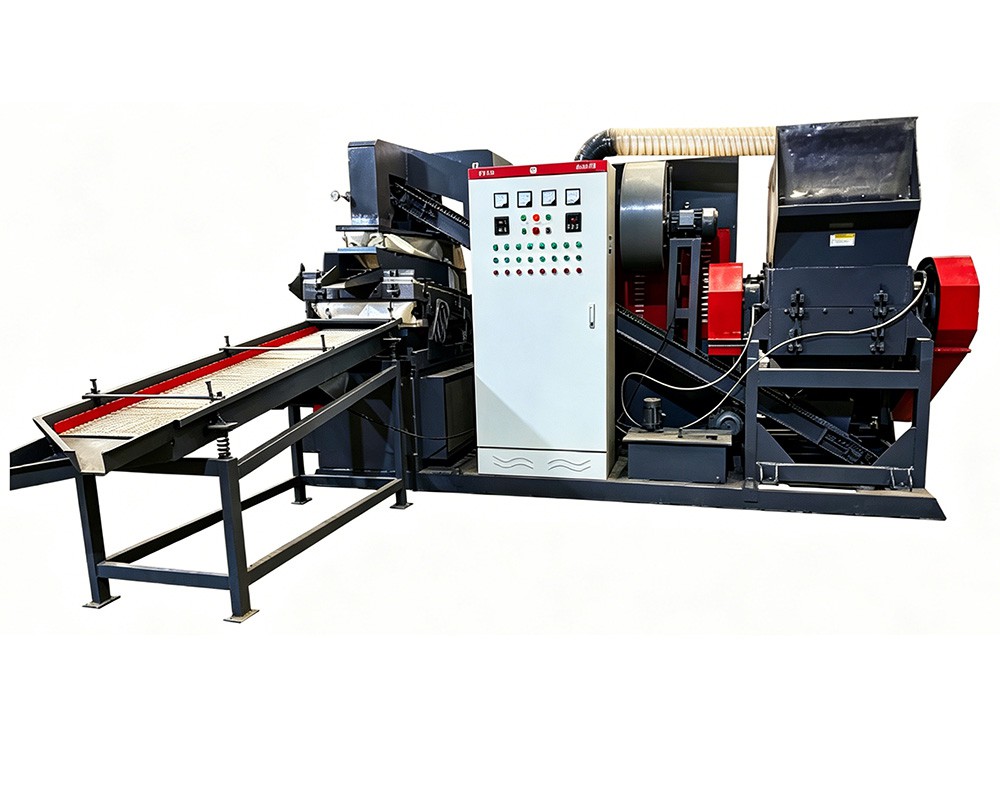
A complete dry-type granulation line — the configuration we present at exhibitions.
How to get the most out of twenty minutes with any equipment manufacturer
- Bring your numbers, not your questions. Conservative monthly tonnage, cable mix by type, shift pattern and your target output specification will get you a real answer instead of a brochure.
- Bring a material sample. A bag of your actual cable is worth more than an hour of discussion.
- Ask for the acceptance criteria in writing. Throughput, copper content, plastic residue and the test method. A manufacturer confident in their machine will state numbers; one who will not is telling you something.
- Ask about spare parts and lead times. Blades, screens and wear plates are consumables. Their lead time determines your worst-case downtime.
- Ask what the machine cannot do. Every machine has limits. A supplier who admits them early is easier to work with when a problem arises.
- Ask for references in your region and material type. Then actually call one.
- Leave with a written next step. A sample request, a quotation, a factory visit date. An exhibition conversation with no follow-up action is entertainment.
Frequently Asked Questions
Which exhibitions does JIACUI attend?
We participate in recycling, waste-management and metal-recovery exhibitions in various regions through the year, and the schedule is confirmed as each event is finalised. Please contact our sales team for the current calendar, stand details, and to arrange a meeting at a specific show. We are also happy to arrange a factory visit or a live video walk-through for buyers who prefer to assess equipment in production rather than at an exhibition.
Can I bring my own cable sample to a show?
Yes, and we would encourage it. A 1–2 kg representative sample lets our engineers assess copper content band, flag whether the material will need pre-shredding, and advise on separation settings. If logistics make that difficult, photographs of the material next to a ruler or a coin for scale are a useful substitute.
Can we meet at the factory instead of an exhibition?
Yes. A factory visit is a better use of time for buyers who are close to a decision, because you can see machining, assembly, the test bay and a live machine run, and speak directly to the engineers who commission the lines. We can also host a live video walk-through for buyers who cannot travel.
Do you exhibit the machines running at exhibitions?
Where the venue and stand allow, we demonstrate machines in operation; at other events we present the line configuration, component samples and product samples, and arrange a live factory video run on request. Either way, seeing copper granules and the plastic fraction at different purity levels is more informative than a photograph of a machine.
How do I prepare for a technical meeting with an equipment supplier?
Bring four things: a conservative monthly tonnage you can actually source, a breakdown of your cable mix by type, your intended shift pattern, and the copper content specification your buyer requires. With those four numbers, any competent supplier can size a line and quote it properly. Without them, you will receive a range of prices for machines that may not fit your business at all.
Arrange a Meeting with Our Team
To arrange a meeting at an upcoming exhibition, a factory visit in Zhengzhou, or a live video walk-through of a granulation line running on your material, send us your cable mix and target tonnage and we will propose a time and an agenda.
Send us your material description, daily tonnage and target output, and our engineering team will respond with a model recommendation, a capacity calculation and a quotation. You are also welcome to book a live video walk-through of the Henan Jiacui Intelligent Equipment Co., Ltd. factory in Zhengzhou, Henan, China, or request a reference list of installations running comparable cable or waste streams.