
Scaling Cable Recycling to Industrial Capacity
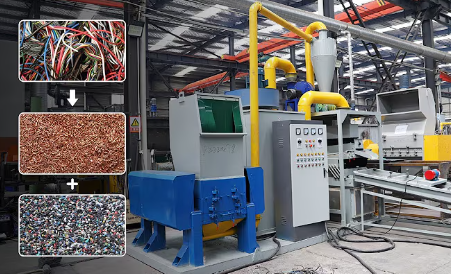
Scaling Cable Recycling to Industrial Capacity: Engineering the RC-CWG1000 for the Secondary Copper Era
Published in News & Insights · Copper Wire Recycling Technology
By Henan Jiacui Intelligent Equipment Co., Ltd.
Introduction: The Copper Supply Gap Is Real — And Recycling Is Moving Upstream
Copper is the nervous system of the energy transition. From EV powertrains and charging infrastructure to solar arrays, wind turbines, and grid storage, every unit of clean energy installed translates into significantly higher copper intensity than the fossil-fuel equivalent. Yet the supply side is tightening: the International Copper Study Group (ICSG) reported a global refined copper surplus in 2025, but that apparent softness masks a deeper structural reality — mine production grew by only ~1%, held back by lower ore grades and major disruptions at assets such as Kamoa and Grasberg .
The industry's answer is secondary copper. Recycled refined copper output is already growing faster than primary production, and analysts estimate that recycled copper will rise from roughly 5 million tonnes today to 8.9 million tonnes by 2035 — yet even that expansion will leave a projected 3.6-million-tonne supply shortfall by 2035 . In other words, the bottleneck is no longer demand; it is processing capacity and recovery efficiency.
That is the world the RC-CWG1000 Copper Wire Granulator was built for — a machine designed not for the scrap yard of yesterday, but for the industrial-scale, 24/7 cable-recycling plant the next decade demands.
The Recovery Challenge: Why Throughput Alone Is Not Enough
The technical problem in cable recycling is deceptively simple: separate copper from its polymer jacket with maximum purity, minimum loss, and zero pollution. In practice, three constraints compete:
Constraint | The Trade-off |
|---|---|
Purity | Copper must meet smelter / re-melt specs — typically ≥99.5%, with fine hair-wire demanding even higher |
Recovery rate | Every 1% of copper lost to fines or plastic carry-over is lost margin at 600–1,000 kg/h |
Environmental compliance | Wet separation consumes 300–500 L of water per ton and generates contaminated runoff; open burning recovers <80% of copper and causes severe air pollution |
The global market has answered with a decisive shift toward dry, fully physical separation. It is a shift reinforced by policy: the EU's Circular Economy Action Plan, China's circular-economy planning, and the UK's WEEE Regulations 2013 (amended 2025) all push recovery, reuse, and recycling of electrical and electronic equipment . More than 5 million tonnes of waste cable enter the global recycling stream each year — and the opportunity is to recover the copper that informal or low-efficiency methods leave behind .
Dry Granulation: The Physics Behind the Purity
A modern dry copper granulator processes the entire cable bundle — jacket and all — through four consecutive physical stages. No water. No chemicals. No combustion.
1. Size Reduction (Mechanical Liberation)
A low-speed, high-torque crusher fitted with hardened alloy blades shears cable into uniform 2–5 mm copper–plastic particles. Keeping the cut clean and avoiding excessive heat is critical: melt the jacket, and plastic embeds in the copper strand — contaminating the final product.
2. Airflow & Gravity Separation
The crushed mixture enters a gravity separator, where calibrated airflow exploits the density gap between copper (≈8.9 g/cm³) and PVC/XLPE/PE insulation. Heavy copper settles; light plastic is carried upward. This is the workhorse stage — and the one that determines baseline purity.
3. Vibrating-Screen Refinement
A vibrating deck performs a final precision sort, filtering stray mixed particles. Well-tuned dry systems reliably achieve ≥99.5% copper purity at this stage .
4. Electrostatic Polishing (Optional)
For fine hair-wire and enameled wire, an electrostatic separator applies a controlled electrical field: conductive copper discharges and drops vertically, while non-conductive plastic follows an electrostatic trajectory. The result — 99.8–99.9% purity, with copper loss in fines reduced to roughly 0.1% .
The RC-CWG1000: Dual-Path Architecture for 900–1,000 kg/h
Where the RC-CWG1000 differs from standard single-line granulators is not just scale — it is airflow architecture. To hold ≥99.5% purity at 1,000 kg/h, separation cannot be a bottleneck; it must be parallelized.
Parameter | RC-CWG1000 Specification |
|---|---|
Output Capacity | 900 – 1,000 kg/h |
Total Installed Power | 77.48 kW |
Main Crusher | 55 kW |
Variable-Frequency Fan | 4 kW × 2 = 8 kW |
Dust Collection Fan | 4 kW × 2 = 8 kW |
Gravity Separator | 6 kW |
Vibrating Screen | 0.48 kW |
Blade Configuration | 18 × SKD-11 (HRC 58–62) |
Voltage / Frequency | 380 V / 50 Hz (220 / 415 / 480 V, 60 Hz optional) |
Footprint (L × W × H) | 10,000 × 8,500 × 3,000 mm |
Weight | 5,000 kg |
Engineering Highlights
Dual Air Circuits — The Key to 1,000 kg/h
The RC-CWG1000 runs two parallel separation paths within one integrated chassis: twin variable-frequency fans (8 kW total) for separation airflow, twin dust-collection fans (8 kW total) for fines capture. The redundancy does more than add volume — it stabilizes separation as feed composition changes and lets a single circuit be serviced without stopping the line. That is the engineering basis for true 24/7 production.
55 kW Crusher + 18-Blade Rotor
The largest rotor motor in the Jiacui granulator family, paired with 18 SKD-11 cutters, delivers the finest, most uniform particle size at the highest throughput — directly improving downstream separation efficiency. Blade life runs 600–1,200 hours per regrind.
PLC + VFD Intelligence
A PLC-controlled system with variable-frequency drives auto-adjusts rotor speed and airflow to wire diameter (0.2–30 mm). The principle is the same one McKinsey and industry analysts cite as the route to higher recovery: smart control that adapts to cable type rather than forcing one fixed setting .
Closed-Loop Dust Collection
With zero wastewater discharge and a pulse-jet baghouse capturing fines at source, the RC-CWG1000 aligns with the environmental standards now written into WEEE and circular-economy frameworks worldwide .
The Economics: Capacity Choice as a Payback Decision
One of the most common questions we hear is: "Which model fits my operation?" The answer is governed by daily cable volume. Here is the Jiacui granulator line at a glance:
Model | Capacity | Best For |
|---|---|---|
Model 300 | 100–120 kg/h | Workshops, flexible batch processing |
Model 400 | 350–400 kg/h | Mid-volume yards, regular shifts |
RC-CWG660 | 600–650 kg/h | High-volume plants |
RC-CWG1000 | 900–1,000 kg/h | Industrial-scale, 10–25 t/day, 24/7 |
The selection rule is straightforward: match capacity to volume, and the higher recovery rate pays back the equipment faster. At 900–1,000 kg/h, a 0.5% improvement in recovery is several additional tonnes of salable copper per year — a direct contribution to the bottom line . And because dry systems operate with roughly one operator versus three to four for equivalent wet facilities, the labor saving compounds the return .
Looking Ahead: The Recycling Gap Is Also a Equipment Gap
McKinsey's analysis is unambiguous: by 2035, the world will need more than 1 million tonnes of additional recycling capacity beyond current projections — and no more than 60% of post-consumer scrap will even enter the formal value chain . The competition for scrap will intensify, and processors who can recover more copper, at higher purity, from more varied feedstock will capture the margin.
That is why the industry is moving from selling standalone machines toward turnkey recycling solutions — plant layout, equipment selection, installation, operator training, and maintenance support . It is also why emerging markets in Southeast Asia, the Middle East, and Africa, which face rising solid-waste challenges but have little local granulator manufacturing, represent the next frontier .
Conclusion
The energy transition has made copper recycling a strategic industry rather than a backroom operation. The plants that win will be the ones that can scale cleanly, recover efficiently, and run continuously.
The RC-CWG1000 is Jiacui's answer to that challenge: a dual-path, dry-process, PLC-controlled system engineered for 900–1,000 kg/h of high-purity copper, built on a 5-tonne welded-steel chassis, and designed to integrate upstream shredding and downstream separation into a complete recycling line.
Henan Jiacui Intelligent Equipment Co., Ltd. backs every RC-CWG1000 with CNC-machined rotors, in-house blade hardening, pre-shipment trial runs, and customizable voltage, frequency, blade material, and OEM branding for distributors in Europe, North America, Southeast Asia, and Africa.
About Henan Jiacui Intelligent Equipment Co., Ltd.
We design and manufacture the complete cable-recycling equipment line — from double-shaft shredders for upstream pre-cutting to dry-type copper wire granulators from 100 kg/h to 1,000 kg/h. Explore the full range: Model 300 · Model 400 · RC-CWG660 · RC-CWG1000.
Related reading:
[How Dry Separation Achieves 99.5%+ Copper Purity]
[Single-Drive vs. Dual-Drive Double Shaft Shredders: Which Fits Your Feed?]
[Building a Complete Cable-Recycling Line: From Shredder to Granulator]
Keywords: copper wire granulator, dry type copper separator, RC-CWG1000, 1000kg/h copper granulator, secondary copper, cable recycling, WEEE recycling, SKD-11 blades, electrostatic separation, circular economy
Previous: None