
Small-Scale vs. Industrial Copper Granulators: Which Fits Your Business Scale?
Small-Scale vs. Industrial Copper Granulators: Which Fits Your Business Scale?
Published in News & Insights · Buying & Selection Guides
By Henan Jiacui Intelligent Equipment Co., Ltd.
There are two expensive mistakes in granulator selection, and they cost roughly the same. The first is buying an industrial line for a feed stream that never fills it: the capital is dead, the fixed costs run whether or not you run the machine, and the payback stretches into the next decade. The second is buying a compact unit for a stream that needs a line: you spend every shift preparing material the machine cannot handle, purity drops, and you buy the larger machine anyway two years later — having lost the resale value of the first one.
The decision is not about throughput alone. Between a 100 kg/h compact unit and a 1,000 kg/h industrial line, six other things change: feed width, blade configuration, installed power, footprint, automation level and the labour model required to run it. This article works through each, and then gives you a sizing method you can apply to your own numbers.
What actually changes between scales
Throughput is the headline difference, but it is the least interesting one, because it is the easiest to compare. The differences that decide whether a configuration works are structural.
Dimension | Compact / small-scale | Mid-range | Industrial |
|---|---|---|---|
Typical capacity | 60–220 kg/h | 300–650 kg/h | 700–1,000+ kg/h |
Feed width | up to 12–30 mm cable | up to 40–60 mm cable | up to 80–100 mm cable |
Blade set | 6 blades, SKD-11 | 14 blades, SKD-11 | 16+ blades, SKD-11 / D2 |
Installed power | single compact unit | 40.24 kW (Model 660) | 45 kW main (Model 800) to 77.48 kW installed (Model 1000) |
Footprint | bench or small bay | several metres of line | 5 m × 6 m (Model 800); 10 m × 8.5 m (Model 1000) |
Machine weight | hundreds of kg | roughly 3.8 t (Model 800) | roughly 5 t chassis (Model 1000) |
Labour model | 1 operator, part-time possible | 1–2 operators per shift | 1–2 operators plus maintenance cover |
Separation stages | air + vibrating screen | air + screen (+ electrostatic optional) | air + screen + electrostatic, twin fans, twin dust collection |
Two of those rows deserve emphasis. Feed width is a hard constraint: a compact granulator rated to 30 mm cable will not process 70 mm armoured power cable, no matter how slowly you feed it. And footprint is the constraint that most often surprises buyers of industrial equipment, because a 10 m × 8.5 m machine needs that space plus clearance for feed, discharge, maintenance access and material storage.
The economics are structurally different, not just scaled
A small machine and an industrial line do not simply differ by a multiplier. Their cost structures behave differently, which is why the decision cannot be made on price per kg/h of capacity.
Cost behaviour | Small-scale | Industrial |
|---|---|---|
Capital per unit capacity | Higher — you pay a premium for compactness | Lower — economies of scale are real |
Fixed costs | Low, so idle time is survivable | High, so idle time is punishing |
Labour per tonne | High, because the same operator handles everything | Low, because automation absorbs handling |
Maintenance intensity | Lower absolute cost, but proportionally higher per tonne | Higher absolute cost, lower per tonne if run continuously |
Breakeven tonnage | Low — can be viable at a few hundred kg/day | High — needs contracted feed to justify the capital |
This is why the ‘price per kg/h’ comparison that buyers love is misleading. The compact machine costs more per unit of capacity and is still the correct purchase for a small yard, because its breakeven tonnage is low enough to be reached.
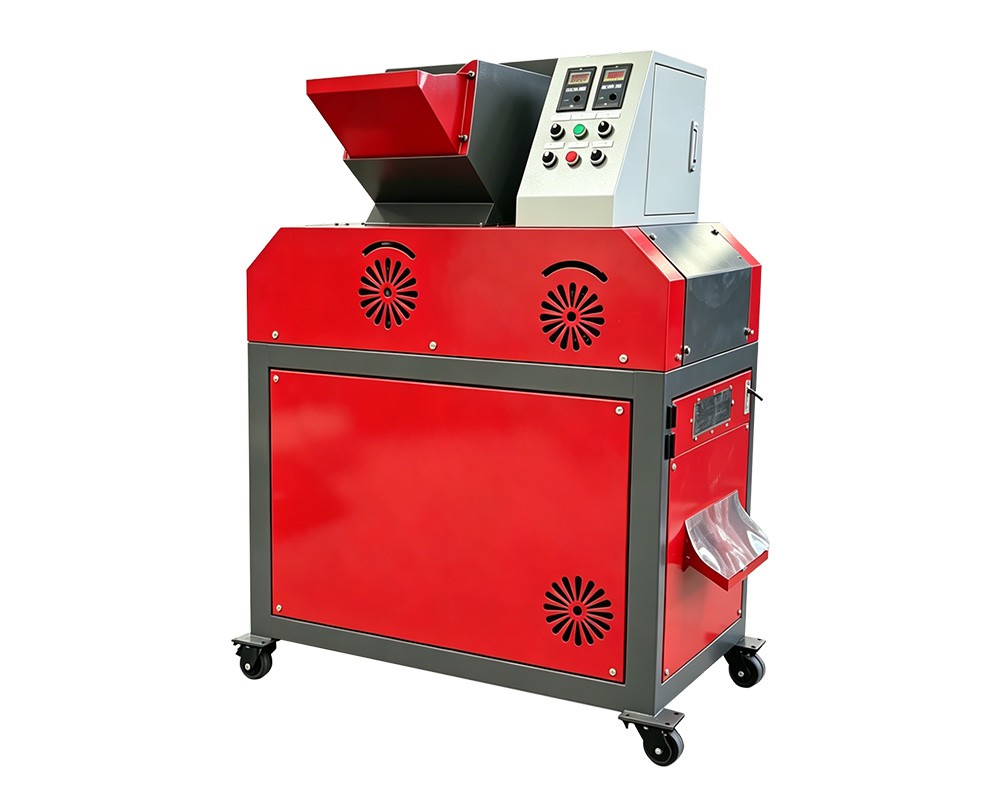
A compact unit is the correct purchase when inflow is low but steady.
A sizing method you can actually use
Work backwards from material availability, not forwards from a capacity figure on a brochure.
- Measure your real inflow. Weigh incoming cable for four consecutive weeks. Not the best week — the average, and the worst.
- Subtract what you should not granulate. Thick single-core cable should be stripped, not chopped. Removing it often cuts the granulator feed by 20–40%.
- Convert to prepared feed. Harness scrap and tangled bundles lose 10–20% of gross weight to depollution and triage before they reach the granulator.
- Add a buffer. Size for roughly 70–80% utilisation at your average inflow, so that a good week does not require a second machine and a bad week does not strand capital.
- Check the hard constraints. Maximum cable diameter, available power supply, floor area, floor loading, and dust and noise limits.
A worked example. Suppose you weigh 2.5 tonnes of mixed insulated cable in an average week, and 30% of it is thick single-core that you strip instead. Granulator feed is 1.75 t/week, or about 350 kg per working day at five days. At six productive hours per day that is roughly 58 kg/h — well inside compact territory. Yet a buyer looking only at ‘2.5 tonnes per week’ might reasonably — and wrongly — conclude they need a 300 kg/h machine.
The same calculation run at 15 tonnes per week, with 25% stripped out and an eight-hour shift, lands at around 700 kg/h — which is industrial territory, and which also means the feed has to be guaranteed rather than hoped for.
Constraints that are not on the specification sheet
Constraint | Why it bites | What to check before ordering |
|---|---|---|
Electrical supply | A 77 kW installed line cannot run from a light industrial supply | Available voltage, phase, capacity and whether a supply upgrade is required |
Floor loading | A 5-tonne chassis plus material is a point load | Slab thickness and condition, especially in rented premises |
Dust extraction | Dry granulation generates dust; capture is mandatory in most jurisdictions | Filter capacity, discharge point, and waste handling for the collected dust |
Noise | High-throughput granulation is loud | Local limits, working hours, and whether enclosure is required |
Material storage | An industrial line consumes feed faster than a small yard can accumulate | Space and working capital for buffer stock |
Permitting | Scale can change your regulatory category | Whether the local authority classifies you differently at higher throughput |
Signals that it is time to step up
- You are routinely turning away material, or stockpiling it, because the machine cannot keep up.
- You are spending more than one shift per week on manual preparation that a pre-shredder would absorb.
- Your copper product purity varies between batches because the machine is being run at or beyond its design envelope.
- You are buying lower-grade material because your machine cannot handle better material's preparation requirements — a sign the machine is now the constraint on your purchasing strategy.
- Maintenance cost per tonne is rising faster than tonnage.
When a compact machine is genuinely the better purchase
It is worth saying plainly that small is often correct, and not only as a stepping stone.
- Your feed is genuinely small and steady. A few hundred kilograms a day, five days a week, is a real business and does not need industrial capital.
- Your space is constrained. A city-yard with 40 m² of usable floor will not accommodate a 10 m line, and pretending otherwise wastes a year.
- Your power supply is limited. If the site cannot support 77 kW, the industrial option is not available regardless of budget.
- You need to prove the model first. A compact unit lets you validate copper content, buyer pricing and labour requirements with real material before committing to a line. That is a legitimate strategy, not a compromise — provided you buy a model you can later run alongside a larger one rather than one you will have to scrap.
- Your material is high-value and low-volume. Some specialty and precision scrap streams are better served by careful small-batch processing than by throughput.
The scale comparison in our own range
For reference, this is how the JIACUI range maps onto the three tiers. Capacities are typical figures for mixed insulated cable and depend on composition and preparation.
Model | Typical capacity | Main power | Best suited to | Feed width |
|---|---|---|---|---|
Model 46-A (RC46A) | 60–80 kg/h | compact single unit | small workshops, mixed household wire | up to 12 mm cable |
Model 300 (RC300) | 100–150 kg/h | compact single unit | start-up recyclers, mixed thin wire | up to 20 mm cable |
Model 350 (RC350) | 200–220 kg/h | 5.5 kW main unit | growing yards stepping up from manual stripping | up to 30 mm cable |
Model 400 (RC400) | 300–400 kg/h | mid-range line | multi-shift commercial yards | up to 40 mm cable |
Model 660 (RC-CWG660) | 600–650 kg/h | 40.24 kW installed | production-class yards, WEEE processors | up to 60 mm cable |
Model 800 (RC-CWG800) | 700–900 kg/h | 45 kW main unit | large yards, cable manufacturers’ off-cuts | up to 80 mm cable |
Model 1000 (RC-CWG1000) | 900–1,000 kg/h | 77.48 kW installed | industrial plants, scrap exporters | up to 100 mm cable |
The gaps between models are deliberate. A 200–220 kg/h machine and a 300–400 kg/h machine look close on paper, but the step exists because buyers tend to outgrow capacity in increments rather than in multiples, and because the 400-class machine accepts cable diameters the 350 cannot.
Frequently Asked Questions
How do I know if I need a small or industrial granulator?
Measure four weeks of actual inflow, subtract the material you should strip rather than granulate, convert to prepared feed, and size for 70–80% utilisation. If the answer is under roughly 250 kg/h of prepared feed, a compact unit is usually correct. Above 600 kg/h sustained, an industrial line is usually the better economic structure — provided the feed is contractually secure.
Is a small machine less efficient at recovering copper?
Not inherently on material it is designed for. A correctly set compact granulator with a gravity separator and vibrating screen recovers copper to a comparable standard on household and communication cable. The gap appears on fine, mixed and harness-type material, where an industrial line’s additional separation stages — particularly electrostatic polishing — recover a fine fraction the compact configuration cannot.
Can I upgrade a small line later instead of replacing it?
Sometimes, and it is worth asking before you buy. Adding a pre-shredder, a magnet or a polishing stage is feasible on many lines. Replacing the granulator itself usually is not. If you expect to grow, choose a model whose separation section can be extended, and plan the floor layout for the larger footprint from day one.
What power supply does an industrial granulator need?
The largest model in our range has 77.48 kW installed, with a 55 kW main crusher. That is a three-phase industrial supply, not a workshop feed. Check available capacity, whether a supply upgrade is needed, and whether your lease permits it — this is a common reason industrial projects stall after the machine is ordered.
Does a bigger machine mean better purity?
Only where it brings additional separation stages. A large machine with the same air-and-screen configuration as a small one will produce broadly similar purity at higher throughput. Purity gains come from classification and polishing stages, not from size.
Get a Scale Recommendation
Send us your measured weekly inflow, the share of thick cable you strip rather than granulate, your available power supply and your floor dimensions. We will tell you which tier actually fits — including when a smaller model than you expected is the better answer.
Send us your material description, daily tonnage and target output, and our engineering team will respond with a model recommendation, a capacity calculation and a quotation. You are also welcome to book a live video walk-through of the Henan Jiacui Intelligent Equipment Co., Ltd. factory in Zhengzhou, Henan, China, or request a reference list of installations running comparable cable or waste streams.
About the Author and the Manufacturer
This article was prepared by the technical sales and engineering team of Henan Jiacui Intelligent Equipment Co., Ltd. (brand name JIACUI). Founded in 2015 in Zhengzhou, Henan Province, China, JIACUI designs and manufactures solid waste recycling equipment and copper wire granulation systems in a 5,000 m² factory with more than 100 employees. Our equipment holds CE, ISO and CSA certification, uses ABB and Siemens control components built to European design standards, and has been delivered to more than 400 customers in over 100 countries. Factory audits have been completed with SGS, BV and TÜV. We hold 27 patents covering shredding, granulation and separation technology. Where this article quotes performance figures, those figures come from our published model specifications and from commissioning tests on real installations; actual results depend on cable composition, feed preparation and operating practice.
Previous: Copper Wire Granulator Cost vs. Return: ROI Analysis for Recycling Yards
Next: None