
Copper Wire Granulator Cost vs. Return: ROI Analysis for Recycling Yards
Copper Wire Granulator Cost vs. Return: ROI Analysis for Recycling Yards
Published in News & Insights · Buying & Selection Guides
By Henan Jiacui Intelligent Equipment Co., Ltd.
Every granulator quotation comes with a brochure that says ‘fast payback’. Almost none comes with a model you can audit. This article is the model: the five inputs that actually determine return, a worked example with every assumption stated, the operating costs that get left out of quotations, and the sensitivity analysis that tells you whether the project survives a bad copper year.
One warning before we start. The arithmetic below is deliberately conservative. If a supplier’s payback figure is dramatically better than what this method produces, the difference is almost always an assumption — usually an optimistic utilisation rate or a scrap purchase price that is too low.
The five inputs that decide everything
Input | Why it dominates | How to get a real number |
|---|---|---|
Purchase price of insulated scrap | The largest single line in your P&L. A one percent error here swamps every other assumption. | Your own last 90 days of purchase invoices, not a market index |
Copper content of that scrap | Determines how much saleable metal each tonne contains | Weigh, granulate and assay a representative sample — not the best cable in the yard |
Granule selling price | Tied to the copper board price but discounted for form and purity | A written quote from your actual buyer, at your actual purity |
Recovery rate | Silent multiplier on revenue — a 2% loss is 2% of gross, every month | Assay the plastic tail once; this is the only honest measurement |
Utilisation | Machines earn nothing while idle | Realistic hours per day and days per month, based on your actual scrap inflow |
A worked model you can replace with your own numbers
The figures below are illustrative and internally consistent. Substitute your own; the structure is what matters. One deliberate choice to note first: the purchase price is expressed as a percentage of the contained copper value, not as a percentage of the bare bright price per tonne of cable. These are two different conventions, and mixing them is the most common error in a home-made payback model — it is exactly how a project that looks profitable on paper ends up losing money in the yard.
Assumption | Value used |
|---|---|
Equipment investment (mid-range line, installed) | USD 45,000 |
Rated capacity | 300 kg/h |
Operating hours | 6 h/day, 22 days/month |
Monthly throughput | 39.6 tonnes |
Copper content of purchased mixed cable | 45% |
Copper recovery from input | 97% |
Scrap purchased at | 82% of contained copper value |
Granule sold at | 92% of bare bright price |
Bare bright reference price (assumed) | USD 8,000/t |
Operating cost (power, labour, blades, maintenance) | USD 55/t processed |
Plastic by-product credit | USD 120/t of plastic recovered |
Line item (per tonne of cable) | Calculation | USD |
|---|---|---|
Contained copper value | 45% × 8,000 | 3,600 |
Cost of scrap purchased | 82% × 3,600 | −2,952 |
Copper revenue | 3,600 × 97% × 92% | +3,213 |
Plastic by-product | 55% × 120 | +66 |
Operating cost | — | −55 |
Net contribution | 272 |
At full rated utilisation that is 272 × 39.6 = USD 10,771 per month, which pays back the USD 45,000 investment in roughly 4.2 months. That figure is in line with the better end of published industry ranges, and it is worth understanding exactly which assumptions are holding it up — because they are the ones that fail first.
Now change one variable at a time, holding everything else constant:
Scenario | Net per tonne | Monthly contribution | Payback |
|---|---|---|---|
Base case, full utilisation | 272 | 10,771 | 4.2 months |
Purchase discount improves to 80% of contained value | 344 | 13,622 | 3.3 months |
Granules sell at 95% instead of 92% | 378 | 14,969 | 3.0 months |
Copper recovery falls to 95% | 205 | 8,118 | 5.5 months |
Copper price falls 20% (purchase and sale both move) | 220 | 8,712 | 5.2 months |
Utilisation falls to 50% (3 h/day) | 272 | 5,386 | 8.4 months |
That table is more useful than the base case. Utilisation, recovery and the purchase spread each move payback by one to four months. The machine price is a one-off number you negotiate once; these three are numbers you live with every shift. A 300 kg/h line run at half utilisation takes twice as long to pay back as the same machine run properly, and no equipment upgrade fixes that.
The lesson generalises: granulator ROI is an operating-discipline and purchasing problem before it is an equipment problem. The machine multiplies whatever spread you already have. If the spread is thin, a faster machine enlarges the loss in absolute terms rather than fixing it.
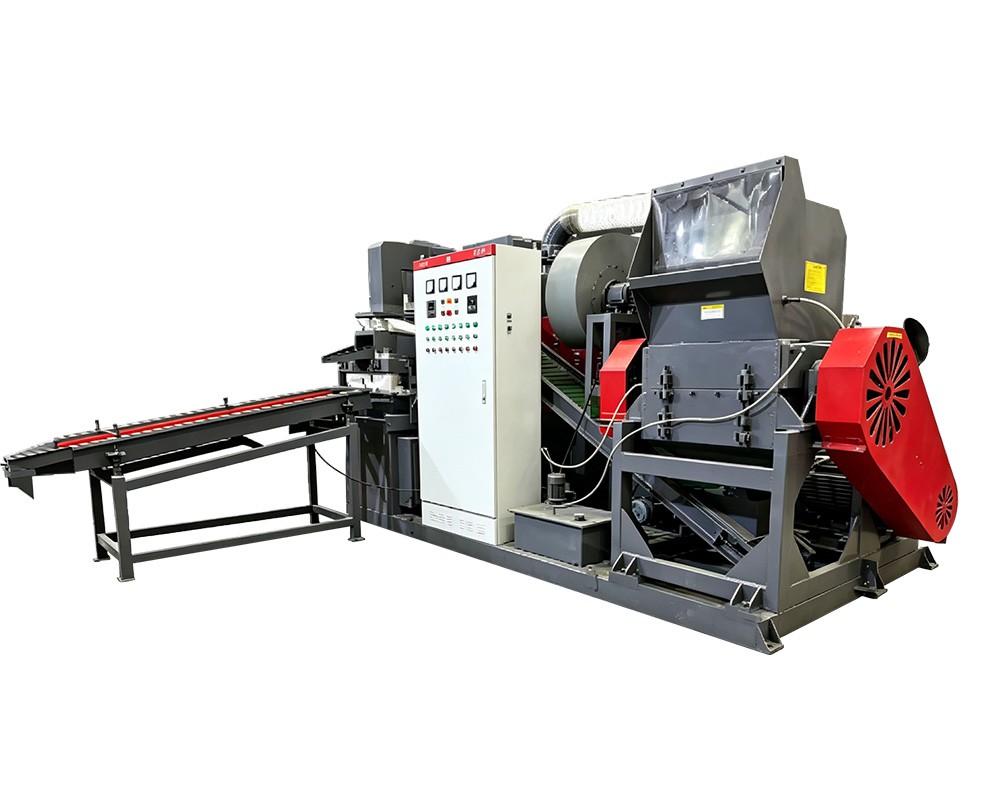
A mid-range line: the capital cost is the smallest variable in the return calculation.
Capex tiers and published payback ranges
Industry reporting on payback varies widely because it is measuring different things. The ranges below are what published sources converge on, and they are worth knowing so you can sanity-check any quotation you receive.
Tier | Typical capacity | Typical installed cost | Published payback range |
|---|---|---|---|
Entry / bench | 30–150 kg/h | USD 3,000–15,000 | Short in absolute terms but depends entirely on scrap access |
Compact commercial | 200–400 kg/h | USD 15,000–45,000 | 3–8 months in scrap-rich markets; 6–18 months where scrap is harder to source |
Mid-range industrial | 400–700 kg/h | USD 45,000–120,000 | 6–18 months depending on utilisation |
Production line | 700 kg/h – 2 t/h | USD 120,000–800,000 | 12–24 months, and only viable with contracted feed |
Notice what is missing from almost every published figure: a stated utilisation rate. Payback is usually quoted at full rated capacity. A 300 kg/h machine running two hours a day is a 60 kg/h machine financially, and its payback is three times longer than the brochure says.
Operating costs the quotation will not mention
Granulator opex is often quoted as a single blended figure per tonne. That is convenient and misleading. These are the components, and they behave very differently.
Cost item | Typical order of magnitude | How it behaves |
|---|---|---|
Electricity | Often the largest single opex line | Scales with tonnage and with chamber efficiency; a dull blade raises kWh per tonne measurably |
Blades | Recurring and lumpy | Depends on contamination and feed rate more than on hours; SKD-11 and D2 sets are consumables, not capital |
Labour | 1–2 operators for an automated line | Steps up sharply if material needs manual triage, which harness and e-waste streams usually do |
Maintenance and spares | Low but non-zero | Bearings, belts, screen panels; dominated by whether the machine is run within its design envelope |
Dust disposal | Small but regulated | A real waste stream with documentation requirements |
Working capital | Frequently ignored and frequently decisive | You buy scrap before you sell granules. At 40 t/month your inventory exposure is a five-figure number that has to be financed |
Sensitivity: does the project survive a bad copper year?
Copper is volatile. A model that only works at today’s price is not a business case, it is a bet. Run your own numbers at 80% and 70% of the current board price before committing capital.
Two things usually happen. First, contribution falls faster than the copper price, because both the purchase cost and the selling price move on the same base but your operating costs do not. Second, the spread percentage tends to compress in a falling market, because scrap sellers are slower to accept lower prices than buyers are. If your project only clears its hurdle at full price, negotiate a supply contract with a formula before you buy the machine.
When a granulator is the wrong investment
Being honest about this is more useful than another payback table. A granulator is the wrong purchase when:
- Your material can be stripped. Intact thick single-core cable stripped mechanically produces bare bright, which prices above granules. The industry rule is strip what you can, granulate what you cannot. A granulator does not replace a stripper.
- Your volume is intermittent. If you see 200 kg one week and nothing the next, the capital sits idle and the payback calculation is fiction. Consider toll processing or a toll agreement until inflow is steady.
- Your copper content is unknown. Buying an expensive machine to process a stream you have never assayed is the most common avoidable mistake in this industry.
- You have no buyer for the plastic. The by-product credit in most models is real money. If your local market cannot take the plastic fraction, remove that credit from the model and re-run it.
- You cannot resource the maintenance. A dry line is simple, but blades, screens and bearings need attention on a schedule. A machine that is run to failure will underperform its specification within one season.
Financing structure changes the answer
Payback period and cash-flow viability are different questions. A two-year payback is fine if you fund the machine from retained earnings. The same project financed at a high short-term rate can be uncomfortable in the first year, when revenue is still ramping and the learning curve is steepest. Model the first six months separately from steady state — that is where projects actually run out of cash.
Frequently Asked Questions
What is a realistic payback period for a copper wire granulator?
Published ranges cluster around 6–18 months for small and medium operations, 3–8 months for well-run operations in scrap-rich markets, and 12–24 months for large industrial lines. Every one of those numbers assumes a stated utilisation rate and a stated scrap purchase spread. Ask for both before accepting the figure.
Should I buy a bigger machine to improve ROI?
Usually not first. Capacity only converts into return if you have the feed to fill it. A larger machine running at 30% utilisation has worse economics than a correctly sized machine running at 80%. Size to your material inflow, then improve the purchase spread, then consider capacity.
How do I measure copper recovery without a laboratory?
Two practical options. First, weigh input and both outputs over a full shift and compute mass balance — it will not give you copper content, but it will expose gross losses. Second, send one representative sample of your plastic tail to a laboratory for assay. One assay per material type is enough to establish your baseline, and it is the cheapest high-value measurement available to you.
What operating cost per tonne should I budget?
Published figures for cable granulation generally fall in the range of USD 8–15 per tonne for energy and consumables alone, before labour, and higher for small machines where fixed costs are spread over less tonnage. Add labour, dust disposal and maintenance on top. For a compact machine, budgeting USD 40–60 per tonne all-in is a defensible planning figure; for a large automated line the per-tonne figure is lower but the fixed cost is higher.
Does purity affect the payback calculation?
Directly, through the selling price. Moving from 97% to 99.5% copper content typically moves you several percentage points up the price scale, and smelters may apply treatment charges to lower-purity material. Run the model at both purities to see how much the polishing stage is actually worth to you.
Request a Cost and Return Model
Send us your last 90 days of purchase prices, your expected copper content and your buyer’s purity requirement. We will build the model with your numbers rather than ours, and if the economics do not work we will say so — a machine that cannot pay for itself is not a sale we are interested in.
Send us your material description, daily tonnage and target output, and our engineering team will respond with a model recommendation, a capacity calculation and a quotation. You are also welcome to book a live video walk-through of the Henan Jiacui Intelligent Equipment Co., Ltd. factory in Zhengzhou, Henan, China, or request a reference list of installations running comparable cable or waste streams.
About the Author and the Manufacturer
This article was prepared by the technical sales and engineering team of Henan Jiacui Intelligent Equipment Co., Ltd. (brand name JIACUI). Founded in 2015 in Zhengzhou, Henan Province, China, JIACUI designs and manufactures solid waste recycling equipment and copper wire granulation systems in a 5,000 m² factory with more than 100 employees. Our equipment holds CE, ISO and CSA certification, uses ABB and Siemens control components built to European design standards, and has been delivered to more than 400 customers in over 100 countries. Factory audits have been completed with SGS, BV and TÜV. We hold 27 patents covering shredding, granulation and separation technology. Where this article quotes performance figures, those figures come from our published model specifications and from commissioning tests on real installations; actual results depend on cable composition, feed preparation and operating practice.