
The Rise of Automated Scrap Cable Sorting: Technology Innovations to Watch
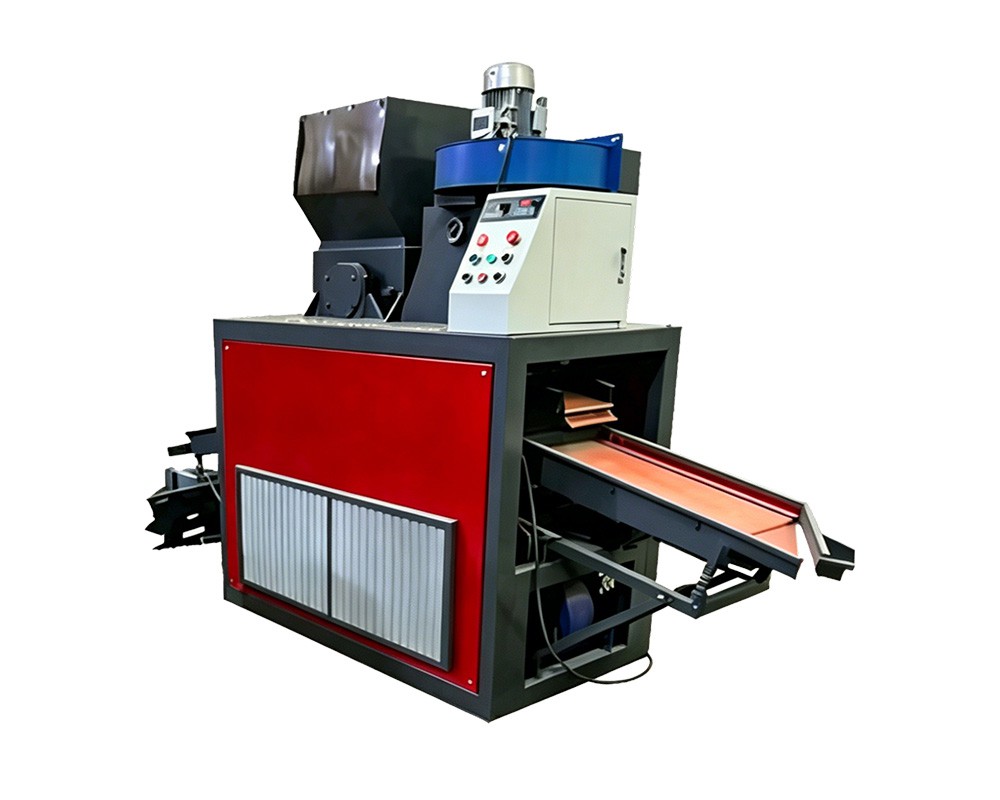
The Rise of Automated Scrap Cable Sorting: Technology Innovations to Watch
Published in News & Insights · Industry News
By Henan Jiacui Intelligent Equipment Co., Ltd.
For two decades the innovation frontier in cable recycling was size reduction: faster rotors, harder blades, tighter screens. That frontier is now largely exhausted — a well-built granulator from any reputable manufacturer liberates copper from insulation competently. The competitive difference has moved downstream, to separation and sorting, where the last few percent of purity and recovery are decided.
This article surveys the technology that is actually changing cable sorting in 2026, distinguishes what is working in production from what is still trade-show language, and sets out what it means for a small or mid-sized recycler who is not going to spend seven figures on a sorting hall.
Why sorting, not shredding, is where the money is now
Published performance ranges tell the story. Air separation — the workhorse of every dry line — typically achieves roughly 95–97% efficiency on mixed feed, and the shortfall concentrates in the fine fraction, because a 0.3 mm copper particle and a 0.3 mm PVC particle behave similarly in an air stream. Electrostatic separation recovers much of that gap by exploiting conductivity rather than density, pushing achievable recovery toward the high 90s on suitable material.
Beyond that, the remaining impurity is a classification problem, not a separation problem: particles that are the right size and conductivity but the wrong material — copper alloyed with something else, brass terminals, aluminium strands, plated conductors, and the plastic that clings to partially liberated copper. That is what optical and sensor-based sorting is being deployed to solve.
Technology track 1: NIR and MWIR optical sorting with deep learning
This is the most commercially mature of the new approaches, and the most widely deployed in the 3–20 mm cable granulate fraction where granulators actually operate.
The principle is straightforward: broadband infrared sensing — near-infrared and mid-wave infrared — identifies material by molecular signature rather than colour, and a deep learning model classifies each object as it passes at speed. Air jets then eject the target fraction. Because the identification is compositional, it can distinguish polymers from metals, and can separate copper from aluminium or brass in a mixed non-ferrous stream.
The clearest industrial example reported this year is the partnership between Eldan Sorting and PICVISA, which integrated AI optical sorting into mechanical cable and metals recycling lines. Two product lines were announced: an SPS (Small Purpose Sorter) aimed specifically at cable granulate in the 3–20 mm range, separating copper granulate from aluminium, insulation residues and mixed fines; and an MPS (Multi Purpose Sorter) for higher-volume mixed streams including shredded WEEE and mixed non-ferrous scrap.
Separately, TOMRA used ReMA2026 to launch the latest generation of its Finder platform, combining an electromagnetic sensor, NIR and an optional high-definition RGB camera with AI object processing. The company describes the RGB-plus-AI combination as enabling separation of insulated wires and thin, adjacent or overlapping objects — precisely the failure case of conventional sorting logic.
What this means practically: optical sorting is no longer experimental in cable granulate. It is a purchasable, integrated option. The question for most recyclers is economic, not technical.
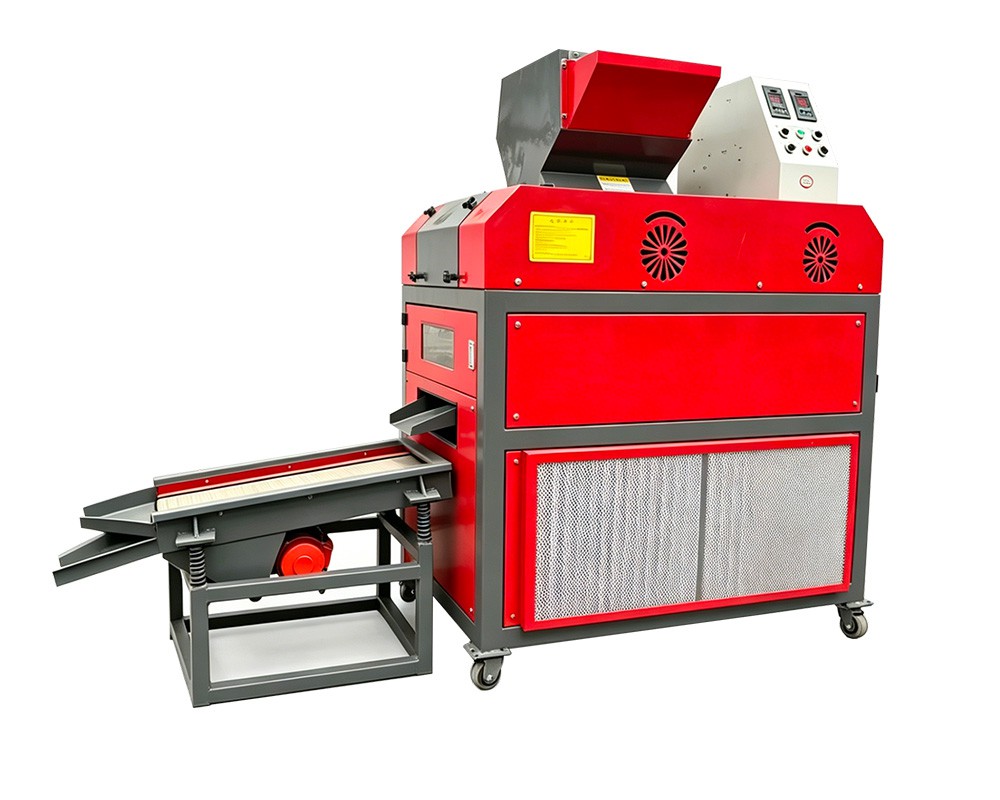
Mechanical separation stages are where the last percent of purity is decided.
Technology track 2: adaptive models rather than fixed rules
The more interesting development is not the sensor but the software model behind it. Conventional optical sorters run fixed decision rules: a material signature maps to an ejection decision. Those rules degrade when feed composition shifts, which in cable recycling it constantly does.
Adaptive deep learning modules — PICVISA’s APT Learner is the example cited in the Eldan partnership — build recognition models that evolve with operational data. That matters most in streams with high signature variability, such as printed circuit boards in e-waste, where a fixed rule set misses patterns a trained model picks up.
For a recycler, the practical question to ask any sorter vendor is: how does the model adapt when my feed changes, and who owns that process? A model that requires a factory visit and a service contract every time your material mix shifts is a different proposition from one that retrains on site.
Technology track 3: robotics and machine vision
Robotic pick-and-place sorting has received a great deal of attention and is genuinely deployed in some applications — construction and demolition waste, bulky item sorting, and quality control stations. In cable granulate it is much less compelling, for a simple physical reason: the particles are small, they move fast, and a robot arm picking individual granules cannot compete with an air jet array on throughput per euro.
Where robotics makes sense in this industry is upstream: pre-sorting mixed incoming material, removing batteries and contaminants in WEEE dismantling, and handling heavy or hazardous items. Those are tasks where a manipulator adds real value. Granule-scale robotic sorting is, for now, mostly a demonstration.
Technology track 4: sensor fusion and 'negative sorting'
The most useful near-term capability is not identifying what you want, but reliably ejecting what you do not. This is sometimes called negative sorting: instead of trying to detect copper and eject it, you detect non-copper — black plastics, PCB fragments, stainless, insulated wire — and eject that, leaving a cleaner copper stream behind.
TOMRA’s description of a Deep Laser option combined with RGB and AI-enabled object processing fits this pattern, as does the general industry movement toward combining electromagnetic, NIR, laser and colour sensing on a single platform. Sensor fusion is valuable precisely because no single sensor handles all the confusion cases: NIR struggles with black plastics, colour struggles with surface contamination, and electromagnetic sensing cannot distinguish metal from metal.
What is working, and what is still marketing
Capability | Status in 2026 | Evidence |
|---|---|---|
NIR/MWIR sorting of cable granulate at 3–20 mm | In production | Integrated product lines offered by major mechanical recycling suppliers |
AI classification with adaptive model retraining | Early production | Vendor-documented adaptive modules; independent performance data still limited |
Negative sorting to eject contaminants from a copper stream | In production | Multi-sensor platforms with laser and RGB options |
Copper-versus-aluminium separation in mixed non-ferrous | In production | Optical sorters applied to shredded non-ferrous fractions |
Robotic granule-scale picking | Mostly demonstration | Throughput economics do not yet compete with air ejection |
Fully autonomous plant with no operator sampling | Not yet | Material variability still requires human verification of assays |
The economics for a small or mid-sized recycler
Optical sorting is capital-intensive, and it only makes sense above a certain material flow. The honest framing is this: a sorter does not create value out of nothing. It captures value that is already in your output stream, in the form of copper you are currently losing or purity you are currently discounting.
So the question to answer before considering one is not ‘can I afford a sorter?’ but ‘how much copper am I losing, and to which fraction?’ If your plastic tail assays at 3% copper, a sorter that recovers half of that has a calculable payback. If your tail assays at 12%, the first intervention is not a sorter — it is fixing liberation and classification upstream, which costs a fraction as much.
For most yards below roughly 1,000 tonnes a month, the sequence that makes economic sense is: fix blade and screen discipline, add electrostatic polishing for the fine fraction, and only then evaluate optical sorting as a final upgrade. Buyers who invert that sequence spend heavily to polish a stream that should have been cleaner before it arrived.
What to do now, regardless of scale
- Start measuring fractions, not just totals. You cannot evaluate any sorting technology without knowing the composition of each output stream. One assay per quarter per stream is enough.
- Keep your upgrade path open. If you are specifying a line now, ask whether a future sorter can be integrated into the discharge arrangement without rebuilding the line.
- Record settings as data. Machines that adapt to material need a baseline to adapt from. A simple log of settings versus assay results is the cheapest AI-readiness step available.
- Be sceptical of single-number claims. ‘99.9% sorting accuracy’ is meaningless without the material, the fraction size, the throughput and the definition of accuracy.
Frequently Asked Questions
Is optical sorting now standard in cable recycling?
No. It is commercially available and increasingly integrated into high-end lines, but the installed base is concentrated in larger operations. Air separation plus electrostatic polishing remains the standard configuration for most dry cable recycling lines.
Can optical sorting replace electrostatic separation?
Not currently, and the two do different jobs. Electrostatic separation handles the sub-millimetre fine fraction efficiently and cheaply. Optical sorting works on larger particles (the 3–20 mm granulate range) and adds material identification that conductivity cannot provide. In a well-designed line they are complementary stages.
What is the minimum throughput for a sorter to make sense?
There is no universal figure, because it depends on the value of what you are recovering. The determinant is the mass of recoverable material per month, not tonnage per hour. A yard processing 500 tonnes a month with a 6% copper tail has a much stronger case than one processing 1,500 tonnes with a 1.5% tail.
How reliable are the vendor accuracy claims?
Treat them as capability statements under defined conditions, and ask for the conditions. Accuracy figures are typically quoted for a specific fraction size, a specific throughput and a specific definition of a correct decision. Ask to test your own material — most sorter vendors offer material trials, and a trial is worth more than a datasheet.
Evaluate Your Sorting Upgrade Path
If you are evaluating a sorting upgrade, send us the assay of your current copper product and plastic tail, together with your monthly tonnage. We will tell you whether the loss sits in your fine fraction, your coarse fraction or your liberation stage — and which intervention actually addresses it.
Send us your material description, daily tonnage and target output, and our engineering team will respond with a model recommendation, a capacity calculation and a quotation. You are also welcome to book a live video walk-through of the Henan Jiacui Intelligent Equipment Co., Ltd. factory in Zhengzhou, Henan, China, or request a reference list of installations running comparable cable or waste streams.
About the Author and the Manufacturer
This article was prepared by the technical sales and engineering team of Henan Jiacui Intelligent Equipment Co., Ltd. (brand name JIACUI). Founded in 2015 in Zhengzhou, Henan Province, China, JIACUI designs and manufactures solid waste recycling equipment and copper wire granulation systems in a 5,000 m² factory with more than 100 employees. Our equipment holds CE, ISO and CSA certification, uses ABB and Siemens control components built to European design standards, and has been delivered to more than 400 customers in over 100 countries. Factory audits have been completed with SGS, BV and TÜV. We hold 27 patents covering shredding, granulation and separation technology. Where this article quotes performance figures, those figures come from our published model specifications and from commissioning tests on real installations; actual results depend on cable composition, feed preparation and operating practice.