
Zero-Pollution Cable Recycling: Achieving 99.9% Pure Copper Granule Recovery
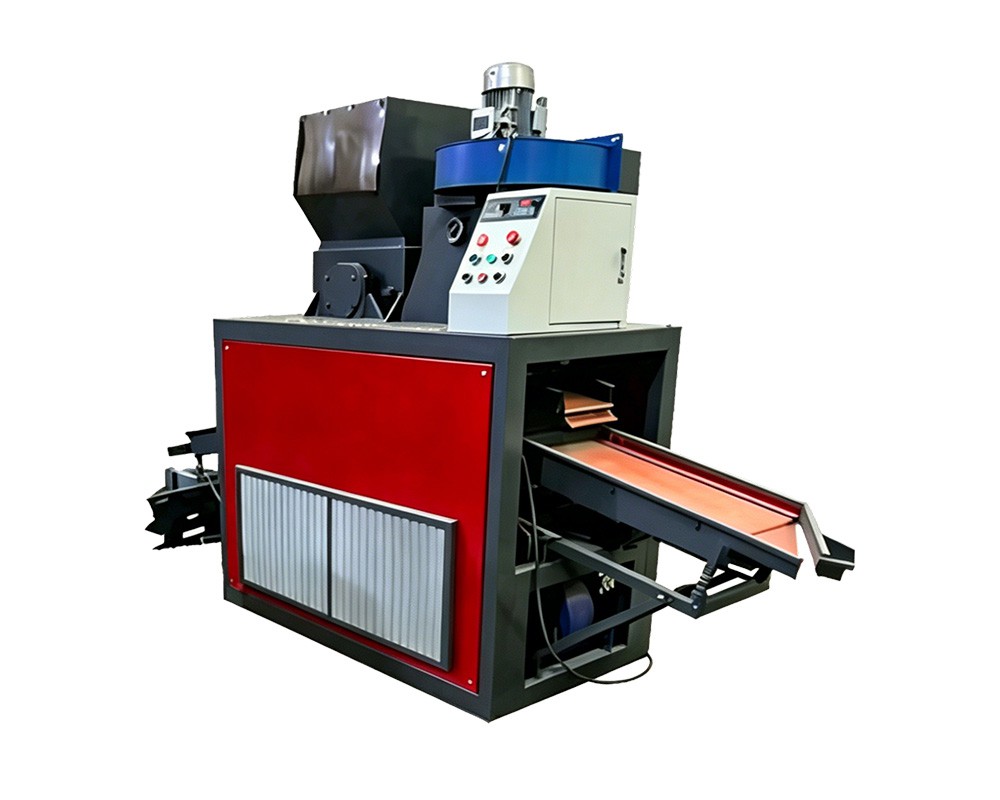
Zero-Pollution Cable Recycling: Achieving 99.9% Pure Copper Granule Recovery
Published in News & Insights · Recycling Solutions
By Henan Jiacui Intelligent Equipment Co., Ltd.
Two phrases dominate every conversation about cable recycling equipment: zero pollution and 99.9% purity. Both are achievable. Both are also routinely misused, and the gap between what a catalogue claims and what a plant measures is where recyclers lose money and, occasionally, their operating permits.
This article does three things. It defines what a genuinely zero-pollution dry process is and is not. It separates the four different numbers that get collapsed into the single word ‘purity’. And it explains, stage by stage, where the last one percent of contamination actually comes from — because that last percent is worth more per tonne than everything else in the plant.
What zero-pollution actually means in a cable recycling line
A dry mechanical line eliminates three specific pollution pathways that older processes created. It does not eliminate every environmental impact, and any supplier who implies otherwise is overselling.
Pathway | How a dry line avoids it | What remains |
|---|---|---|
Liquid effluent | No water is used in separation. Air and conductivity do the work, so there is no wash water, no settling pond, no discharge consent and no sludge to classify as waste. | Nothing from the process itself. Site drainage is unaffected. |
Combustion emissions | No burning at any stage. Dioxins and furans are not formed because there is no thermal decomposition of PVC, and no hydrogen chloride is released. | Nothing from the process. This is the decisive advantage over open burning. |
Chemical reagents | No acids, no leaching agents, no flotation chemicals. | Nothing from the process. |
Dust | Captured at the granulator, the air separator and the screen by cyclones and bag filters. | Captured dust is a real waste stream that must be handled and, in most jurisdictions, documented. |
Noise and vibration | Reduced by enclosure and mounting design, not eliminated. | Noise is a genuine occupational issue at high throughput and needs hearing protection and zoning. |
Energy | Optimised drives reduce consumption per tonne, but granulation is still an energy intensive process. | Electricity consumption is the main ongoing environmental cost. |
So: zero process pollution, yes. Zero environmental footprint, no. The distinction matters when you are writing an environmental permit application, because regulators read carefully.
The four numbers hidden inside the word ‘purity’
When a specification says 99.9%, it is referring to one of these four metrics. They are not interchangeable, and a plant can be excellent at one while being mediocre at another.
Metric | Definition | Typical published range | What it means commercially |
|---|---|---|---|
Copper content of the copper product | Mass of copper divided by total mass of the copper fraction, as sold | 98–99.5% | Sets your selling price and your smelter’s treatment charge |
Copper recovery from input | Mass of copper in product divided by mass of copper fed in | 95–98% | Sets your yield, and therefore your gross margin |
Separation rate | Share of material correctly routed to its own fraction | up to 99.9% on favourable feed | A process-capability figure, not a product specification |
Plastic purity in the plastic fraction | Share of plastic in the plastic product | 90–97% | Decides whether the plastic is a saleable product or a disposal cost |
A line that reports a 99.9% separation rate on clean household cable may still deliver 98.5% copper content when the same machine is fed mixed harness scrap in humid weather. Both figures can be true. Only one of them describes what you will be paid for.
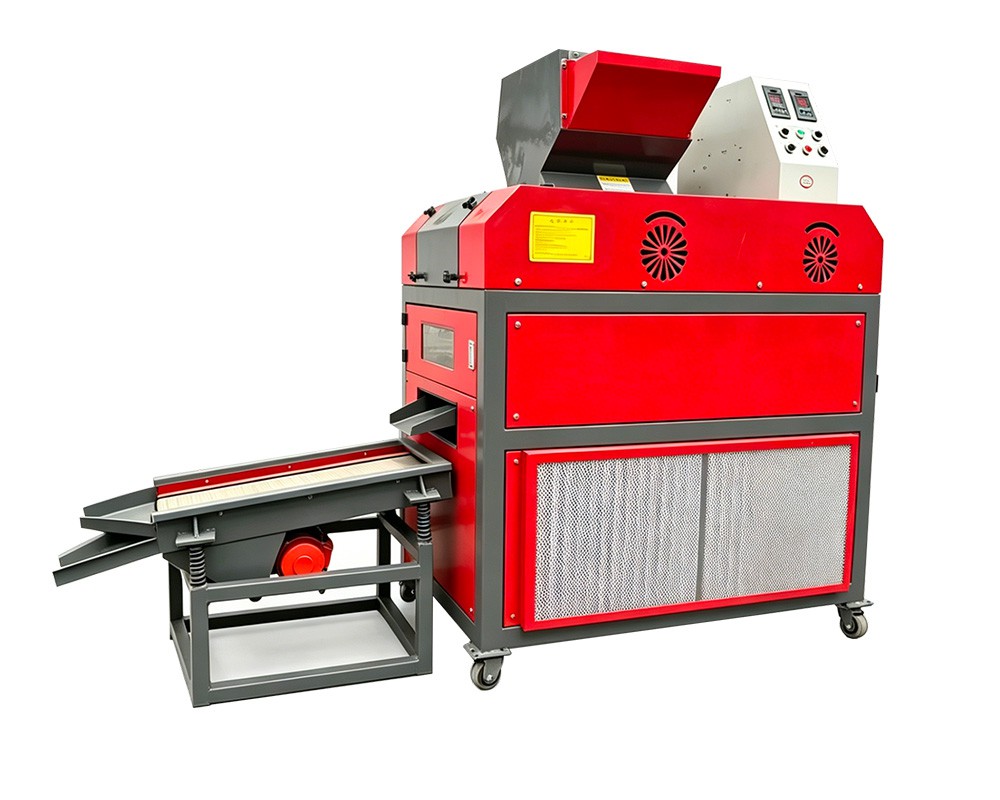
Screening before the final separation stage is what makes high purity repeatable.
Where the last one percent comes from
Getting from 97% to 99.5% is not a matter of running the same machine harder. It is four distinct physical problems, each with its own solution.
Liberation: is the copper actually free?
Separation cannot fix liberation. If a copper strand is still locked inside a piece of insulation, no amount of air or electrostatic charge will extract it. Liberation quality is set by blade sharpness, blade-to-screen gap, rotor speed and residence time. A dull blade does not cut — it tears, producing elongated particles with plastic still attached.
The practical test is visual and cheap: take a sample of the granulated mix before separation, spread it on a tray, and count how many copper particles still have visible insulation attached. If it is more than a few percent, fix liberation before touching the separator settings.
Classification: are you comparing like with like?
Air separation and electrostatic separation both become less effective when the particle size distribution is wide, because drag and charge-to-mass ratio both scale with size. A stream containing everything from 0.2 mm dust to 6 mm chunks cannot be separated cleanly in a single pass at a single setting.
Screening before the final separation stage is what converts a wide distribution into two narrow ones, each of which can be tuned. This is the single most under-invested stage in otherwise good lines.
Density separation: tuning air to the material, not to the machine
A gravity separator has one job: hold copper in the heavy fraction while letting plastic leave. Air velocity, deck angle, vibration amplitude and feed rate all interact. Published performance ranges put air separation at roughly 95–97% on mixed feed, and the residual loss is concentrated in fines.
The mistake operators make is to chase a cleaner copper product by increasing air speed. That improves the copper product while making the copper loss in the plastic worse — you are simply moving the error from one output to the other. Tune for the total mass balance, not for the appearance of one sample.
Conductivity separation: the only stage that can see fines
Electrostatic separation does not weigh particles. It charges them and lets conductors discharge instantly while insulators hold charge, then deflects them differently. That is why it can separate a 0.4 mm copper particle from a 0.4 mm PVC particle of nearly identical mass — something no air table can do.
It is also the most condition-sensitive stage in the plant. Relative humidity in the 30–50% band is the usual working window; outside it, results drift. Belt loading must be even. And the field setpoint (commonly in the 20–40 kV range) needs to be established for the actual material, on site, during commissioning.
A mass balance you can audit
Every claim about purity should survive a simple mass balance. Here is a worked example for a line processing 1,000 kg of mixed insulated cable. The figures are illustrative but internally consistent, and they show why the plastic tail matters so much.
Stream | Mass (kg) | Copper content | Copper mass (kg) | Note |
|---|---|---|---|---|
Input: mixed insulated cable | 1,000 | 50% | 500 | Assumed composition |
Copper product | 487 | 99.0% | 482 | Sold at granule price |
Plastic product | 495 | 2.8% | 14 | Sold at plastic price |
Dust and filter catch | 12 | 33% | 4 | Recoverable or disposable, depending on set-up |
Loss to moisture and handling | 6 | — | 0 | Unaccounted |
Total copper accounted for: 482 + 14 + 4 = 500 kg. Recovery is 482/500 = 96.4%. Copper content of the copper product is 99.0%. Separation rate is (482 + 481)/1,000 ≈ 96.3%. Three numbers, all different, all defensible. When you ask a supplier what their 99.9% refers to, this is the arithmetic you are asking them to fit their claim into.
The five variables that decide whether you hit the top of the range
- Blade condition. Sharp, correctly gapped blades produce clean liberation. This is the highest-leverage maintenance item in the plant and the one most often deferred.
- Screen integrity. A slack or torn screen under-classifies, and everything downstream is then asked to separate material it was never tuned for.
- Air setting. Tuned to the material and re-checked when the feed changes, not set once at commissioning and forgotten.
- Ambient humidity. The single largest cause of day-to-day variance in electrostatic performance, and the one operators most often blame on the machine.
- Feed rate stability. Every separation stage degrades quietly when overloaded. Uniform feeding is worth more than any control upgrade.
The compliance case for choosing dry
Beyond the operating economics, the dry process has become the easier one to permit. The Basel Convention amendments that took effect in January 2025 brought all waste electrical and electronic equipment under Prior Informed Consent procedures, with non-hazardous WEEE under the new entry Y49 and hazardous WEEE under A1181. Regulation (EU) 2024/1157 phases in tighter shipment controls, with most provisions applying from 21 May 2026 and export rules from 21 May 2027.
None of that directly regulates your granulator. All of it regulates the paperwork around your material, and material that can be shown to have been mechanically separated into clean, consistently specified fractions is far easier to document than material of uncertain provenance. A dry line gives you a clean story: no effluent permit, no combustion, no chemical inventory, and a measured output specification.
Frequently Asked Questions
Is 99.9% purity realistic?
As a separation rate on favourable feed, yes — our largest models are specified at up to 99.9% separation rate under controlled conditions. As a guaranteed copper content on any feedstock, no. Realistic copper content on mixed insulated cable is 98–99.5%, and it depends on liberation quality, screen condition, humidity and feed rate. Always ask which metric a figure refers to.
Does a dry line produce any waste at all?
Yes: captured dust from the cyclones and bag filters, plus any plastic fraction too contaminated to sell. Neither is a liquid or gaseous emission, but both are waste streams that must be handled and, in most jurisdictions, documented. Claiming a line produces no waste at all is inaccurate.
Why is humidity such a problem for electrostatic separation?
Because separation depends on how long a particle retains an electric charge, and surface moisture gives insulators a leakage path so they discharge faster than they should. That erodes the conductivity difference the separator relies on. Working guidance is typically 30–50% relative humidity; outside that band, results become unstable.
Can I reach 99.9% without an electrostatic stage?
On clean, coarse, single-type cable, air separation plus screening can get very close. On mixed, fine or harness-type material it generally cannot, because the fine copper particles are aerodynamically indistinguishable from plastic. If your plastic tail assays above roughly 5% copper, a polishing stage is the economical fix.
Does zero-pollution mean zero energy cost?
No. Granulation is energy intensive and electricity is the dominant ongoing environmental and financial cost of a dry line. What the dry process removes is water treatment, chemical handling and combustion emissions — not energy demand.
Request a Purity and Recovery Assessment
Tell us the material mix you intend to run, the copper content you expect, and the purity specification your buyer requires. We will tell you honestly which of the four purity metrics that specification refers to, and whether a dry line with air and electrostatic separation can meet it on your feed — or whether you need a different configuration.
Send us your material description, daily tonnage and target output, and our engineering team will respond with a model recommendation, a capacity calculation and a quotation. You are also welcome to book a live video walk-through of the Henan Jiacui Intelligent Equipment Co., Ltd. factory in Zhengzhou, Henan, China, or request a reference list of installations running comparable cable or waste streams.
About the Author and the Manufacturer
This article was prepared by the technical sales and engineering team of Henan Jiacui Intelligent Equipment Co., Ltd. (brand name JIACUI). Founded in 2015 in Zhengzhou, Henan Province, China, JIACUI designs and manufactures solid waste recycling equipment and copper wire granulation systems in a 5,000 m² factory with more than 100 employees. Our equipment holds CE, ISO and CSA certification, uses ABB and Siemens control components built to European design standards, and has been delivered to more than 400 customers in over 100 countries. Factory audits have been completed with SGS, BV and TÜV. We hold 27 patents covering shredding, granulation and separation technology. Where this article quotes performance figures, those figures come from our published model specifications and from commissioning tests on real installations; actual results depend on cable composition, feed preparation and operating practice.
Previous: How to Process Mixed Automotive Wire Harnesses Efficiently with Granulators
Next: None