
How to Process Mixed Automotive Wire Harnesses Efficiently with Granulators
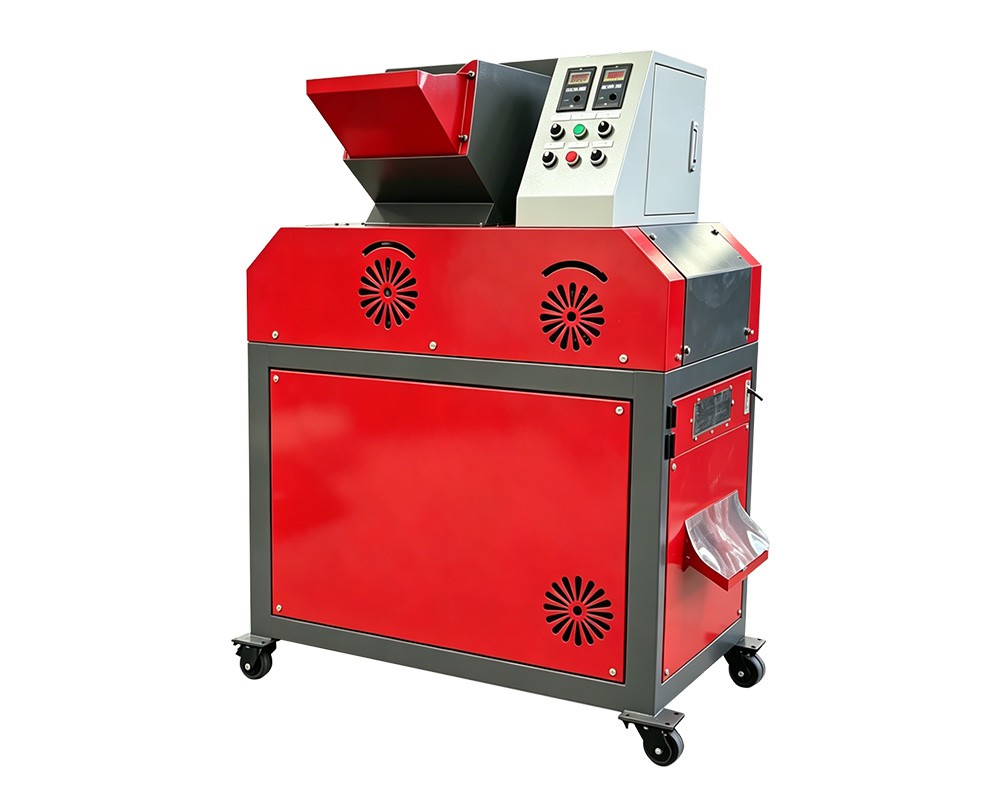
How to Process Mixed Automotive Wire Harnesses Efficiently with Granulators
Published in News & Insights · Recycling Solutions
By Henan Jiacui Intelligent Equipment Co., Ltd.
Automotive wire harnesses are the most valuable low-grade cable stream most recyclers will ever handle, and the one that punishes a badly configured line hardest. A scrap harness bundle is a dense, tangled network of thin multi-strand conductors, taped and sleeved in several different polymers, punctuated by connectors, terminals and steel clips. By weight it looks like ordinary mixed cable. In a granulator it behaves nothing like it.
This article explains what is actually inside harness scrap, why conventional granulation loses money on it, how to prepare the material before it reaches the cutting chamber, and how to configure the separation stages so the fine copper fraction is recovered rather than blown out with the plastic. The numbers come from JIACUI commissioning work on dry granulation lines running automotive and mixed electronics scrap, and from published separation-efficiency ranges for air and electrostatic systems.
What is actually inside an automotive harness
A harness is not a cable. It is an assembly: conductors, insulation, protective sleeving, tape wrapping, connectors, and often a share of non-copper metal. That composition is what makes the material both attractive and awkward.
Fraction | Typical share of harness weight | Behaviour in a granulator |
|---|---|---|
Copper conductor (multi-strand, 0.2–2.5 mm² typical) | 35–55% | Liberates easily but produces very fine, light granules that air separation tends to carry into the plastic stream. |
PVC and XLPE insulation | 25–35% | Cuts cleanly when cold; softens and smears if the chamber runs hot, which blinds screens. |
Fabric and corrugated sleeving, adhesive tape | 5–15% | The main cause of clumping. Adhesive residue makes particles stick together and blocks the vibrating screen. |
Connectors, terminals, plugs (plastic plus brass or steel) | 3–10% | Hard, dense and often non-copper. Blunts blades and contaminates the copper fraction. |
Steel clips, brackets, screws | 1–5% | Must be removed magnetically upstream, or it ends up in your copper and downgrades the batch. |
The four failure modes that cost harness recyclers money
1. Fines carried into the plastic stream
Grinding a 0.3 mm² conductor produces particles with a very low mass-to-drag ratio. In a gravity air separator tuned for 4 mm household-wire granules, those particles behave aerodynamically like plastic and leave with it. Published performance ranges put air separation at roughly 95–97% efficiency on mixed feed, with the shortfall concentrated almost entirely in the fine fraction. On harness scrap that shortfall is not a rounding error — it is the margin.
The fix is not to blow harder. Increasing air velocity simply pushes more copper out with the plastic. The fix is to stop relying on air alone for the fine fraction: classify it out and send it to a second separation stage.
2. Adhesive tape and sleeving blinding the screen
Adhesive residues become tacky as the chamber warms. Particles agglomerate into soft balls that either ride over the screen or block apertures. Once the screen blinds, everything downstream is being fed a stream that has not been properly classified, and the operator usually compensates by slowing the feed — which looks like a capacity problem but is really a material-preparation problem.
Practical measures that work: remove as much tape as is economic at the depollution bench, keep the screen tension correct, and where sticky harness scrap is a permanent part of the diet, discuss a processing aid with the material supplier and follow its safety data sheet and your site dust-control procedure. A small, controlled amount of an inert anti-stick agent is a legitimate production tool; an unmeasured scoop used to mask a badly prepared feed is not.
3. Hard components destroying the blade set
A brass terminal or a hardened steel clip does not cut — it chips. On a 6-blade compact rotor a single chipped edge degrades cut quality across the whole rotor because the remaining blades now carry an uneven load. The symptom is a sudden drop in granulate uniformity and a rise in the plastic content of the copper output, two or three weeks before the operator notices the chip itself.
The answer is upstream: depollution. Remove large connectors and plugs, and put a magnetic separator ahead of the cutting chamber. In a properly designed harness line the magnet sits after pre-shredding, where the material is open enough for ferrous parts to be exposed rather than buried inside a bundle.
4. Heat, not hardness, is what shortens blade life
Harness insulation is a mix of PVC, XLPE and rubber with different softening points. Feeding at a rate the chamber cannot clear causes dwell time to rise, chamber temperature to climb, and the insulation to smear instead of shear. Smearing does two things: it coats the blades so they stop biting cleanly, and it produces agglomerated plastic that is much harder to separate from copper. Nearly every case of 'these blades wore out in six weeks' we investigate turns out to be a feed-rate problem, not a metallurgy problem.
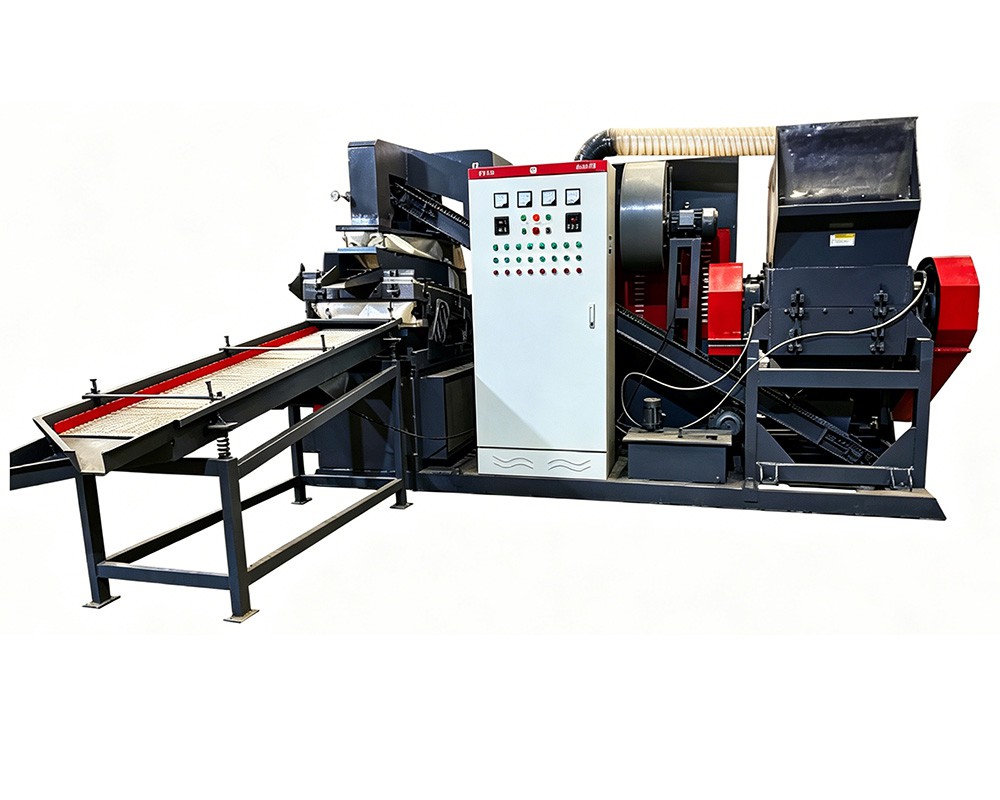
A dry granulation line configured for mixed harness and household cable scrap.
How to prepare harness scrap before granulation
The preparation sequence matters more on harness scrap than on any other cable type. Each step removes a specific failure mode from the line.
Step | What you do | Why it matters | Equipment |
|---|---|---|---|
1. Depollution check | Confirm the harness batch has already had batteries, fluids and pyrotechnic devices removed under your vehicle depollution procedure | Legal requirement in most jurisdictions and a safety requirement in all of them | Site procedure, not machinery |
2. Manual triage | Cut out large plugs, fuseboxes and heavy connectors; pull obvious steel brackets | Protects blades and keeps non-copper metal out of the copper fraction | Bench, bolt cutters |
3. Pre-shredding | Reduce tangled bundles to roughly 30–50 mm segments | Stops bundles wrapping the granulator rotor and gives a uniform feed | Twin-shaft shredder, low speed / high torque |
4. Magnetic separation | Overband or drum magnet on the pre-shredded stream | Removes clips, screws and steel terminals before they reach the blade set | Overband magnet |
5. Granulation | Shear to 2–5 mm with sharp, correctly gapped blades | Liberation quality determines everything downstream | Copper wire granulator |
6. Air separation | Bulk split by density on a gravity separator | Removes the majority of plastic cheaply and quickly | Gravity separator with adjustable air |
7. Fine classification | Screen out the sub-millimetre fraction | Prevents fines from being carried into the plastic stream | Vibrating screen |
8. Electrostatic polishing | Recover residual copper from the fine plastic tail | Pushes recovery from the mid-90s toward the high-90s on fine material | Electrostatic separator |
Setting the separation stages for a fine-strand feed
Air separation works on density and drag. Electrostatic separation works on conductivity. On harness scrap you need both, in that order, and the handover point between them is where lines are usually configured badly.
Run the gravity separator to make a clean split of the coarse fraction, accepting that the fine tail leaving with the plastic still contains recoverable copper. Then screen that plastic tail, and feed the fine fraction to an electrostatic stage. The electrostatic stage is the only one that can distinguish a 0.4 mm copper particle from a 0.4 mm PVC particle of similar mass, because it is not measuring mass at all — it is measuring how fast each particle sheds charge.
Operating conditions that actually decide electrostatic performance:
- Relative humidity. Conductivity-based separation is humidity-sensitive. Published guidance for electrostatic separators puts the workable band at roughly 30–50% RH. In a humid climate, or in a shed with open water, results will drift day to day until the feed is dried or the space is dehumidified.
- Particle size consistency. A wide size distribution separates unevenly because charge-to-mass ratio changes with size. Screening before the electrostatic stage is not optional.
- Field strength. Typical working voltages are in the 20–40 kV range, set against the material actually being run. Treat the setpoint as a commissioning value, not a permanent one.
- Feed rate stability. Electrostatic separation degrades quietly when the belt is overloaded. It does not jam; it just gets worse.
What recovery and purity you should realistically expect
Claims of 99.9% need to be read carefully. Purity of the copper product and recovery of copper from the input are two different numbers, and a line can be excellent at one and mediocre at the other.
Metric | Realistic range on harness scrap | What moves it |
|---|---|---|
Copper content of the copper product | 98–99.5% | Blade condition, screen integrity, electrostatic set-up |
Copper recovery from input | 95–98% | Capture of the fine fraction; whether a polishing stage exists |
Copper content of the plastic tail | 2–6% | The number to watch monthly — it is your direct financial loss |
Plastic content of the copper product | 0.5–2% | Incomplete liberation, usually from blunt blades or over-fast feed |
If a supplier quotes a single headline purity figure without telling you which of these four it refers to, ask. The distinction is not pedantry — it decides whether your monthly yield reconciliation makes sense.
Matching the machine to harness volume
Harness scrap is slower to process per kilogram than household cable because of the preparation burden. Size the line on prepared feed, not on gross intake, and allow for the pre-shredding and magnetic stages in the layout.
Model | Typical capacity | Main power | Best suited to | Feed width |
|---|---|---|---|---|
Model 46-A (RC46A) | 60–80 kg/h | compact single unit | small workshops, mixed household wire | up to 12 mm cable |
Model 300 (RC300) | 100–150 kg/h | compact single unit | start-up recyclers, mixed thin wire | up to 20 mm cable |
Model 350 (RC350) | 200–220 kg/h | 5.5 kW main unit | growing yards stepping up from manual stripping | up to 30 mm cable |
Model 400 (RC400) | 300–400 kg/h | mid-range line | multi-shift commercial yards | up to 40 mm cable |
Model 660 (RC-CWG660) | 600–650 kg/h | 40.24 kW installed | production-class yards, WEEE processors | up to 60 mm cable |
Model 800 (RC-CWG800) | 700–900 kg/h | 45 kW main unit | large yards, cable manufacturers’ off-cuts | up to 80 mm cable |
Model 1000 (RC-CWG1000) | 900–1,000 kg/h | 77.48 kW installed | industrial plants, scrap exporters | up to 100 mm cable |
As a working rule: below roughly 500 kg/day of prepared harness material, a compact single-unit granulator with a gravity separator is the right economic answer. Between 1 and 5 tonnes/day, a line with pre-shredding, magnetic separation, screening and electrostatic polishing justifies its capital. Above 10 tonnes/day the constraint stops being the granulator and becomes material supply and logistics.
Commissioning checklist for a harness line
- Run the first batch with the magnet in place and weigh what it captures. If it is more than 2–3% of feed, your manual triage step is not working.
- Sample the copper product at three points in the shift, not one. Purity drifts as the chamber warms.
- Sample the plastic tail and have it assayed once. This is the only way to know your real copper loss.
- Record the air-separator settings that produced your best sample, and treat them as the baseline for that material type.
- Check screen tension weekly. A slack screen under-separates and looks like a separation fault.
- Measure chamber temperature indirectly by watching for smearing on the blades at the end of a shift.
- Log blade hours and product purity together, so blade changes are driven by evidence rather than by the calendar.
Frequently Asked Questions
Can a standard copper wire granulator process automotive harnesses?
Yes, provided the material is depolluted, triaged, pre-shredded and magnetically cleaned first, and provided the separation section includes a fine-fraction polishing stage. A granulator sized and set up only for household cable will run harness scrap, but it will lose a meaningful share of the fine copper with the plastic.
Why does harness scrap produce so much fine copper?
Because the conductors are thin multi-strand wires. Cutting a 0.3–0.5 mm strand produces particles whose mass is small relative to their surface area, so air separation — which sorts on density and drag — cannot hold them in the heavy fraction. This is a materials characteristic, not a machine defect, and it is why electrostatic polishing exists.
Is a pre-shredder really necessary?
For tangled, bundled harness scrap, yes. Long bundles wrap around the granulator rotor, cause torque spikes and force operators to feed slowly and unevenly. A low-speed, high-torque twin-shaft pre-shredder producing 30–50 mm segments stabilises the whole line. For already-short, pre-cut material it is optional.
How do I stop adhesive tape from clogging the screen?
Three things, in order of importance: remove as much tape as is economic upstream, keep the feed rate within the chamber's clearing capacity so the material does not heat up, and maintain correct screen tension. Where sticky material is unavoidable, a controlled anti-stick processing aid can help; it must be applied at a specified rate with proper dust control, not used as a substitute for preparation.
What purity can I expect on harness scrap?
Typically 98–99.5% copper content in the copper product, with copper recovery of 95–98% from input depending on whether the line has a fine-fraction polishing stage. Quote requests that promise 99.9% without qualification should be checked against the definition being used.
Do I need an electrostatic separator to process harnesses?
Not for coarse household cable. For harness scrap, mixed electronics wire and communication cable, it is the stage that converts a mid-90s recovery into a high-90s recovery. If your plastic tail assays above about 5% copper, the polishing stage will usually pay for itself.
Specify a Harness-Ready Granulation Line
If automotive harnesses are part of your feed mix, send us a sample description — conductor sizes, approximate tape and sleeving content, and the share of connectors still attached — together with your target daily tonnage. We will specify the preparation sequence and separation configuration that suits that material specifically, rather than quoting a machine built for household cable.
Send us your material description, daily tonnage and target output, and our engineering team will respond with a model recommendation, a capacity calculation and a quotation. You are also welcome to book a live video walk-through of the Henan Jiacui Intelligent Equipment Co., Ltd. factory in Zhengzhou, Henan, China, or request a reference list of installations running comparable cable or waste streams.
About the Author and the Manufacturer
This article was prepared by the technical sales and engineering team of Henan Jiacui Intelligent Equipment Co., Ltd. (brand name JIACUI). Founded in 2015 in Zhengzhou, Henan Province, China, JIACUI designs and manufactures solid waste recycling equipment and copper wire granulation systems in a 5,000 m² factory with more than 100 employees. Our equipment holds CE, ISO and CSA certification, uses ABB and Siemens control components built to European design standards, and has been delivered to more than 400 customers in over 100 countries. Factory audits have been completed with SGS, BV and TÜV. We hold 27 patents covering shredding, granulation and separation technology. Where this article quotes performance figures, those figures come from our published model specifications and from commissioning tests on real installations; actual results depend on cable composition, feed preparation and operating practice.