
Buyer's Checklist for a Copper Wire Granulation Line: From Feed Specification to Guaranteed Copper Purity
Buyer's Checklist for a Copper Wire Granulation Line: From Feed Specification to Guaranteed Copper Purity
Published in News & Insights · Buying & Selection Guides
By Henan Jiacui Intelligent Equipment Co., Ltd.
A copper wire granulation line is bought once and lived with for a decade. Unlike a shredder, where the main variables are mechanical, a granulation line is judged by a single commercial output: how much clean copper you recover, at what purity, from the cable you actually feed. That makes it unusually easy to buy badly — because the machine that wins the demonstration is not always the machine that survives your real feedstock.
This checklist is written from the buyer's chair. It walks through the specification decisions in the order you should make them, and it ends with acceptance criteria you can put into a purchase contract so that 'guaranteed purity' becomes a measurable obligation rather than a brochure phrase.
Step 1 — Specify your feed before you look at any machine
Every granulation line is designed around a cable mix. You cannot evaluate a quotation until you have characterised your feed honestly, because the same machine performs completely differently on single-conductor power cable and on tangled low-grade automotive harness.
Feed parameter | Why it drives machine selection |
|---|---|
Conductor size range (mm² or AWG) | Fine wires need different blade geometry and screening than heavy armoured cable |
Cable type mix | Household wire, power cable, communication cable and auto harness separate very differently |
Insulation material | PVC, XLPE and rubber behave differently in the cutting chamber and separator |
Copper content (% by weight) | Sets your expected yield and therefore your payback |
Contamination (steel, armouring, fillers) | Drives the need for a pre-shredder, magnetic separation or heavy-metal handling |
Moisture and cleanliness | Wet or dirty feed reduces separation efficiency and must be handled up front |
Do not accept a capacity figure without a feed definition. 'Two tonnes per hour' is meaningless until both parties agree what that tonnage is made of. Insist that the quotation states the feed assumption beside the capacity number.
Step 2 — Match capacity to your real working pattern
Capacity should be sized to the hours you will realistically run, with headroom — not to the single largest number you hope to achieve. A line rated at your peak demand and run flat out every shift has no margin for harder feed, and no reserve when you win a larger contract.
- Choose a capacity roughly one step above your current average production, so normal variation in feed does not become a bottleneck.
- Confirm the capacity figure is quoted on your feed, not on clean single-conductor cable — the difference can be a factor of two.
- Check whether the stated capacity is for clean separation or for gross throughput including insulation and waste fractions.
- Ask how capacity changes when insulation type or wire fineness moves away from the test sample.
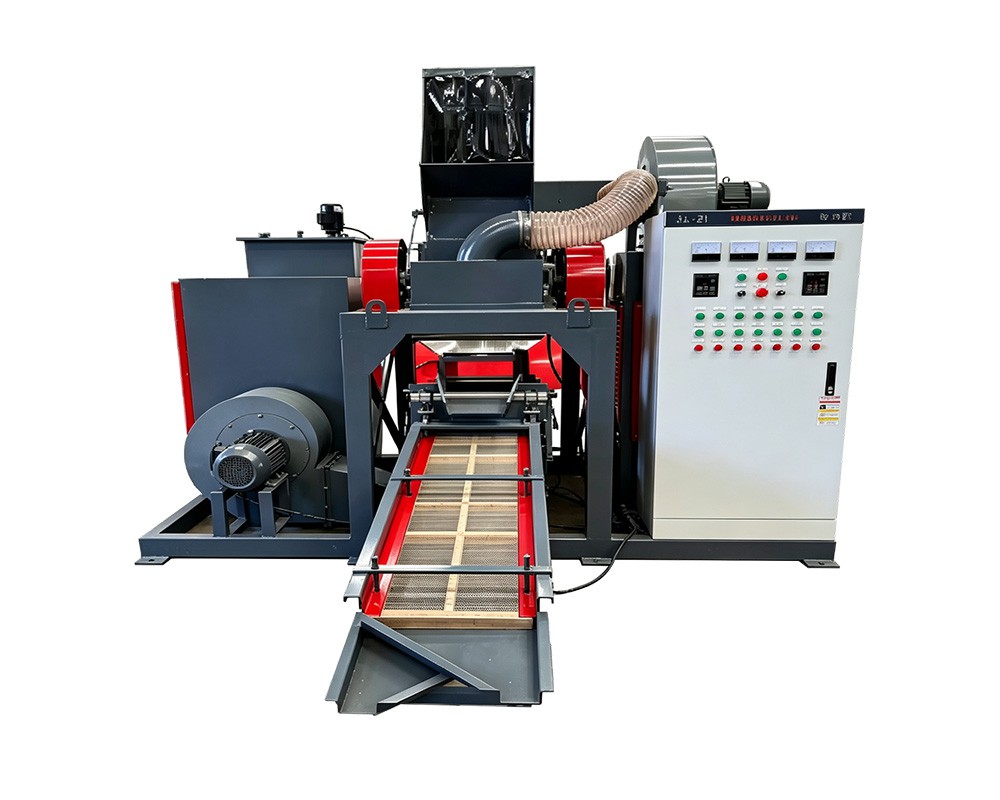
A modern copper wire granulation line: cutting section, air separator and dust collection working as one system. Capacity claims are only valid when the whole line is matched.
Step 3 — Insist on a separation-rate test on your own material
Separation rate is the single most important performance number on a granulation line, and the single most commonly inflated. A good line recovers the great majority of the copper in the feed as clean, saleable granules, with the remainder reporting to a recyclable plastic fraction. The only way to know what a given line will do on your cable is to test your cable through it.
- Send a representative sample — at least several hundred kilograms, drawn from your normal mix, not a hand-picked clean batch.
- Require a mass balance. In goes X kg; out comes copper granules, plastic and dust. The three must reconcile. A line that recovers '98% copper' but produces a large third stream is losing copper inside the plastic.
- Have the copper output assayed or at least weighed and inspected for residual insulation, dust and fines.
- Test at both ends of your wire range — the finest wire you handle and the heaviest cable. A line tuned for heavy cable often loses fines; a line tuned for fines often struggles with thick armour.
- Watch the running conditions. Is the line stable, or is it being hand-fed to hide surges? Does dust escape? Does the operator intervene constantly?
A supplier confident in their separation performance will welcome this test. A supplier who wants to demonstrate on their own sample is telling you something about the reliability of their numbers.
Step 4 — Convert 'guaranteed purity' into contract language
Purity guarantees are only meaningful when they are measurable, bounded and linked to a consequence. Before signing, make sure the contract states all of the following:
Clause | What it should say |
|---|---|
Purity figure | A stated copper content in the output granules, measured on an agreed method (e.g. loss-on-ignition or customer assay) |
Reference feed | The exact feed specification against which the purity figure applies |
Recovery rate | The proportion of copper in the feed that reports to the copper output stream |
Test method | Who tests, with what equipment, at whose cost, and how disputes are resolved |
Acceptance test | A witnessed run at commissioning on your material, with the result recorded |
Remedy | What the supplier does if the acceptance test misses the guarantee |
A supplier who commits in writing to purity on a defined feed, tested by a defined method, with a defined remedy is offering a real guarantee. One who offers a round number with no reference feed is offering marketing.
Step 5 — Check the supporting systems, not just the cutter
Buyers focus on the cutting chamber because it is the visible part. In practice, copper losses and customer complaints usually originate in the systems around it — separation, dust control and material handling.
- Air separation. How is the heavy copper fraction separated from the lighter insulation? Is the air flow adjustable for different feed, and can the operator see and tune it?
- Dust and fines collection. Copper fines are pure profit and a health hazard simultaneously. A proper line captures them with enclosed dust collection rather than venting them.
- Screening and re-processing. Is there a route for partially separated material to return to the circuit instead of leaving as waste?
- Conveying and feeding. Manual feeding is a false economy at commercial tonnage — it sets both your throughput ceiling and your labour cost, and it exposes operators to risk.
- Electrical standard. Confirm the control system uses recognised international components with proper motor protection; substitution of unknown brands is a hidden lifetime cost.
For recyclers handling printed circuit boards and electronic scrap alongside cable, the same procurement logic applies to a PCB recycling line — with additional separation stages for metals and resin powder. The test-on-your-material principle is identical.
Step 6 — Evaluate the supplier, not only the machine
A granulation line is a long relationship. The questions that protect you are about the company behind the machine:
- Is there verified manufacturing capability — a real factory, not a trading desk reselling import?
- Are certifications and test reports available for the models offered (CE, ISO, and market-specific requirements)?
- Is there a reference list of installations running comparable cable, ideally in a comparable market?
- What is the spare-parts policy for blades, screens and separator components — lead time, stock, and cost over the machine's life?
- Is installation, commissioning and operator training included, and who attends?
- What remote and on-site support is available after handover, and in what language?
Trust is established by evidence: a factory audit, a video walk-through of a line running a customer's material, references you can actually contact. Ask for all three.
Step 7 — Build a decision matrix, not a price list
When the quotations come back, score them against the same weighted criteria. Price should be one column, not the deciding row.
Criterion | Weight | What to look for |
|---|---|---|
Verified separation rate on your feed | High | Mass balance from your own sample test |
Copper purity guarantee | High | Measurable, on a defined feed, with a remedy |
Capacity at your feed | High | Quoted against your actual cable mix, with headroom |
Build quality and components | Medium | Recognised bearings, drives and control gear |
Dust and fines handling | Medium | Enclosed collection, no visible dust escape |
Supplier credibility | Medium | Factory audit, certifications, contactable references |
Spare parts and support | Medium | Lead times and stock for wear parts |
Purchase price | Medium | Total, delivered and commissioned |
Score each supplier one to five on every row, multiply by the weight, and compare the totals. The exercise almost always separates the genuine performer from the one whose only advantage was the quotation.
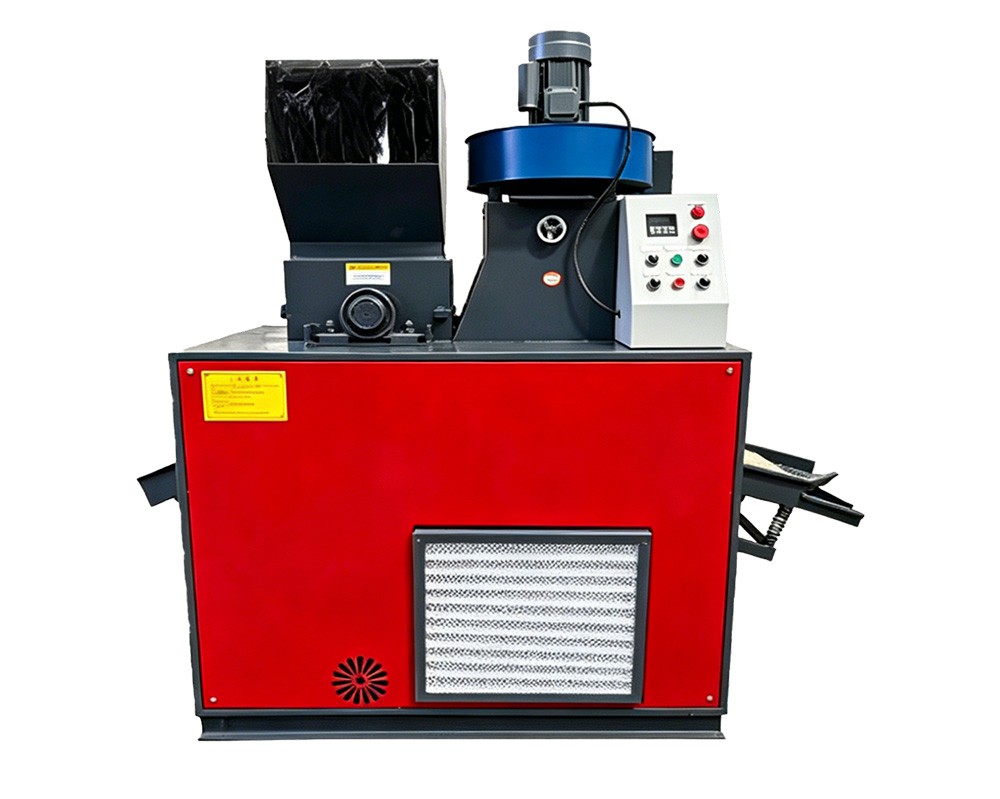
A compact granulation line for small-to-medium operations. Even here, the checklist applies: test your feed, define purity, and evaluate the supplier as carefully as the machine.
Frequently Asked Questions
Can I trust a separation rate quoted from the supplier's own sample?
Treat it as an indicative maximum, not a guarantee. The supplier's sample is usually clean, single-conductor and dry — the most favourable possible feed. Your cable mix is the only valid basis for a performance commitment, which is why testing your own sample is step three of this checklist and non-negotiable.
What copper purity should I expect from a good granulation line?
A well-designed and properly tuned line should deliver high-purity copper granules suitable for direct sale, with the exact figure depending on your wire mix, insulation type and how finely the material is freed before separation. The productive approach is not to chase a general number but to define the purity you need for your off-taker, then require the line to meet it on your feed.
How important is a pre-shredder on a granulation line?
It depends on your feed. If you handle heavy armoured cable, large-diameter conductors or tangled harness, a pre-shredding stage stabilises the feed and protects the granulator, and it usually pays for itself in throughput and blade life. If your feed is already uniform small wire, it may be unnecessary. Decide from your feed specification, not from the catalogue.
What kills the payback on a granulation line most often?
Overstated capacity and optimistic purity, both of which come from specifying the machine on the wrong feed. When actual throughput and recovery fall short of the brochure, the payback period stretches and the operator compensates with extra labour — the hidden cost that erodes the business case. Testing on your own material is the cheapest insurance against this.
Get a Selection Review
Send Jiacui a sample of your cable mix and your target purity, and we will return a mass-balance test result, a matched line specification and a written purity guarantee against your feed.
Contact us for a specification review, a factory audit video call or a reference list of installations running comparable material.