
Complete Turnkey Solution for Processing Fine and Capillary Wires
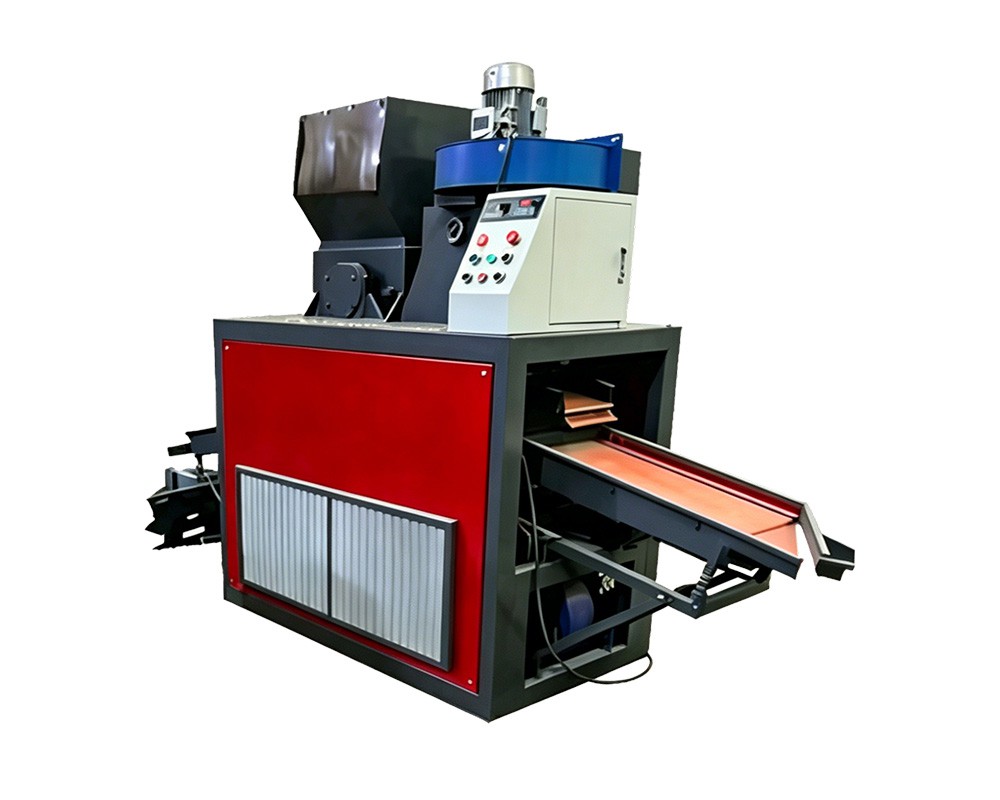
Complete Turnkey Solution for Processing Fine and Capillary Wires
Published in News & Insights · Recycling Solutions
By Henan Jiacui Intelligent Equipment Co., Ltd.
Thin wire is where most cable recycling operations discover the limits of their equipment. Thick single-core power cable is forgiving: the copper is heavy, the geometry is simple, and air separation has an easy job. Fine and capillary wire — multi-strand flexible cable, fine automotive harness tails, communication cable, and the near-dust wire found in electronics — behaves completely differently. It tangles, it wraps around rotors, it carries a high plastic-to-metal ratio, and the copper it contains is light enough to be carried away in the airstream if separation is not tuned for it.
This is why a 'complete turnkey solution' for fine and capillary wire is not simply a bigger granulator. It is a sequence of machines and settings designed around the physics of small copper particles, from the way material enters the line to the way the final product is classified.
Why fine wire is genuinely harder to process
Property of the feed | Effect on processing | What the line must do about it |
|---|---|---|
Very low copper-to-plastic ratio (often 25–40% copper) | You are moving a lot of plastic to recover a modest amount of copper; throughput per kg of copper is low | High volumetric throughput, and a separation stage that is not overloaded by plastic mass |
Copper strands of 0.1–0.5 mm diameter | Copper particles are light enough to be entrained in the separation airstream and lost to the plastic outlet | Adjustable, low-velocity air separation with fine control rather than a fixed fan setting |
Long, flexible, springy strands | Material wraps around the rotor, bridges in the hopper and defeats feeding | Pre-shredding or pre-cutting to a controlled length before granulation |
High proportion of tinned, lacquered or mixed-alloy strands | Some material resists clean liberation; purity expectations must be set realistically | Multi-stage crushing and classification, plus an honest purity guarantee |
Fines and dust generation | Loses copper as dust, creates housekeeping and compliance problems | Correct screen aperture, closed dust collection and a fines recovery path |
The turnkey line, stage by stage
A properly configured fine-wire line typically runs five stages. Each stage exists to protect the performance of the one after it.
Stage 1 — Reception and pre-sorting
Fine wire almost always arrives contaminated: with armouring, steel clips, connectors, tape and occasionally whole appliances. Every kilogram of steel that enters the granulator costs you blade life and creates a purity problem downstream. A simple magnetic separation step at reception is one of the highest-return additions to any fine-wire line.
Stage 2 — Pre-shredding to controlled length
This is the stage most often omitted, and the omission is why so many operators report that 'the granulator cannot handle thin wire'. A low-speed, high-torque twin-shaft shredder reduces long, springy cable to a loose, free-flowing material that meters evenly into the granulator. Our double-shaft shredders use counter-rotating, staggered claw-type blades that pull material in and shear it rather than wrapping it. The Model 400, for example, uses a single JZQ250 cylindrical gear reducer at 4 kW driving 20 blades of 160 mm diameter and 20 mm width with matching spacing sleeves — deliberately low speed and high torque, which is exactly what tangled fine wire needs.
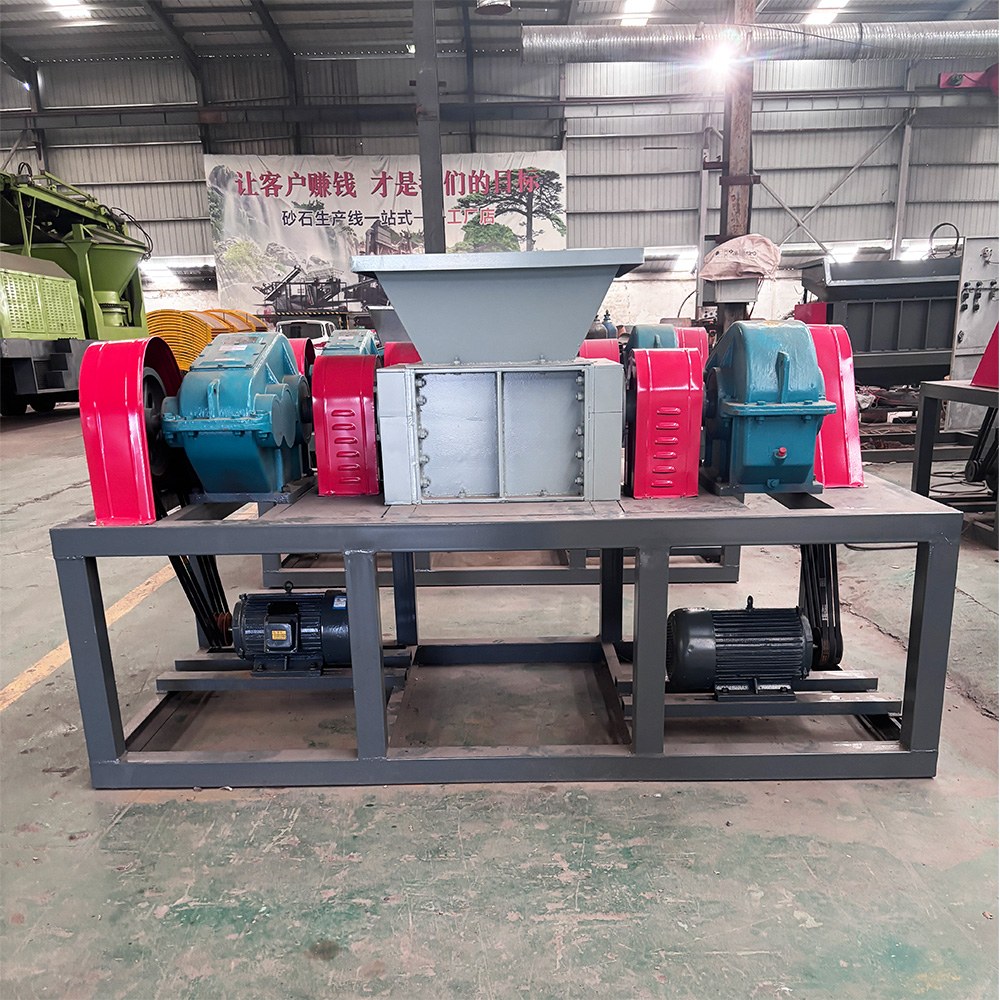
Pre-shredding fine wire to a controlled length is what makes the granulation stage reliable.
Stage 3 — Granulation and liberation
The granulator's job is to liberate copper from insulation without producing excessive fines and without smearing copper into the plastic. Blade geometry, rotor speed and screen aperture have to match the feed. For capillary wire, a tighter screen aperture and a more conservative feed rate produce a cleaner liberation than simply raising throughput.
For reference, across the JIACUI range the machines most often specified for fine-wire work are the compact Model 300 and the mid-range Model 350, moving up to the Model 660 where fine wire is part of a mixed feed at production scale. Blade material matters more than people expect here: SKD-11 tool steel holds a cutting edge rather than deforming, which is the difference between slicing strands and dragging them.
A complete fine-wire line: pre-shredding, granulation, air separation, screening and dust collection.
Stage 4 — Air separation tuned for light particles
Air separation is where fine-wire recovery is won or lost. The principle is simple — copper is roughly eight times denser than PVC or PE, so a controlled airstream can lift plastic and let metal fall. The difficulty is that a 0.2 mm copper strand and a PVC granule of similar size have competing aerodynamic behaviour, and a fan set for thick power cable will blow fine copper straight out of the machine.
The solution is a separation stage with genuinely fine velocity control — typically a variable-frequency fan rather than a fixed-speed unit — combined with a second, gentler separation pass on the plastic outlet. A single separation pass is adequate for household wire; for capillary wire it is the difference between 97% and 99%+ copper content, which is the difference between a discounted grade and a premium one.
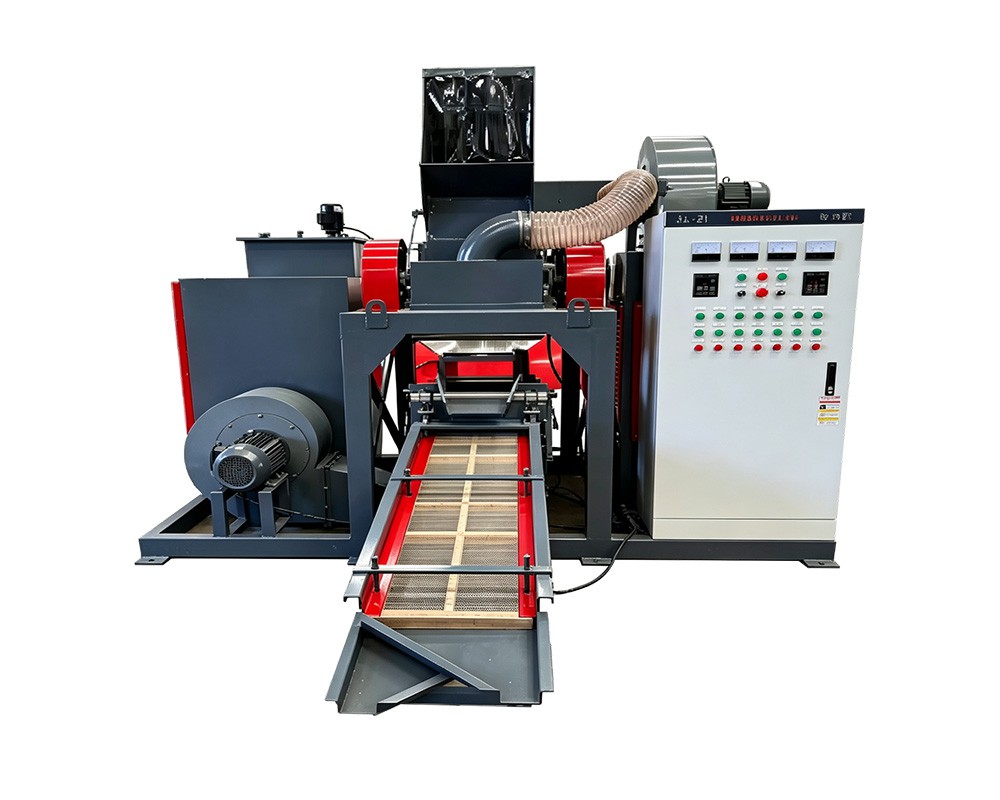
Variable-speed air separation, followed by sizing on a vibrating screen.
Stage 5 — Screening and classification
The final stage sizes the copper product and recovers fines before they become a housekeeping problem. A vibrating screen separates the copper granules into usable grades and pulls out dust and fines for recovery rather than loss. Closed dust collection is not merely a compliance feature on a fine-wire line — it is a copper recovery feature.
What 'turnkey' should actually include
A turnkey solution is not a machine delivered in a crate. Buyers should expect and insist on the following, and should be wary of any supplier who treats them as optional extras.
Deliverable | Why it belongs in the scope |
|---|---|
Feed-material testing on a representative sample | Purity and recovery claims are only meaningful against your actual cable mix; test data on a favourable sample is marketing, not engineering |
Process flow diagram and equipment layout drawing | Lets you plan power, foundations and material flow before the equipment arrives |
Electrical load schedule and control philosophy | Independent verification that your supply can carry the starting and running load |
Commissioning and performance test at site | The acceptance test should state throughput, copper content and plastic-residue limits, with a defined test method and a remedy if the figures are not met |
Operator training and a written operating manual | Most 'machine faults' reported in the first year are setup and feeding issues, not mechanical failures |
Recommended spare-parts list with lead times | Blades, screens and wear plates are consumables; knowing the lead time before you need it is the difference between a day of downtime and a month |
Dust, noise and safety provisions | Fine wire produces more dust than any other cable stream; the whole line should be designed around controlling it |
Setting realistic performance expectations
It is worth being candid about what fine and capillary wire can and cannot deliver. Recovery rate — the share of contained copper that leaves the machine as saleable copper — is typically very high, but not identical to what you would achieve on thick power cable, and the copper content of the plastic output is usually higher because fine strands are simply harder to liberate completely. A supplier who promises identical results on 0.15 mm strands and 50 mm single-core cable is not being straight with you.
The honest targets for a well-set-up dry line on mixed fine wire are a copper granule product of 98–99.5% copper content, a plastic fraction carrying a low single-digit percentage of copper, and a mass balance that closes to within a few per cent. That is an excellent outcome — and it is achieved by configuration and discipline, not by a single clever component.
Where JIACUI fits
For fine and capillary wire, JIACUI typically supplies a configuration built from the existing product range rather than a bespoke machine: a twin-shaft pre-shredder from the Model 400 to 1,500 series, a dry-type granulator from the Model 300 to Model 1000 series, variable-speed air separation, a vibrating screen and closed dust collection. Sizing is driven by your feed mix and your target output, and we will tell you plainly where a claim cannot be met.
Because all the process stages are manufactured and integrated by the same company, the separation settings, screen apertures and dust handling are matched to the granulator rather than assembled from unrelated suppliers — which is the practical reason 'turnkey' is worth paying for on difficult material.
Frequently Asked Questions
Can a standard copper wire granulator process capillary and very fine wire?
A standard dry-type granulator can process it, but throughput will be lower than on thick cable and the separation stage must be tuned for light particles. The single most valuable addition is a pre-shredding stage to cut long springy strands to a controlled length. Without it, fine wire tends to wrap and bridge, and operators often wrongly conclude that the granulator itself is unsuitable.
What copper purity can I expect from fine wire?
With correct pre-shredding and a variable-speed air separation stage, a 98–99.5% copper content in the granule product is realistic on mixed fine wire, with a low single-digit percentage of copper remaining in the plastic fraction. Achieving the top of that range requires discipline in feed rate and regular checking of the separation setting — not a different machine.
Why is a pre-shredder necessary for fine wire?
Fine wire arrives as long, flexible, springy strands that will wrap around a granulator rotor and bridge in the feed hopper. A low-speed, high-torque twin-shaft shredder converts that material into short, free-flowing pieces that meter evenly. It also removes the need to run the granulator at an excessive rotor speed to cope with long strands, which reduces fines and blade wear.
How do I know whether my separation is losing copper?
Weigh and sample the plastic output. If the plastic fraction contains more than a low single-digit percentage of copper, or if you can see clearly bright copper strands in it, your air velocity is too high or your feed rate is too aggressive. Reducing fan speed slightly and moderating the feed usually recovers more copper than any hardware change.
Is a wet separation line better for fine wire?
Wet lines can hold purity well on difficult material, but they bring water treatment, sludge handling, corrosion and a permanent operating cost. Dry lines now achieve comparable purity on the great majority of fine-wire streams with none of those burdens. We would recommend a wet process only where a specific material genuinely demands it and the environmental infrastructure exists to support it properly.
Request a Fine-Wire Line Configuration
Fine and capillary wire rewards configuration far more than it rewards brute force. Send us a representative sample of your material and your target daily tonnage, and we will propose the complete line — pre-shredding, granulation, separation, screening and dust control — with the performance figures we are prepared to put in the contract.
Send us your material description, daily tonnage and target output, and our engineering team will respond with a model recommendation, a capacity calculation and a quotation. You are also welcome to book a live video walk-through of the Henan Jiacui Intelligent Equipment Co., Ltd. factory in Zhengzhou, Henan, China, or request a reference list of installations running comparable cable or waste streams.
About the Author and the Manufacturer
This article was prepared by the technical sales and engineering team of Henan Jiacui Intelligent Equipment Co., Ltd. (brand name JIACUI). Founded in 2015 in Zhengzhou, Henan Province, China, JIACUI designs and manufactures solid waste recycling equipment and copper wire granulation systems in a 5,000 m² factory with more than 100 employees. Our equipment holds CE, ISO and CSA certification, uses ABB and Siemens control components built to European design standards, and has been delivered to more than 400 customers in over 100 countries. Factory audits have been completed with SGS, BV and TÜV. We hold 27 patents covering shredding, granulation and separation technology. Where this article quotes performance figures, those figures come from our published model specifications and from commissioning tests on real installations; actual results depend on cable composition, feed preparation and operating practice.
Previous: How to Start a Profitable Scrap Cable and Copper Wire Recycling Business
Next: None