
How to Start a Profitable Scrap Cable and Copper Wire Recycling Business
How to Start a Profitable Scrap Cable and Copper Wire Recycling Business
Published in News & Insights · Recycling Solutions
By Henan Jiacui Intelligent Equipment Co., Ltd.
Scrap cable recycling is one of the very few recycling businesses in which the feedstock is a known commodity, the output is a globally traded metal, and the processing step in between can be operated profitably at almost any scale — from a two-person workshop to a 25-tonne-per-day plant. That is what makes it attractive. The same arithmetic that makes it attractive is also what makes it unforgiving: the margin is not created by optimism or by clever marketing, it is created by the spread between what you pay for cable and what you sell the recovered copper for, minus your true processing cost.
This guide is written from the point of view of the people who manufacture the equipment. Over the past decade we have commissioned dry-type copper wire granulation systems from 60 kg/h up to 1,000 kg/h in more than 100 countries. The projects that failed almost never failed because a machine broke. They failed because the business model was never tested with a calculator before the machine was ordered. What follows is the calculation, in the order you should actually perform it.
The whole business in one sentence
You buy insulated cable at a discount to bare copper, you mechanically liberate the copper from the insulation, you sell clean copper granules and clean plastic granules — and your profit is the difference between the two, minus the cost of doing the work. Every decision you make either improves that spread or consumes it.
Value line | Typical relationship | Why it matters |
|---|---|---|
Purchase price of mixed insulated cable | 45–65% of the bright bare copper price | The single largest variable in your P&L. The lower the copper content, the closer the price should sit to the low end. |
Sale price of copper granules (98–99.5% purity) | 90–96% of bright bare copper | Purity is money. Going from 97% to 99.5% typically moves you several percentage points up the price scale. |
Sale price of recovered plastic | USD 0.15–0.45 per kg | Often ignored, occasionally the difference between a marginal and a comfortable operation. |
Processing cost (power, labour, blades, maintenance) | 3–8% of copper value | Scales with throughput and with how well the machine is set up and maintained. |
Step 1 — Get precise about what you are actually selling
A granulator does not sell copper; it sells copper granules at a specification a smelter or trader will accept. Before you spend money, find out three things from your intended buyer: the minimum accepted copper content, the maximum acceptable plastic residue, and the maximum acceptable moisture. Those three numbers define your process requirement.
In practice, most dry granulation lines aim for 99% copper content or better on clean household and communication cable, with the residual plastic fraction running 2–5% copper. The plastic fraction is not waste — it is a second product, but only if it is clean enough to be sold to a plastics recycler rather than sent to landfill.
Step 2 — Quantify the supply before you buy any equipment
This is the step that separates the businesses that succeed from the ones that scrape by on 40% of planned throughput. Cable is not bought from an exchange; it is gathered from dozens of small, irregular sources. Before ordering a machine, build a written list of sources and the realistic monthly tonnage each can give you:
- Electricians and electrical contractors — the highest-quality, most consistent source of household and installation wire.
- Telecom and network decommissioning — large volumes of communication cable, often with low copper content per metre but easy to process in bulk.
- Auto dismantlers and scrap yards — car harnesses and battery cable, generally heavier gauge and higher value.
- Industrial plant maintenance and shutdowns — infrequent but very large single-lot events; worth planning capacity around.
- Demolition contractors — mixed, dirty, often containing steel and armouring that must be removed before granulation.
Write down a conservative monthly tonnage — the number you would still believe in a bad month, not the number you hope for in a good one. Then size the machine to roughly 70% of that figure. A granulator that runs two shifts five days a week at 70% utilisation is a business. A granulator that runs four hours a week is a very expensive ornament, and the finance cost on it does not care.
Step 3 — Choose your entry point honestly
There are three credible ways to enter this business. Each has a different capital requirement and a different labour profile, and none of them is 'wrong' — but choosing one that does not match your supply will cost you.
Entry point | Typical capacity | Best when | Main limitation |
|---|---|---|---|
Manual / bench stripping | 10–50 kg/h, 1–3 people | you are testing the market with a small, clean supply of thick single-core cable | labour cost per tonne is high and thin wire cannot be stripped economically |
Compact granulator (Model 46-A / Model 300 class) | 60–150 kg/h | you already have a steady 5–15 t/month of mixed cable and want to stop selling it raw | thin wire and fine strands need careful feed control to hold purity |
Integrated line (Model 350 up to Model 1000) | 200–1,000 kg/h | you have contracted supply of 20+ t/month and want to move to multi-shift production | higher capital and power requirement; needs disciplined maintenance |
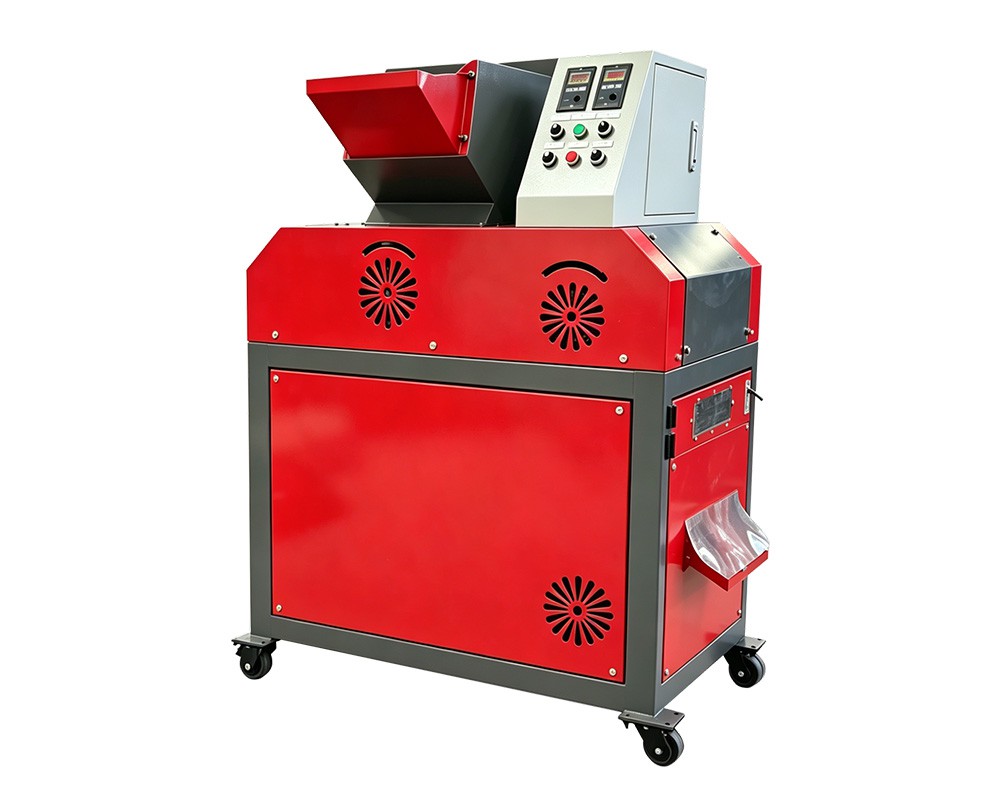
A compact dry-type granulator such as the Model 300 class is the usual first step up from manual stripping, at 100–150 kg/h.
Step 4 — Work out the real capital requirement
New entrants almost always under-budget by leaving out the items that sit around the machine. Use this as a checklist, and treat the columns as a percentage of the machine's purchase price rather than a fixed number, because both vary widely by market.
Cost item | Typical share of total project cost | Notes |
|---|---|---|
Granulation machine (incl. air separation and screening) | 45–60% | Dry type, sized to your realistic throughput, not your best-ever month. |
Transformer, cabling and switchgear | 8–15% | A 800–1,000 kg/h line can draw 45–78 kW installed; confirm your supply can carry the starting current. |
Concrete pad, canopy or building | 8–15% | Dust and weather protection, plus space to stock inbound cable and outbound product separately. |
Pre-shredder (where cable is long or bulky) | 0–12% | A low-speed twin-shaft shredder pays for itself quickly when you process long power cable or harnesses. |
Loaders, scales, packaging, hand tools | 4–8% | A forklift and accurate platform scales are not optional; you cannot manage a margin you cannot measure. |
Working capital for cable purchases | 15–25% | The most commonly forgotten line. If you cannot pay for cable on delivery you will never get priority access to good material. |
Step 5 — Licensing, permits and compliance
Requirements differ by country and often by province or state, but the same four categories appear almost everywhere: an environmental permit or registration for the storage and processing of metal waste; a business licence that covers scrap trading; an electrical installation approval for the connected load; and a fire-safety inspection of the storage and processing area.
Two practical points. First, the dust collection and plastic storage arrangements are usually the items inspected most closely — a dry granulation line produces dust and a combustible plastic fraction, and both need to be handled deliberately rather than piled in a corner. Second, choose equipment that carries recognised certification (CE, ISO or CSA as applicable to your market). It reduces the friction of inspection and it is a real signal about the build quality of the machine.
Step 6 — Site, power and material flow
Lay the site out as a one-way flow: inbound cable storage, pre-shredding, granulation, separation, copper product, plastic product, outbound. Any layout that makes material cross its own path will cost you a permanent, invisible labour penalty.
Keep two separate stock areas — one for unprocessed cable and one for finished copper granules. Mixed stock is the fastest route to a purity dispute with your buyer, and purity disputes are expensive.
Step 7 — Secure your offtake before you start the machine
Copper granules are a commodity and can be sold to smelters, metal traders, or directly to manufacturers; recovered plastic goes to plastics recyclers or processors. Approach at least three buyers before you buy equipment, ask each one for their actual specification, and get their pricing basis in writing. A granulation line running at 99%+ copper content will always find a buyer; a line producing 96% with visible plastic contamination will find a buyer who knows they have you over a barrel.
A worked example
The numbers below are illustrative — substitute your own local prices. They are presented because the pattern matters more than the digits: the copper recovery percentage and the cable purchase price dominate everything else.
Line | Figure | Comment |
|---|---|---|
Cable processed per month | 20,000 kg | one shift, 5 days/week, ~85% utilisation |
Average copper content of feed | 55% | mixed household, communication and light power cable |
Copper recovered at 99% purity | 10,780 kg | 98% of contained copper, allowing 2% loss to plastic fraction |
Recovered plastic | 9,000 kg | minus ~2% dust and fines |
Copper sale price | USD 8.20 /kg | 97% of a hypothetical USD 8.45 bare copper price |
Plastic sale price | USD 0.28 /kg | clean, low-copper PVC/PE fraction |
Cable purchase price | USD 4.35 /kg | 53% of the bare copper price for this mix |
Monthly revenue | USD 88,396 + 2,520 = 90,916 | copper granules plus plastic |
Monthly cable cost | USD 87,000 | the dominant cost |
Energy, labour, blades and maintenance | USD 5,400 | roughly 6% of copper revenue |
Indicative monthly margin | USD -1,484 to +3,000 | the honest answer: at these prices the margin is thin and every percentage point of copper recovery or purchase discount decides the outcome |
That last figure is not discouraging — it is the whole point. In this business the difference between profit and loss is a couple of percentage points. A granulation system that holds 99% copper purity instead of 97%, a blade set that keeps cutting geometry instead of smearing, and a purchase discipline that shaves 3% off the cable price are worth more than a discount on the machine.
The five mistakes that sink new cable recycling businesses
- Buying capacity before securing supply. The machine does not create cable. Contract the supply first, even if it means starting smaller.
- Ignoring the plastic fraction. Two to five per cent copper in your plastic is both lost revenue and a contamination problem. Tuning separation properly is free money.
- Running blades past their working life. Dull blades do not simply cut slowly; they smear and tear, producing more fines, more copper trapped in plastic, and a lower price for both products.
- No scales and no mass balance. If you are not weighing feed in and copper out every batch, you cannot tell whether the machine is set up well or badly — you will just slowly lose money.
- Treating the machine as the business. The machine is a tool. The business is the supply network, the offtake relationship and the discipline of the daily numbers.
Frequently Asked Questions
How much does it cost to start a cable recycling business?
It depends heavily on scale and country. As a rough structure, a compact dry-type granulator suited to 5–15 t/month might represent 45–60% of the total project cost, with power connection, site preparation, loaders and scales taking most of the remainder, and working capital for cable purchases typically adding a further 15–25%. The working-capital line is the one new entrants most often omit, and it is the one that determines whether you can buy good material when it appears.
Is cable recycling profitable?
Yes, but the margin is arithmetic rather than romantic. Buyers of insulated cable typically pay 45–65% of the bare copper price for it, and clean copper granules sell for 90–96% of bare copper. The gross spread is real, but processing cost, copper losses to the plastic fraction and purchase discipline decide whether it survives. Operators who measure feed and output every day consistently outperform those who do not.
Do I need a granulator, or can I sell cable as it is?
Selling cable unprocessed is always possible, and always at a discount — the buyer captures the liberation work you could have done. Manual stripping works for thick single-core cable but fails economically on thin and mixed wire, which is exactly the material available in the largest volumes. A dry-type granulator is what allows you to convert that difficult material into saleable copper.
What is the smallest machine that makes sense as a business?
In our experience the practical floor for a business rather than a hobby is somewhere around 100–150 kg/h, which is the range covered by the compact Model 300 class. Below that you are doing the work of a plant with the margins of a workshop. Above roughly 200 kg/h you are into the Model 350 class and above 600 kg/h into the production-class Model 660, 800 and 1000 machines.
How much space does a granulation line need?
A compact 100–150 kg/h unit can work in a good-sized unit with a concrete floor and canopy. A production-class Model 800 occupies roughly 5 m x 6 m for the machine alone and weighs about 3,800 kg; the Model 1000 footprint is around 10,000 x 8,500 x 3,000 mm at roughly 5,000 kg. Add storage area for inbound cable and separate area for outbound copper and plastic.
Plan Your Cable Recycling Business with Us
If you are planning a cable recycling business, the most useful thing we can do is stress-test your numbers before you buy anything. Tell us your cable mix, your achievable monthly tonnage and your local copper and plastic prices, and we will model the recovery and the capacity you actually need.
Send us your material description, daily tonnage and target output, and our engineering team will respond with a model recommendation, a capacity calculation and a quotation. You are also welcome to book a live video walk-through of the Henan Jiacui Intelligent Equipment Co., Ltd. factory in Zhengzhou, Henan, China, or request a reference list of installations running comparable cable or waste streams.
About the Author and the Manufacturer
This article was prepared by the technical sales and engineering team of Henan Jiacui Intelligent Equipment Co., Ltd. (brand name JIACUI). Founded in 2015 in Zhengzhou, Henan Province, China, JIACUI designs and manufactures solid waste recycling equipment and copper wire granulation systems in a 5,000 m² factory with more than 100 employees. Our equipment holds CE, ISO and CSA certification, uses ABB and Siemens control components built to European design standards, and has been delivered to more than 400 customers in over 100 countries. Factory audits have been completed with SGS, BV and TÜV. We hold 27 patents covering shredding, granulation and separation technology. Where this article quotes performance figures, those figures come from our published model specifications and from commissioning tests on real installations; actual results depend on cable composition, feed preparation and operating practice.