
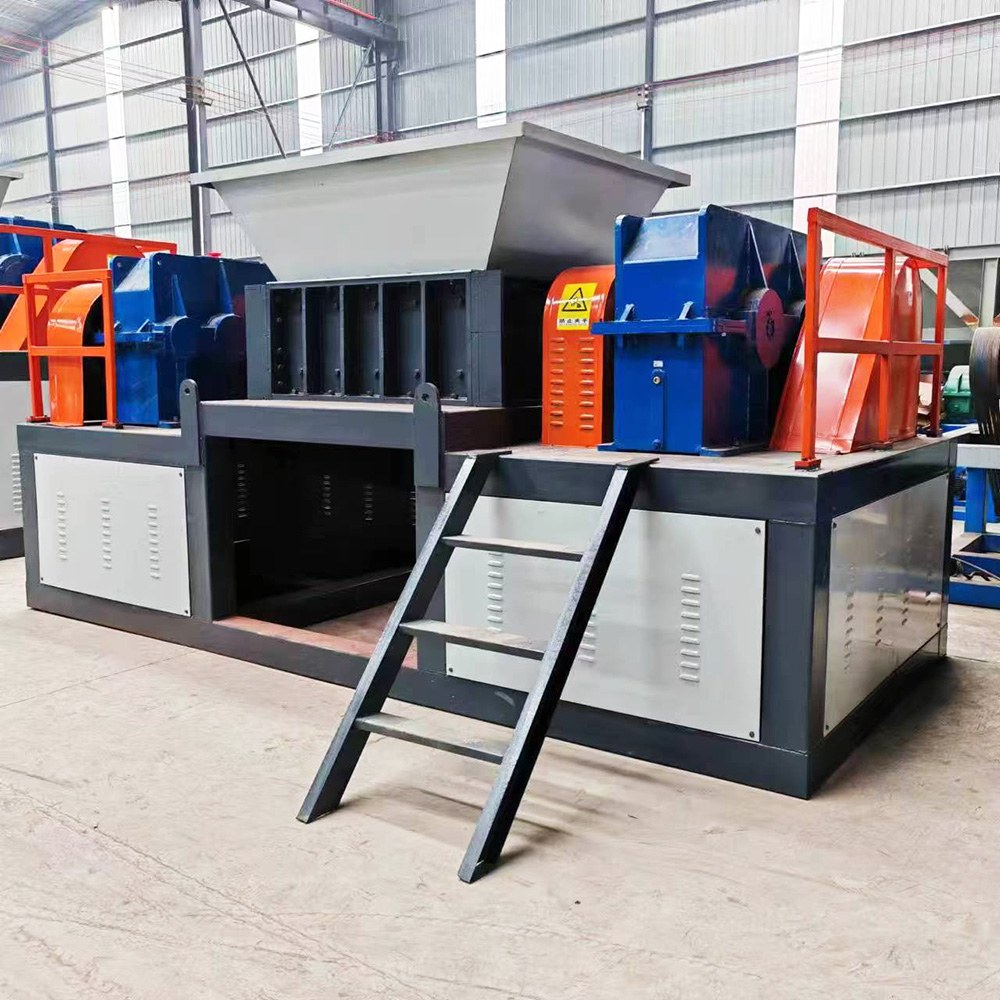
Model 1200 Double Shaft Shredder
Shredders
Model 1200 Double Shaft Shredder — 45 kW x 2 Twin-Shaft Shredder with Alloy Steel Blades. Twin-shaft low-speed high-torque shredder with 1200 x 800 mm chamber, 45 kW x 2 (90 kW total), 24 pcs Alloy steel blades at 52-54 HRC, 400 mm blade diameter. CE / ISO / CSA certified manufacturer.
Product Description
Model 1200 Double Shaft Shredder — Twin-Shaft Industrial Shredder by JIACUI
Product Overview
The Model 1200 Double Shaft Shredder is a low-speed, high-torque double shaft shredder (also called a twin-shaft or two-shaft shredder) manufactured by Henan Jiacui Intelligent Equipment Co., Ltd. It is a flagship primary size-reduction machine designed to tear bulky, mixed or contaminated solid waste into a manageable fragment size before the material moves on to granulation, screening, magnetic or eddy-current separation.
Two counter-rotating shafts, each driven by its own motor through a dedicated gear reducer, carry interlocking hooked blades. Because the machine cuts by shear and tear rather than by high-speed impact, it runs at only 10-12 rpm — slow enough to keep dust, noise and blade wear low, yet geared to deliver enough torque to pull in material that would stall a conventional granulator. Installed power is 45 kW x 2 (90 kW total), and the shredding chamber measures 1200 x 800 mm.
This model suits large-scale waste-treatment plants and continuous industrial duty. Typical throughput is 4-8 t/h with an output fragment size of roughly 50-120 mm, depending on feed material, blade condition and screen configuration.
Working Principle — Low Speed, High Torque
A double shaft shredder reduces material through four mechanical actions acting together in the cutting chamber:
1. Feed and self-gripping. Material is loaded by hand, by grab or by belt conveyor into the hopper. The hooked blade profile bites the material and pulls it inward — no hydraulic ram or pusher is needed for most feed streams.
2. Clamping and tearing. The two shafts rotate toward each other at 10-12 rpm. Because each shaft is driven independently, torque is applied to both sides of the material simultaneously, splitting large items apart rather than merely denting them.
3. Shearing and re-shearing. Blades are arranged in a staggered, meshing pattern — 24 pcs on each shaft of this model. Material is gripped at several points at once and cut repeatedly as it travels down through the chamber.
4. Discharge. Once fragments are small enough to pass the blade gap, they drop out of the bottom of the chamber onto a take-away conveyor, ready for the next process stage.
The low rotational speed matters more than it first appears. Impact crushers and hammer mills throw material against a wall at high velocity, which generates dust, noise and rapid wear. A twin-shaft unit instead applies a slow, controlled tearing force. In practice this means lower dust emissions at the feed point, noise levels that stay within a comfortable working range, and blade edges that hold their profile far longer between regrinds.
Key Features & Advantages
Automatic reverse on overload: when the control system senses a current spike caused by an unshreddable object, the shafts reverse for a few seconds to release the jam, then resume forward rotation. No operator intervention, no burned motor.
Blades are machined from Alloy steel and heat treated to 52-54 HRC — hard enough to resist abrasive wear, but not so hard that the edge chips when it meets an unexpected steel inclusion. See the metallurgy section below.
The blade profile uses a small hooked angle on the outer edge with a large-inclination triangular tooth, keyed to an internal hexagonal bore. The hexagonal bore is not a cosmetic choice: it locks the blade to the Hexagonal, Ø180 mm shaft without a keyway, spreading torque evenly around the shaft and eliminating the stress concentration that causes keyway cracking.
The reducer is coupled to the main shaft by a chain-and-sprocket flexible connection instead of a rigid coupling. This absorbs shock loads from hard inclusions and makes alignment and belt service considerably easier in the field.
Main bearings are 22232 (Wafangdian) spherical roller bearings, specified for the combination of very high radial load and the shaft deflection that is unavoidable in a shredder. Details below.
Technical Specifications
| Model | Model 1200 Double Shaft Shredder |
| Shredding chamber (L x W) | 1200 x 800 mm |
| Rotor speed | 10-12 rpm |
| Installed power | 45 kW x 2 (90 kW total) |
| Gear reducer | Square-box JZQ750 x 2 cylindrical gear reducer |
| Reducer ratio | 40.17 |
| Blade count | 24 pcs |
| Blade material | Alloy steel |
| Blade hardness | 52-54 HRC |
| Blade diameter | 400 mm |
| Blade thickness | 50 mm |
| Main shaft | Hexagonal, Ø180 mm |
| Spacer sleeves | 24 pcs |
| Main bearing | 22232 (Wafangdian) |
| Frame | 120 x 120 mm square tube, welded |
| Drive connection | Chain-and-sprocket flexible coupling between reducer and main shaft |
| Machine body | Split detachable body; chamber welded from Q235 carbon steel |
| Overload protection | Automatic reverse on overload |
| Overall dimensions (L x W x H) | 4300 x 1900 x 2000 mm |
| Machine weight | ≈ 7.5 t |
| Typical throughput* | 4-8 t/h |
| Typical output size* | 50-120 mm |
* Throughput and output size are indicative figures measured on mixed industrial waste. Actual performance depends on material density, moisture, blade sharpness and downstream configuration. Ask us for a test run with your own material before committing to a capacity guarantee.
Blade Metallurgy — Why Alloy steel at 52-54 HRC
Blade material is the single largest influence on operating cost in a shredder, so it is worth explaining the choice rather than just quoting a grade.
55SiCr is a silicon-chromium alloy spring steel defined under GB/T 1222 (unified numerical code A21553). It is broadly equivalent to JIS SUP12 and EN 54SiCr6 (1.7102), with ASTM 9254 as an approximate match. Its nominal composition is 0.51–0.59 % carbon, 1.20–1.60 % silicon, 0.50–0.80 % manganese and 0.50–0.80 % chromium.
Each element earns its place. Carbon provides the base hardness after quenching. Silicon raises the elastic limit — critical for a blade that flexes slightly under each bite — and improves temper resistance, so the edge does not soften during long runs. Chromium improves hardenability, suppresses temper brittleness and reduces decarburisation during heat treatment.
Quenched from around 860 °C and tempered in the 400–500 °C band, 55SiCr reaches a tensile strength of roughly 1450 MPa and a yield strength near 1300 MPa. Holding the blades in the 52-54 HRC window is a deliberate compromise: hard enough that abrasive fillers, glass and mineral contamination do not round the edge quickly, yet tough enough that the edge deforms rather than shatters when a bolt or bearing race goes through the chamber. Blades that are specified harder — say 60 HRC and above — cut beautifully for a short time and then chip catastrophically in real waste streams.
Drive Train and Bearing Selection
Power from each motor passes through a Square-box JZQ750 x 2 cylindrical gear reducer, converting high motor speed into the low-speed, high-torque output the shafts need. A chain-and-sprocket connection then transfers that torque to the shaft while allowing a small amount of angular misalignment and damping shock loads.
The main shafts run in 22232 (Wafangdian) spherical roller bearings sourced from Wafangdian, China's oldest bearing-manufacturing base. A spherical roller bearing is the correct choice here for three reasons. It carries very high radial load in a compact envelope. Its self-aligning geometry tolerates shaft deflection and housing misalignment, which matters because a shredder shaft is loaded unevenly along its length and will bend slightly under peak torque. And its double-row construction absorbs the axial thrust that builds up when material is pulled toward one end of the chamber. Running a shredder on ordinary deep-groove ball bearings is a well-known shortcut that leads to premature failure.
Typical Applications
The Model 1200 Double Shaft Shredder is sized for Municipal solid waste, bulky refuse, tyres, RDF, industrial rejects. In the wider JIACUI product range, twin-shaft shredders of this family are deployed for:
Cable and wire recycling — opening bundled scrap cable before it enters a copper wire granulator, so the granulator sees a consistent feed and delivers higher copper purity.
WEEE and e-waste — liberating metals from housings, circuit boards, radiators and small appliances.
Plastics — purgings, drums, pipes, film bales and thick-wall mouldings before washing and re-granulation.
Rubber and tyres — primary shredding of car and truck tyres into chips for further granulation or TDF (tyre-derived fuel).
Wood and biomass — pallets, demolition timber, tree trimmings and furniture waste.
Municipal solid waste and RDF — reducing bulky household and commercial refuse, and preparing refuse-derived fuel feedstock.
Light metal — aluminium profiles, cans, swarf briquettes and thin steel sheet.
Maintenance and Blade Service Life
Blade life is the question every buyer asks, and the honest answer is that it depends almost entirely on what you feed the machine. On clean plastic or wood, blades can run for many months between regrinds. On mixed municipal waste with glass and grit, expect to inspect every few weeks.
Inspect rather than schedule. Open the chamber and look at the blade edges. Dull, rounded edges waste power and produce oversize output long before they visibly fail.
Watch motor current. A steady rise in running amperage at the same feed rate means the blades are dulling.
Let the reverse function work. If the machine reverses repeatedly on a given load, the feed contains something it cannot process — remove it instead of forcing the machine.
Grease the bearings on the recommended interval. Bearing failure is the most common cause of unplanned shredder downtime, and it is almost always a lubrication problem rather than a load problem.
Rotate or replace blades in sets so wear stays even across the shaft. Mixing new and worn blades unbalances the rotor and shortens bearing life.
Why Buy from JIACUI
Founded in 2015 and based in Zhengzhou, Henan, Henan Jiacui Intelligent Equipment Co., Ltd. operates a 5,000 m² production facility with more than 100 employees and holds 27 patents on recycling equipment.
Machines carry CE, ISO and CSA certification — the three standards that matter when equipment must clear customs and insurance inspection in Europe and North America.
Control systems are built on ABB and Siemens components to European design practice, so spare parts are obtainable locally almost anywhere in the world.
Factory acceptance testing and third-party inspection by SGS, Bureau Veritas or TÜV can be arranged before shipment.
We have supplied equipment to customers in more than 100 countries, with installation, commissioning and operator training handled by our own mechanical, hydraulic and electrical engineers.
Frequently Asked Questions
What is the difference between a single-shaft and a double-shaft
shredder?
A single-shaft machine uses one rotor working against a fixed counter-blade, with a
screen underneath to control the final particle size precisely. A double-shaft machine uses two
counter-rotating shafts that tear material by shear, with no screen. The double-shaft design handles
bulkier, tougher and more contaminated feed; the single-shaft design gives a more tightly controlled output
size. If your line needs a specific final size, put a granulator after this shredder.
Can it process metal?
Yes, light-gauge metal — aluminium
profiles, cans, thin sheet, swarf briquettes — is well within scope. Solid steel billets, thick plate and
rebar are not; those belong in a shear or a hammer mill, and feeding them will damage the blades.
What output size should I expect?
Roughly
50-120 mm for this model, controlled by blade thickness and gap rather than by a screen. If you need
a tighter specification, tell us the target and we will configure the blade gap and recommend a downstream
granulator to hit it.
How long do the blades last?
Anywhere from a few weeks to
over a year, depending almost entirely on how abrasive and contaminated your feed is. We will quote an
expected blade life once we know your material — and we would rather give a conservative figure than an
optimistic one.
Do you provide installation and training?
Yes. Our
engineers handle on-site installation, commissioning and operator training, and we provide lifetime
technical consultation for every machine we sell.
Get a Quotation
Tell us your material type, required capacity and target output size, and we will size the machine, configure the blades and build the line around it. Material test runs are available before you commit.
Contact Henan Jiacui Intelligent Equipment Co., Ltd. — factory in Zhengzhou, Henan, China. Video calls, factory audits and third-party inspections are welcome.