
How to Choose the Right Copper Wire Granulator Machine: Capacity & Budget Guide
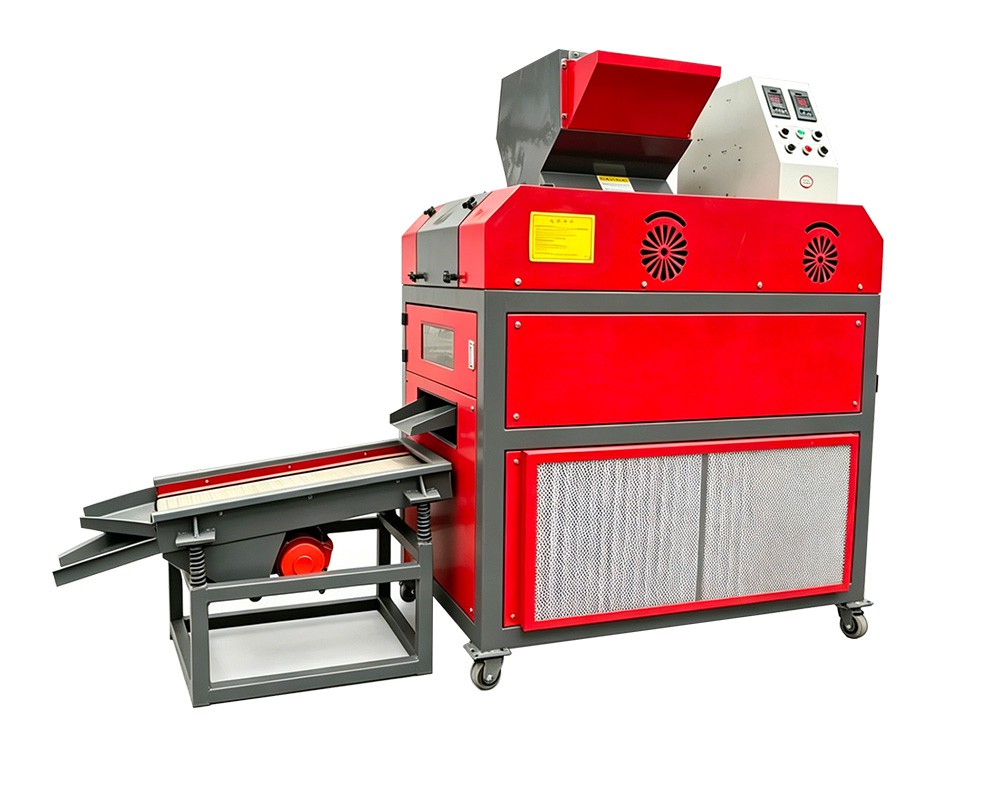
How to Choose the Right Copper Wire Granulator Machine: Capacity & Budget Guide
Published in News & Insights · Buying & Selection Guides
By Henan Jiacui Intelligent Equipment Co., Ltd.
Choosing a copper wire granulator goes wrong in a predictable way. A buyer starts from the machine catalogue, finds a model with an attractive price, and works backwards to justify it. The result is usually one of two problems: a machine that cannot keep up with the material the buyer can actually source, or a machine so oversized that its finance and power costs eat the margin it was bought to create.
The reliable method is to start from two numbers you already have or can measure in a week, then let those numbers select the machine. This guide walks through that method, then through the four layers of budget that a real purchase decision includes — most buyers only ever consider the first.
Start with the two numbers you already have
Everything about machine selection follows from two inputs: how much cable you can reliably obtain per month, and what that cable is made of. Neither requires a machine to measure.
Input | How to establish it | Why it dominates the decision |
|---|---|---|
Reliable monthly cable tonnage | List every source, ask each for a conservative monthly figure, and add them up. Then use 70% of the total. | Determines the capacity class. A machine sized above your real supply spends most of its life idle while still incurring finance, power and space cost. |
Cable mix by type and copper content | Sort a representative 200–500 kg sample into household wire, communication cable, power cable, harness and mixed/miscellaneous, and weigh each fraction. | Determines the process configuration. Thin, mixed and heavily insulated cable needs different screen apertures, separation settings and often a pre-shredding stage. |
What 'kg/h' actually means
Published capacity figures are honest, but they are measured under defined conditions: continuous feed, a favourable material mix, a correctly sharpened blade set and a machine that is not stopping every twenty minutes. Your achievable hourly rate will be lower, and you should plan on the lower number.
Model | Typical capacity | Main power | Best suited to | Feed width |
|---|---|---|---|---|
Model 46-A (RC46A) | 60–80 kg/h | compact single unit | small workshops, single-phase-mix household wire | up to 12 mm cable |
Model 300 (RC300) | 100–150 kg/h | compact single unit | start-up recyclers, mixed thin wire | up to 20 mm cable |
Model 350 (RC350) | 200–220 kg/h | 5.5 kW main unit | growing yards stepping up from manual stripping | up to 30 mm cable |
Model 400 (RC400) | 300–400 kg/h | mid-range line | multi-shift commercial yards | up to 40 mm cable |
Model 660 (RC-CWG660) | 600–650 kg/h | 40.24 kW installed | production-class yards, WEEE processors | up to 60 mm cable |
Model 800 (RC-CWG800) | 700–900 kg/h | 45 kW main unit | large yards, cable manufacturers' off-cuts | up to 80 mm cable |
Model 1000 (RC-CWG1000) | 900–1,000 kg/h | 77.48 kW installed | industrial plants, scrap exporters | up to 100 mm cable |
Note the pattern: capacity roughly triples between the compact class and the production class, and installed power does not rise proportionally — a well-designed 900–1,000 kg/h line is considerably more efficient per tonne than three compact units doing the same work, which is one of the strongest arguments for buying capacity once you have secured supply.
The three capacity traps
Trap 1 — Sizing for your best month instead of your average month
Cable supply is lumpy. One demolition contract can double your tonnage for two months and then vanish. Sizing for the peak leaves you with an idle machine for most of the year; sizing for the trough leaves you with material you cannot process. The workable compromise is to size for a realistic average plus a defined amount of overtime or a second shift, and to keep the ability to sell surplus cable rather than store it.
Trap 2 — Forgetting that mixed and thin feed runs slower
The same machine that holds 1,000 kg/h on clean power cable will typically run substantially slower on fine and heavily insulated material, because more volume has to pass through the separation stage for each kilogram of copper recovered. If your mix is 40% fine wire, plan on a lower effective rate — and consider whether a pre-shredder is needed to keep the granulator fed consistently.
Trap 3 — Assuming continuous uptime
Blade changes, screen cleaning, feed jams, dust bin emptying and shift changes all consume time. A realistic planning figure for a well-run single-shift operation is around 85% availability. Multiply your capacity class by your working hours and by 0.85 — that, not the datasheet figure, is your monthly output.
The specification that matters more than capacity: purity
Copper granule price is a function of copper content. The difference between a 97% product and a 99.5% product is not cosmetic; it is a move between two price grades, and on 10 tonnes a month it is a material amount of money. When comparing machines, ask for the copper content figure the supplier is prepared to state, the test method behind it, and whether the machine has independent air-separation control or a single fixed fan.
- Fixed single-fan separation is adequate for a consistent, single-type feed such as clean household wire, and it is cheaper.
- Adjustable, variable-speed separation is what lets you move between thick power cable and capillary wire on the same machine without losing copper to the plastic outlet. If your feed mix varies, this is the option worth paying for.
- Multi-stage separation (a second, gentler pass over the plastic outlet) is the configuration that turns a 98% product into a 99%+ product on difficult material.
Budget: the four layers, not one
The purchase price is usually between half and two-thirds of what you will actually spend. Plan against all four layers or the project will be underfunded at exactly the wrong moment.
Layer | What it contains | Typical share of project cost |
|---|---|---|
1. Purchase | Granulator, air separation, screening, control panel, delivery | 45–60% |
2. Installation | Power connection and switchgear, foundations, canopy or building, lifting and commissioning | 15–30% |
3. Operating | Power, labour, blades and wear parts, maintenance, dust disposal | 3–8% of copper revenue, ongoing |
4. Working capital | Cash to buy cable before you sell copper — typically 3–6 weeks of purchase volume | 15–25% of project cost |
The fourth layer is the one that most often kills an otherwise sound project. A granulator that cannot be fed is worthless, and priority access to good cable goes to buyers who pay promptly.
Matching the model to the situation
Your situation | Recommended class | Why |
|---|---|---|
Testing the market, under 5 t/month, clean household wire | Model 46-A or Model 300 (60–150 kg/h) | Low capital, low power, quick to commission; can be upgraded later without abandoning the business model |
Steady 5–20 t/month, mixed cable, single shift | Model 350 to Model 400 (200–400 kg/h) | The sweet spot for a commercial yard: meaningful throughput without a production-class power requirement |
20–60 t/month, mixed feed including fine wire, two shifts | Model 660 (600–650 kg/h) with pre-shredder | Production-class reliability and enough separation control for variable feed |
Over 60 t/month, or cable manufacturer off-cut recovery | Model 800 or Model 1000 (700–1,000 kg/h) | Installed power of 45–77 kW and heavy chassis built for continuous multi-shift duty |
The 200–400 kg/h class is the most common choice for a commercial yard running a single shift.
Options worth paying for — and options that are not
Option | Verdict | Reasoning |
|---|---|---|
Variable-frequency air separation | Worth it | The single biggest lever on product purity and the only way to handle mixed feed on one machine |
Pre-shredding stage | Worth it above 200 kg/h, or whenever fine wire is in the mix | Protects the granulator, prevents wrapping, stabilises feed rate |
Closed dust collection | Worth it, always | Compliance, housekeeping and copper recovery in one item |
Oversized motor 'for headroom' | Usually not worth it | Excess power does not increase throughput; it increases your electricity bill and your connected-load cost |
Automatic feeding conveyor | Depends on scale | Pays for itself above roughly 300 kg/h by removing a full-time labour position |
Non-standard bespoke control system | Rarely worth it | Standard ABB or Siemens components are easier and cheaper to support anywhere in the world than a proprietary controller |
A decision sequence you can actually follow
- Measure a 200–500 kg representative sample of your cable and calculate the copper content by weight.
- Establish a conservative monthly tonnage from written source commitments, then take 70% of it.
- Calculate the required hourly rate at your intended shift pattern and 85% availability.
- Select the lowest capacity class that meets that rate — then confirm the class above is not a better long-term buy.
- Decide whether your feed mix requires a pre-shredder, variable-speed separation, or both.
- Obtain a written performance statement — throughput, copper content, plastic residue — with the test method and the acceptance conditions.
- Budget all four cost layers, including working capital, before signing anything.
- Confirm the spare-parts list and lead times for blades, screens and wear plates.
Frequently Asked Questions
How do I calculate what capacity I need?
Divide your conservative monthly tonnage by your monthly operating hours, then divide again by about 0.85 to allow for blade changes, cleaning and feed interruptions. A yard expecting 12 tonnes a month on one shift (about 160 hours) needs roughly 88 kg/h of effective capacity, which points to the 100–150 kg/h class once the utilisation allowance is included — not to a machine rated at exactly 88 kg/h.
Is a bigger machine always more efficient?
Per tonne, yes — energy and labour per kilogram of copper recovered fall as capacity rises, and one 900 kg/h line is more efficient than three compact units doing the same work. But only if you can feed it. An oversized machine carries finance, power and space costs whether it is running or not, which is why capacity should follow secured supply rather than anticipate it.
What is the difference in price between a compact and a production-class granulator?
As a rule of thumb the production class costs several times a compact unit, and that multiple is broadly consistent with the roughly tenfold increase in throughput. The comparison only becomes meaningful when it is expressed as cost per tonne of monthly capacity including power and installation, which is how we would encourage you to compare quotations from any supplier.
Do I need a pre-shredder as well as a granulator?
For clean household and thick power cable, often not. For long power cable, automotive harness, or any significant proportion of fine and capillary wire, a pre-shredder is the difference between a granulator that runs smoothly and one that jams, wraps and produces excessive fines. Above roughly 200 kg/h the productivity gain usually justifies it on its own.
How long does it take to get a machine installed and running?
For standard models, manufacturing and shipping typically dominate the timeline, with site preparation — power connection and foundations — running in parallel. Commissioning itself is fast when the site is ready. The practical advice is to start the electrical and civil work as soon as the layout drawing is agreed rather than waiting for the machine to arrive.
Get a Capacity and Budget Recommendation
Send us your sample analysis and your conservative monthly tonnage and we will specify the lowest-capacity class that meets it, price the options that genuinely change your numbers, and give you the throughput and purity figures we are prepared to stand behind.
Send us your material description, daily tonnage and target output, and our engineering team will respond with a model recommendation, a capacity calculation and a quotation. You are also welcome to book a live video walk-through of the Henan Jiacui Intelligent Equipment Co., Ltd. factory in Zhengzhou, Henan, China, or request a reference list of installations running comparable cable or waste streams.
About the Author and the Manufacturer
This article was prepared by the technical sales and engineering team of Henan Jiacui Intelligent Equipment Co., Ltd. (brand name JIACUI). Founded in 2015 in Zhengzhou, Henan Province, China, JIACUI designs and manufactures solid waste recycling equipment and copper wire granulation systems in a 5,000 m² factory with more than 100 employees. Our equipment holds CE, ISO and CSA certification, uses ABB and Siemens control components built to European design standards, and has been delivered to more than 400 customers in over 100 countries. Factory audits have been completed with SGS, BV and TÜV. We hold 27 patents covering shredding, granulation and separation technology. Where this article quotes performance figures, those figures come from our published model specifications and from commissioning tests on real installations; actual results depend on cable composition, feed preparation and operating practice.