
Factory Test Video: Running 500kg/h Cable Granulation Line for European Client
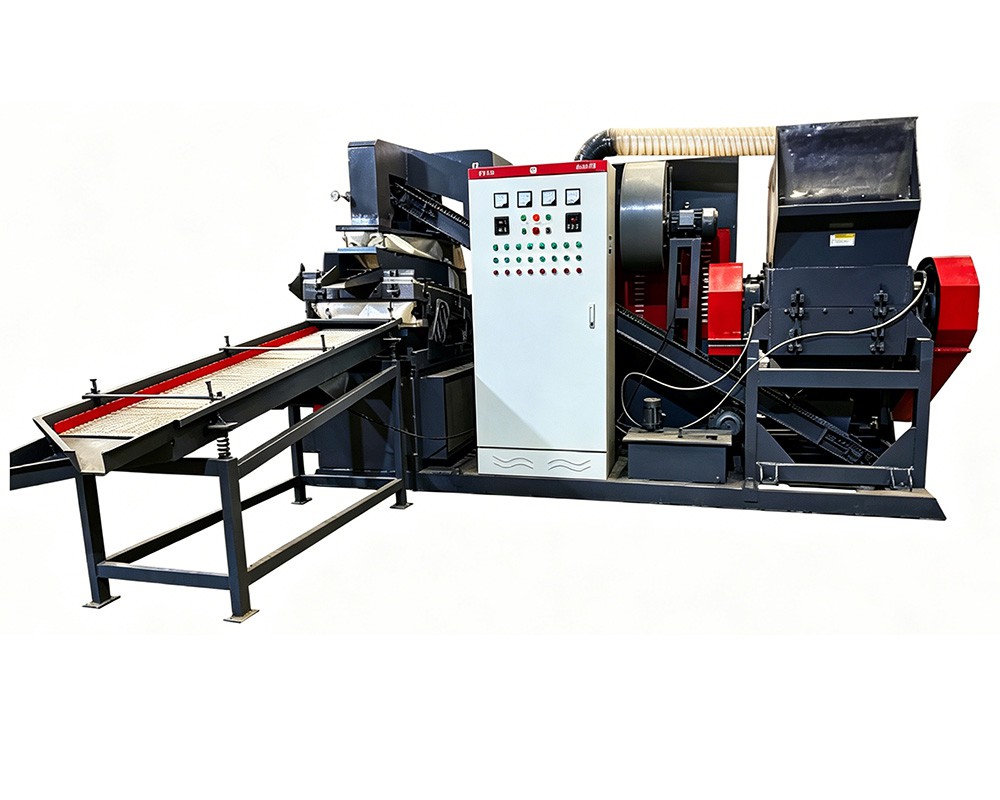
Factory Test Video: Running 500kg/h Cable Granulation Line for European Client
Published in News & Insights · Company News
By Henan Jiacui Intelligent Equipment Co., Ltd.
Last month the JIACUI factory in Zhengzhou ran a factory acceptance test on a dry-type cable granulation line for a recycling customer in Europe. The contractual requirement was a sustained 500 kg/h on the customer’s own material mix, with a copper product specification their smelter would accept. This article explains what was tested, what the numbers were, and what changed as a result — because a factory test that produces no engineering changes is usually a test that was designed to be passed rather than to find problems.
The brief
The customer operates a cable and WEEE processing yard and was replacing a manual stripping operation plus an ageing granulator. Their requirements were specific, which is what made the test worth running properly:
- Sustained throughput of at least 500 kg/h on their actual feed mix, not on clean demonstration cable.
- Copper product acceptable to a European smelter without a treatment charge for contamination.
- A dry process — no water discharge, because their site has no discharge consent and obtaining one would have delayed the project by a year.
- Dust capture sufficient for an indoor installation in a residential-adjacent industrial zone.
- Documentation for a CE-marked installation and a traceable output specification.
Why we specified a larger model than the target throughput
The 500 kg/h requirement sits inside the rated range of the RC-CWG660, which is specified at 600–650 kg/h with 40.24 kW installed and 14 SKD-11 blades. We could have quoted a machine rated at exactly 500 kg/h. We did not, for three reasons:
- Rated capacity assumes favourable feed. A machine rated at 500 kg/h on mixed household cable will not deliver 500 kg/h on a mix containing harness scrap and fine communication wire, because preparation and separation both take longer per kilogram.
- Headroom protects the guarantee. Running a machine at 100% of rating to hit a contractual number leaves nothing for the days when material is difficult, and it accelerates wear.
- Growth is cheaper than replacement. A customer who outgrows a machine in two years buys twice. Specifying one tier up costs less than the resale loss on a premature replacement.
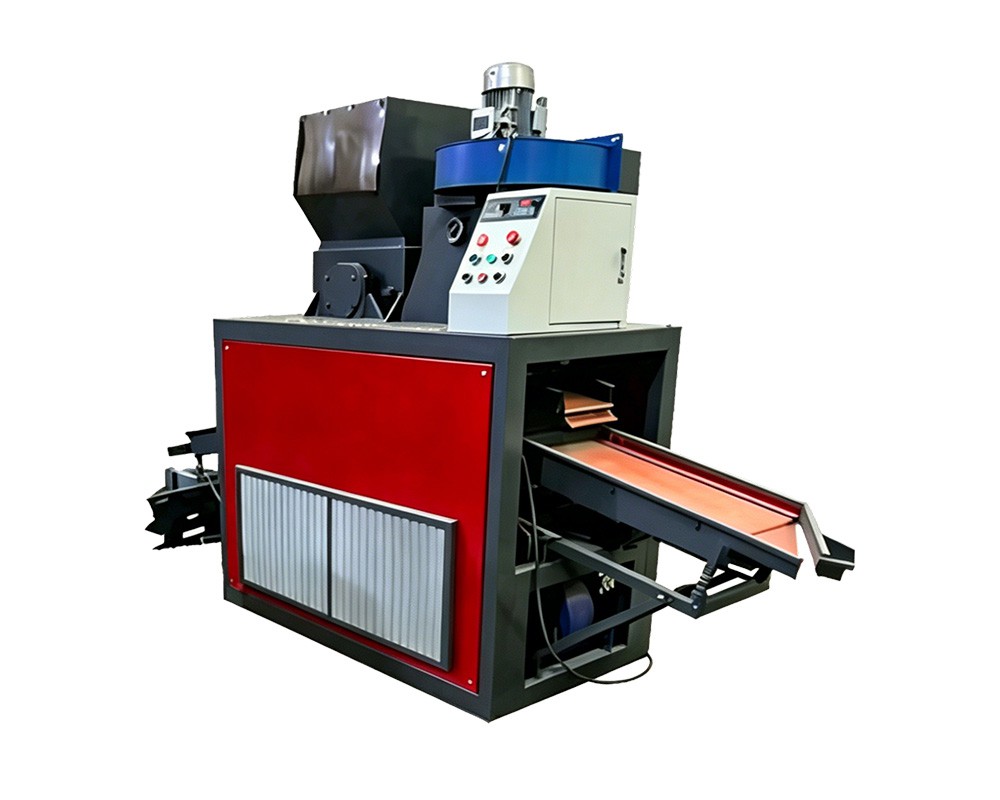
Factory acceptance testing is run on the customer’s own material, not demonstration cable.
What was actually tested
The test material was shipped by the customer: approximately 4 tonnes of their normal intake, supplied in the proportions they actually process, not pre-sorted for the demonstration.
Material in the test batch | Approximate share | Why it was included |
|---|---|---|
Mixed household and installation cable | 45% | Baseline material; sets the throughput expectation |
Communication and data cable | 20% | Fine conductors; the hardest fraction for air separation |
Automotive harness off-cuts | 20% | Tape, sleeving and connectors; stresses liberation and blade condition |
Thick single-core power cable | 15% | Tests feed width at the upper end of the model’s range (up to 60 mm) |
Test results
Measurements were taken over a four-hour steady-state run after a warm-up period, with input and both outputs weighed continuously and samples taken at hourly intervals.
Parameter | Result | Contract requirement |
|---|---|---|
Sustained throughput | about 560 kg/h average over four hours | at least 500 kg/h |
Installed power | 40.24 kW | — |
Copper content of copper product | 98.6–99.1% across hourly samples | smelter specification |
Copper content of plastic tail | 3.4% average | reported, not specified |
Granulate size | predominantly 2–5 mm | 2–5 mm |
Dust | captured at granulator, separator and screen; no visible emission in the shed | indoor installation |
Water discharge | none | no discharge consent available |
Two honest notes on those figures. First, 560 kg/h is an average over a four-hour run with prepared feed; a full shift with real-world interruptions will be lower, and we told the customer that plainly. Second, the 3.4% copper in the plastic tail is a real loss, not a rounding error. On this material it was within the range we consider normal for a two-stage line, but it is the number we recommend the customer track monthly, because it is where margin leaks.
What the test changed
Three things came out of the run that would not have come out of a demonstration on clean cable.
1. The pre-shredder discharge gap was opened slightly
Harness off-cuts were producing a slightly wide particle distribution after pre-shredding, which made the granulator’s feed rate less consistent than we wanted. Opening the discharge gap produced a more uniform 30–50 mm segment and stabilised the amp draw. Throughput improved marginally; consistency improved noticeably.
2. The magnetic separator was moved downstream of the pre-shredder
In the original layout the magnet sat ahead of pre-shredding. On bundled harness material, steel clips were still enclosed inside bundles and passed through. Moving the magnet to the pre-shredded stream exposed the ferrous fraction properly. This is now our standard arrangement for any line expected to run harness material.
3. The screen cleaning interval was specified, not left to the operator
Adhesive tape from the harness fraction caused partial blinding over roughly 90 minutes of continuous running. Rather than accept a throughput dip and recovery cycle, we specified a defined screen inspection interval for this material mix and noted it in the operating manual. It is a five-minute task that protects a five-figure monthly copper recovery.
What a factory acceptance test should include
If you are commissioning equipment from any supplier, these are the items worth insisting on. A supplier who resists them is telling you something.
- Your own material, in your own proportions. Not demonstration cable.
- A sustained run — four hours minimum — not a fifteen-minute demonstration.
- Weighed input and weighed outputs, so the mass balance can be checked.
- Hourly samples of both outputs, retained and labelled so they can be assayed independently.
- Power draw recorded, not estimated, so the operating cost can be modelled.
- A written record of every setting used, so the customer can reproduce the result after shipping.
- Video of the run, so that the record survives the departure of the engineers who ran it.
How we run these tests
Customers are welcome to attend in person or to join by live video. We run the line on their material, take the measurements above, and provide the settings sheet, the sampling record and the video with the shipping documents. If the result does not meet the contractual figure, the conversation happens before the machine leaves Zhengzhou rather than after it arrives — which is the entire point of a factory acceptance test.
We also tell customers what the test cannot tell them: how their material will behave in a different season, with a different operator, or after the blades have been in service for three months. Those are operational variables, and the only honest way to handle them is to log production data from the first shift and compare it against the acceptance record.
Frequently Asked Questions
Can I send my own material for a factory test?
Yes, and we prefer it. A batch of three to five tonnes is usually enough to cover a four-hour run plus sampling, depending on bulk density. We will tell you the quantity and packing requirements once we know your material type.
Is the 500 kg/h figure guaranteed?
Throughput guarantees are given against a defined material specification, because throughput depends heavily on composition, preparation and cable diameter. We state the model rating, the test result on the customer’s material, and the conditions under which the guarantee applies. A guarantee without a material definition is not a guarantee.
Can I watch the test remotely?
Yes. We run tests with a live video link and record the session. You can see the feed, the discharge points and the instruments in real time, and ask for specific samples to be taken.
What documentation comes with the machine?
Operating and maintenance manuals, the settings sheet from the acceptance test, electrical drawings, the certification package (our equipment holds CE, ISO and CSA certification), and the sampling record from the test run.
Arrange a Factory Acceptance Test
If you are specifying a line and want it tested on your own material before shipment, tell us the material mix, the throughput you need to sustain and your target copper specification. We will propose a test plan and a model, and we will tell you if the throughput you have asked for is not realistic on your feed.
Send us your material description, daily tonnage and target output, and our engineering team will respond with a model recommendation, a capacity calculation and a quotation. You are also welcome to book a live video walk-through of the Henan Jiacui Intelligent Equipment Co., Ltd. factory in Zhengzhou, Henan, China, or request a reference list of installations running comparable cable or waste streams.
About the Author and the Manufacturer
This article was prepared by the technical sales and engineering team of Henan Jiacui Intelligent Equipment Co., Ltd. (brand name JIACUI). Founded in 2015 in Zhengzhou, Henan Province, China, JIACUI designs and manufactures solid waste recycling equipment and copper wire granulation systems in a 5,000 m² factory with more than 100 employees. Our equipment holds CE, ISO and CSA certification, uses ABB and Siemens control components built to European design standards, and has been delivered to more than 400 customers in over 100 countries. Factory audits have been completed with SGS, BV and TÜV. We hold 27 patents covering shredding, granulation and separation technology. Where this article quotes performance figures, those figures come from our published model specifications and from commissioning tests on real installations; actual results depend on cable composition, feed preparation and operating practice.