
Copper Recycling Enters a New Era: Why Cable Granulation Is Becoming More Important in 2026
Copper Recycling Enters a New Era: Why Cable Granulation Is Becoming More Important in 2026
September 2026 | Industry News & Recycling Technology
The global copper market is entering a period of heightened attention. Copper prices recently approached record levels, while changing trade flows and concerns about long-term supply are encouraging manufacturers and recyclers to look more closely at secondary copper resources.
At the same time, governments are putting greater emphasis on circular economy development and the recovery of valuable materials from waste.
For the recycling industry, this creates an important opportunity: old electrical wires and cables are no longer simply waste. They are a source of recoverable copper.
One of the technologies helping recyclers turn this opportunity into a practical business is the copper wire granulator.
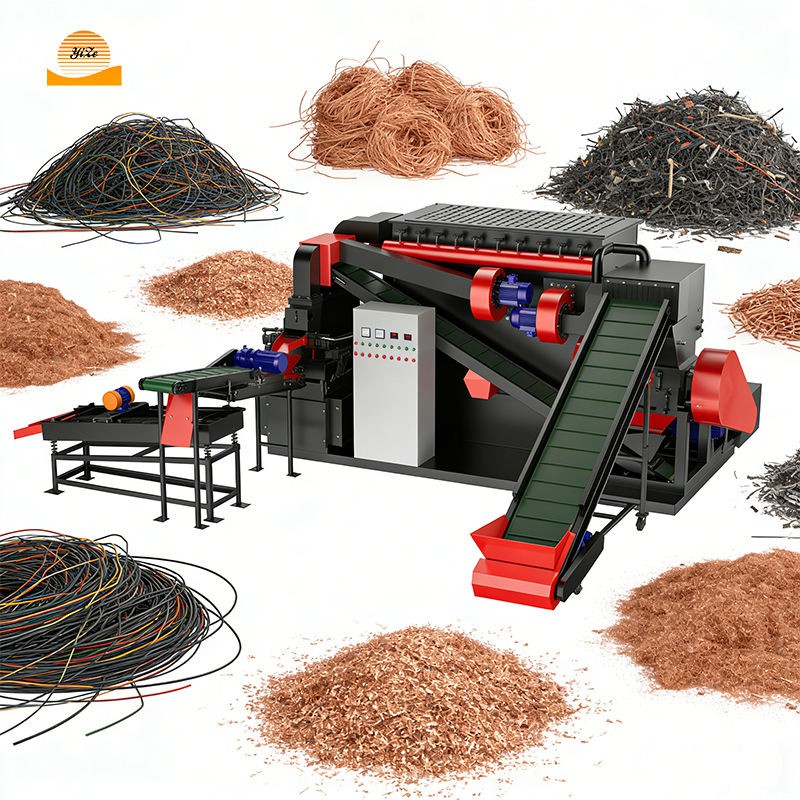
Chinese recycling equipment manufacturer Henan Jiacui Intelligent Equipment Co., Ltd. (JIACUI) manufactures copper wire granulators designed for processing scrap copper wires and cables into separated copper granules and non-metallic material.
Copper Supply Is Becoming a Strategic Issue
Copper is essential to modern infrastructure, including power transmission, electrical equipment, renewable energy systems, electric vehicles, construction and industrial manufacturing.
However, increasing demand is occurring alongside uncertainty in global supply chains.
In August 2026, Reuters reported that copper prices on the London Metal Exchange rose close to an all-time high, with the market being influenced by U.S. tariff uncertainty, changing global trade flows and supply concerns.
This does not mean that recycling can replace primary copper mining. Instead, it highlights the economic importance of recovering copper that is already in circulation.
For scrap dealers, cable recyclers, waste management companies and metal recovery businesses, this creates a straightforward question:
How can copper contained in discarded cables be recovered efficiently and converted into a marketable secondary raw material?
Europe Is Increasing Its Focus on Secondary Raw Materials
The shift toward recycling is not only driven by commodity prices.
European policymakers are increasingly treating waste recovery as part of industrial competitiveness and resource security.
The European Commission's upcoming Circular Economy Act is intended to increase the supply of high-quality recycled materials, stimulate demand for secondary raw materials and reduce dependence on imported primary resources. The Commission currently reports an EU circular material use rate of approximately 11.8%, with an ambition to reach 24% by 2030.
The European Commission's Joint Research Centre also identified waste streams including electrical equipment and cables as having significant potential for recovering valuable raw materials. The report emphasizes that improved waste collection and processing can help increase domestic supplies of secondary materials and reduce dependence on external sources.
Meanwhile, the revised EU Waste Shipment Regulation and the new DIWASS digital platform entered into application in May 2026, strengthening traceability and management of cross-border waste movements and supporting the recovery of secondary raw materials.
These developments point to a broader industrial trend:
Waste processing is increasingly becoming part of the raw-material supply chain.
Why Scrap Cables Are an Attractive Recycling Feedstock
Discarded electrical wires and cables typically consist of valuable conductive metal surrounded by insulating materials such as plastic.
The challenge for recyclers is not simply to cut the cable into smaller pieces. The valuable metal needs to be separated from the insulation so that the recovered copper can enter the next stage of the recycling chain.
This is where a copper wire granulator can provide a practical solution.
A typical cable recycling process may involve:
Scrap cable feeding → shredding/granulation → material separation → copper granules → collection of non-metallic material
The objective is to transform mixed cable scrap into more manageable and reusable material streams.
For recycling companies, the advantages can include:
Turning low-value or difficult-to-handle cable scrap into a recoverable copper product
Separating copper from plastic insulation
Improving the handling and storage of recovered materials
Supporting a more circular use of copper resources
Creating an additional revenue stream from scrap cable processing
Actual recovery results depend on the type, composition, diameter and condition of the incoming cable, as well as the configuration and operating conditions of the recycling line.
JIACUI Copper Wire Granulators: From Scrap Cable to Recovered Copper
Against this background, JIACUI provides a range of Copper Wire Granulators for different processing capacities.
According to JIACUI's technical specifications, its product range includes compact models as well as larger-capacity systems, allowing recycling businesses to select equipment according to their material volume and operating requirements.
For smaller-scale operations, the RC-CWG46A is specified with a processing capacity of approximately 60–80 kg/h, while the larger RC-CWG260 is specified at approximately 150–170 kg/h. The two models have total power ratings of 5.58 kW and 9.05 kW respectively.
For businesses handling larger quantities of scrap cable, JIACUI's range extends to higher-capacity equipment.
The RC-CWG400 is specified at approximately 350–400 kg/h, while the RC-CWG660 is specified at approximately 600–650 kg/h. Both models use SKD-11 blades according to the company's technical documentation.
At the higher end of the range, the RC-CWG800 is specified at approximately 700–900 kg/h, while the RC-CWG1000 is specified at approximately 900–1,000 kg/h.
This range is particularly relevant for recyclers because equipment selection should be based on the actual feedstock and required throughput rather than simply choosing the largest available machine.
Choosing a Copper Wire Granulator: Capacity Is Not the Only Factor
For an overseas recycling business considering a copper wire granulator, processing capacity is an important starting point, but it should not be the only consideration.
1. What Type of Cable Will Be Processed?
Different cable types can have different structures, copper contents, insulation materials and diameters.
A machine suitable for relatively uniform scrap wire may not necessarily be the ideal choice for mixed or more complicated cable feedstock.
Before purchasing equipment, recyclers should evaluate the actual cable materials they expect to process.
2. What Is the Required Throughput?
A small scrap dealer may only need tens or hundreds of kilograms per hour, while a larger recycling operation may require several hundred kilograms or close to one tonne per hour.
JIACUI's current product specifications cover a broad capacity range, from approximately 60–80 kg/h for the RC-CWG46A to approximately 900–1,000 kg/h for the RC-CWG1000.
The appropriate model should therefore be matched to the buyer's expected feedstock volume, working hours and available installation space.
3. What Are the Local Power Requirements?
Electrical standards differ between markets.
JIACUI's specifications include both 220 V and 380 V configurations, with some models listed as customizable. For example, the RC-CWG300 is specified for 220 V/380 V, 50 Hz, while the RC-CWG660 and RC-CWG1000 are specified for 380 V, 50 Hz with customization indicated in the documentation.
This makes it important for buyers to confirm electrical requirements before placing an equipment order.
4. What Happens to the Recovered Material?
The purpose of cable recycling is not simply size reduction.
A commercially useful recycling process needs to produce separated material streams that can move into subsequent recycling or material-processing stages.
For this reason, separation performance, feedstock compatibility, equipment configuration and operating conditions should all be considered when evaluating a cable recycling machine.
A More Circular Future for Copper
The concept behind copper wire granulation is closely aligned with the broader development of the circular economy.
Instead of following a linear model of:
Mine → manufacture → use → discard
recycling creates another pathway:
Use → collect → process → recover copper → reuse
This approach can help keep valuable materials in circulation for longer.
The European Commission has explicitly identified improved recycling and recovery of materials from waste as an important part of strengthening resource efficiency and supply security. Its work on the Circular Economy Act also places greater emphasis on developing markets for secondary raw materials.
For cable recyclers, the opportunity is therefore larger than simply handling waste.
It is about becoming part of a growing secondary raw-material supply chain.
JIACUI's Approach to Cable Recycling Equipment
JIACUI, formally Henan Jiacui Intelligent Equipment Co., Ltd., is based in Zhengzhou, Henan, China. Its product documentation covers copper wire granulators across multiple processing capacities, from compact machines to larger industrial models.
The company's copper wire granulator range includes models such as:
RC-CWG46A
RC-CWG260
RC-CWG300
RC-CWG350
RC-CWG400
RC-CWG660
RC-CWG800
RC-CWG1000
The published specifications show different machine dimensions, motor configurations, blade quantities, power requirements and processing capacities across the range.
This allows the equipment selection process to begin with a practical question:
How much cable do you need to process, and what type of cable is in your feedstock?
From there, the appropriate machine capacity and configuration can be evaluated.
Why Cable Recycling Equipment Matters More in 2026
Three trends are converging in the recycling industry.
First, copper is receiving increased attention as a strategic industrial material. Recent price volatility and changing international trade flows have highlighted the economic importance of reliable copper supply.
Second, governments are strengthening circular economy policies. The EU is developing new measures designed to increase recycled material use, improve resource efficiency and create stronger markets for secondary raw materials.
Third, waste is increasingly being viewed as a resource. European research and policy initiatives are specifically examining how electrical equipment and cable waste can contribute to the recovery of valuable materials.
For the cable recycling industry, these trends create a clear direction.
The future of scrap cable management is not simply about disposing of waste.
It is about recovering value from materials that have already been manufactured, used and discarded.
Conclusion: Turning Cable Waste into a Resource
The rise of circular economy policies, increasing attention on copper supply and growing demand for secondary raw materials are changing the economics of waste recycling.
For companies processing scrap electrical wires and cables, a copper wire granulator can become an important part of this transition.
JIACUI's range of copper wire granulators provides equipment options from approximately 60–80 kg/h to 900–1,000 kg/h, covering different levels of processing demand.
As the global recycling industry moves toward more efficient resource recovery, the value of a discarded cable is increasingly measured not by what it has become, but by what can be recovered from it.
For copper recyclers, that makes cable granulation more than a waste-processing technology. It is a practical step toward turning scrap into a secondary resource.