
Municipal Solid Waste (MSW) Recycling Line: Turning Mixed Waste into RDF, Metals and Recyclable Polymers
Municipal Solid Waste (MSW) Recycling Line: Turning Mixed Waste into RDF, Metals and Recyclable Polymers
Published in News & Insights · Recycling Solutions
By Henan Jiacui Intelligent Equipment Co., Ltd.
Municipal solid waste is the hardest feedstock in the recycling industry. It arrives mixed, wet, contaminated and inconsistent — household refuse, commercial packaging, textiles, organics, inert rubble and occasional metal all in the same truck. A single machine cannot process it. What works is a staged line: each unit does one physical job, and the output of one becomes the input of the next.
This article walks through how a modern MSW recycling line is actually configured, what each stage delivers, and which machine classes are used — including where our own heavy double-shaft shredders fit into the flow. The process description below follows the generally accepted layout used in municipal plants worldwide: reception and metering, primary size reduction, screening, secondary size reduction, and material-specific separation.
Stage 1 — Reception, Metering and Bag Opening
Waste is weighed on entry and tipped into a reception bunker. A plate apron feeder or chain conveyor meters the flow at a controlled rate, which matters more than it sounds: downstream shredders are rated by volume per hour, and an uncontrolled surge will trip overload protection. A dual-rotor bag opener is usually installed here to split garbage sacks without shattering glass, so that glass stays in larger pieces and can be screened out rather than contaminating the light fraction.
Stage 2 — Primary Size Reduction (Heavy-Duty Shredding)
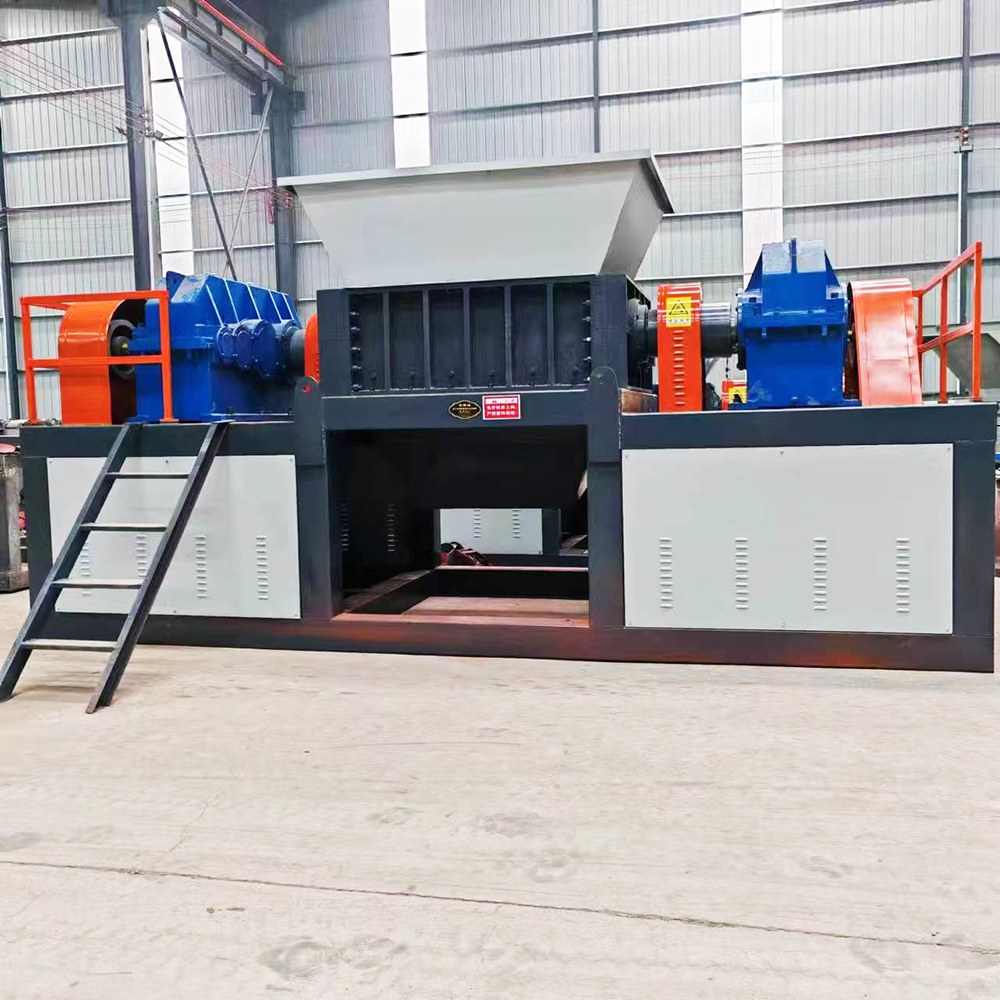
This is the workhorse stage. A low-speed, high-torque double-shaft shredder shears bulky and oversized items — furniture, mattresses, drums, pallets, appliances — down to a coarse fraction typically in the 150–300 mm range. Low speed is the point: two counter-rotating shafts fitted with hooked blades grip material and tear it, rather than impacting it. That produces high torque at low RPM, which is what lets the machine swallow items that would destroy a high-speed hammer mill.
For municipal duty the shredder must be sized generously, because MSW is abrasive and unpredictable. Our Model 1500 is the unit normally specified at this position: a 1,500 × 1,050 mm working chamber, twin 75 kW drive motors, Ø550 mm blades in M6V alloy at 50 mm thickness, a Ø245 mm main shaft carried on 22240 spherical roller bearings, and a ZSY400 gearbox. Total installed weight is about 15 t — mass that matters when the feed includes concrete and steel.
Parameter | Model 1500 specification |
|---|---|
Working chamber | 1,500 × 1,050 mm |
Main motor power | 75 kW × 2 |
Blade diameter | Ø550 mm |
Blade thickness | 50 mm |
Blade material | M6V alloy steel |
Number of blades | 30 pcs |
Main shaft diameter | Ø245 mm |
Bearing model | 22240 spherical roller |
Gearbox | ZSY400 |
Overall dimensions | 5,200 × 2,100 × 2,300 mm |
Machine weight | ≈ 15 t |
Where the waste stream is lighter — predominantly commercial packaging rather than bulky household items — a Model 1000 or Model 1200 is usually sufficient and reduces both capital cost and floor space. The Model 1200 runs a 1,200 × 800 mm chamber on twin 45 kW motors with Ø400 mm blades.
Stage 3 — Screening and Organic Scalping
A multi-deck rotary trommel (rotary screen) receives the coarse shredded fraction and splits it by size. The fine underflow — putrescible organics, sand, broken glass grit — drops out and is routed to composting or anaerobic digestion. The oversize stream, now largely dry packaging, continues to the next stage. Screening at this point is what protects the downstream fine shredder: organic fines are abrasive, wet and low-value, and removing them early sharply reduces wear.
Stage 4 — Secondary Size Reduction for RDF
To produce Refuse Derived Fuel (RDF / SRF), the light fraction — plastics, textiles, paper, wood — must be reduced to a homogeneous 30–50 mm fluff or pellet suitable for injection into a cement kiln or a waste-to-energy boiler. This is a different machine from the primary shredder: a single-shaft shredder with a calibrated screen, which shears against a fixed counter-knife and discharges only what passes the screen aperture. Screen size therefore defines output size precisely, which is exactly what fuel specifications demand.
RDF produced by this route typically reaches a lower heating value of roughly 18–22 MJ/kg (approximately 4,300–5,250 kcal/kg), which is why cement producers accept it as a partial coal replacement. Achieving that figure depends less on the shredder than on how well the wet organic fraction was removed in Stage 3 — moisture is the single biggest enemy of calorific value.
Stage 5 — Material-Specific Separation
With the stream now sized, the valuable fractions are extracted by four well-established physical principles:
- Magnetic separation. Self-cleaning overband magnets continuously lift ferrous steel cans and structural iron off the belt. This protects downstream equipment as much as it recovers value.
- Eddy current separation (ECS). A high-speed alternating magnetic rotor (typically 2,500–3,000 RPM) induces eddy currents in non-ferrous metals, generating a repulsive force that physically throws aluminium cans and copper fragments clear of the inert stream.
- Air classification (wind shifting). High-velocity air fluidises the material bed in a zig-zag chamber; light films, paper and foam are lifted into a cyclone while heavy inerts fall by gravity.
- Near-infrared (NIR) optical sorting. Hyperspectral cameras identify the spectral signature of PET, HDPE, PP and PS, and pneumatic nozzle manifolds eject selected polymers. Well-tuned NIR lines routinely exceed 95% purity on single-polymer streams.
AI-guided pick-and-place robots are increasingly deployed for final quality control, typically at 80–100 picks per minute. They are an enhancement, not a replacement — the bulk separation is still done by magnets, eddy currents, air and optics.
Sizing a Line: A Practical Starting Point
Published figures for municipal plants commonly quote throughputs in the 20–50 t/h band for a full advanced line. Rather than starting from a capacity number, we recommend starting from three questions:
- What is in the waste? A stream weighted toward packaging produces far more RDF than one weighted toward construction rubble.
- Where does the output go? If a cement kiln is the customer, RDF sizing and calorific value dictate the specification. If a materials recovery facility is the customer, polymer purity matters more.
- What is the permitting envelope? Odour, dust and noise rules determine how much enclosure, negative-pressure ventilation and baghouse filtration the plant needs.
Waste type | Recommended primary machine | Notes |
|---|---|---|
Bulky household waste, mattresses, furniture | Model 1500 / 1200 double-shaft | Largest chamber available; tolerate metal and concrete |
Commercial packaging, light industrial waste | Model 1000 / 800 double-shaft | Lower capital cost, smaller footprint |
Wood pallets, crates | Model 800 (Ø400 blade) | 40 mm blade handles nails and dense hardwood |
Mixed plastics, film, drums | Model 600 / 800 (Ø316 blade) | Thinner blade gives finer tear at lower torque demand |
Utilities, Emissions and Site Requirements
A municipal line is not just machinery. Three support systems are non-negotiable in most jurisdictions:
- Negative-pressure ventilation and dust extraction. Tipping halls, trommel enclosures and conveyor transfer points are held under negative pressure and exhausted through pulse-jet baghouse filters, frequently with bio-trickling scrubbers and activated carbon for odour control.
- Three-phase power sized for peak starting current. Twin 75 kW motors present a significant inrush; the site panel or a dedicated transformer must be specified during procurement, not after delivery.
- Fire and explosion precautions. Shredding generates dust and can generate sparks; enclosed lines handling dry RDF require spark detection and suppression.
Frequently Asked Questions
What size of MSW plant can a single shredder support?
A single heavy double-shaft shredder is normally the primary stage for a line in the 20–50 t/h range. Below roughly 10 t/h a smaller unit such as the Model 800 is more economical; above 50 t/h plants often run two primary shredders in parallel to maintain availability during maintenance.
Can one shredder handle both bulky waste and packaging?
It can mechanically, but blade thickness is a compromise. Thick blades (50 mm) survive bulky waste with hidden metal; thinner blades (20–30 mm) cut packaging more finely and use less power. If your stream is genuinely mixed, specify the thicker blade and accept a coarser output, or install two stages.
How much of the incoming waste actually becomes RDF?
It depends entirely on composition and on how effectively the wet organic fraction is screened out. In packaging-heavy streams the light fraction going to RDF preparation can exceed half the input mass; in streams dominated by food waste and rubble it may be well under a quarter. A representative sample analysis is the only reliable way to predict it.
Do you supply the whole line or only the shredders?
Jiacui manufactures the size-reduction equipment — double-shaft shredders, single-shaft shredders and pulverizers — that forms the core of stages 2 and 4. We work with the customer's chosen suppliers for screening, magnetic, eddy current, optical and conveying equipment, and provide the interface drawings needed to integrate them.
Next Step
If you are scoping an MSW line, the most useful document you can send us is a composition analysis of your waste together with a target throughput and a description of where the output will be sold. From those three inputs we can specify the primary shredder model, blade specification and drive configuration, and provide layout drawings and power requirements. Contact us for a project consultation.