
PCB and E-Waste Recycling Line: How Circuit Boards Are Turned Into Copper, Precious Metals and Resin Powder
PCB and E-Waste Recycling Line: How Circuit Boards Are Turned Into Copper, Precious Metals and Resin Powder
Published in News & Insights · Recycling Solutions
By Henan Jiacui Intelligent Equipment Co., Ltd.
Printed circuit boards are among the densest concentrations of recoverable metal in the urban waste stream. They are also one of the most difficult materials to process: a composite of copper foil, glass fibre, cured epoxy resin, solder, brominated flame retardants and — in populated boards — gold, silver and palladium. Landfill and incineration are both increasingly restricted, which is driving investment in dedicated mechanical recycling lines.
The process below is the dry physical separation route, which dominates modern installations because it avoids the wastewater treatment burden of wet (shaking-table) separation. The sequence — dismantling, two-stage size reduction, then density and electrostatic separation — is standard across the industry.
Stage 1 — Dismantling and Component Removal
Populated boards carry the highest-value components. Capacitors, ICs, CPUs and memory modules are removed first, either thermally — heating the board above roughly 200 °C until the solder reflows — or with solvents that dissolve the solder and release components intact. Dismantled components then go to dedicated precious-metal leaching and refining circuits, which is where the majority of the gold value sits.
What remains is the bare board: copper foil, resin and glass fibre. This is what the mechanical line processes. Whether you dismantle or feed whole boards depends on grade — low-grade consumer boards are frequently processed whole, because the labour cost of dismantling exceeds the recoverable component value.
Stage 2 — Coarse Shredding
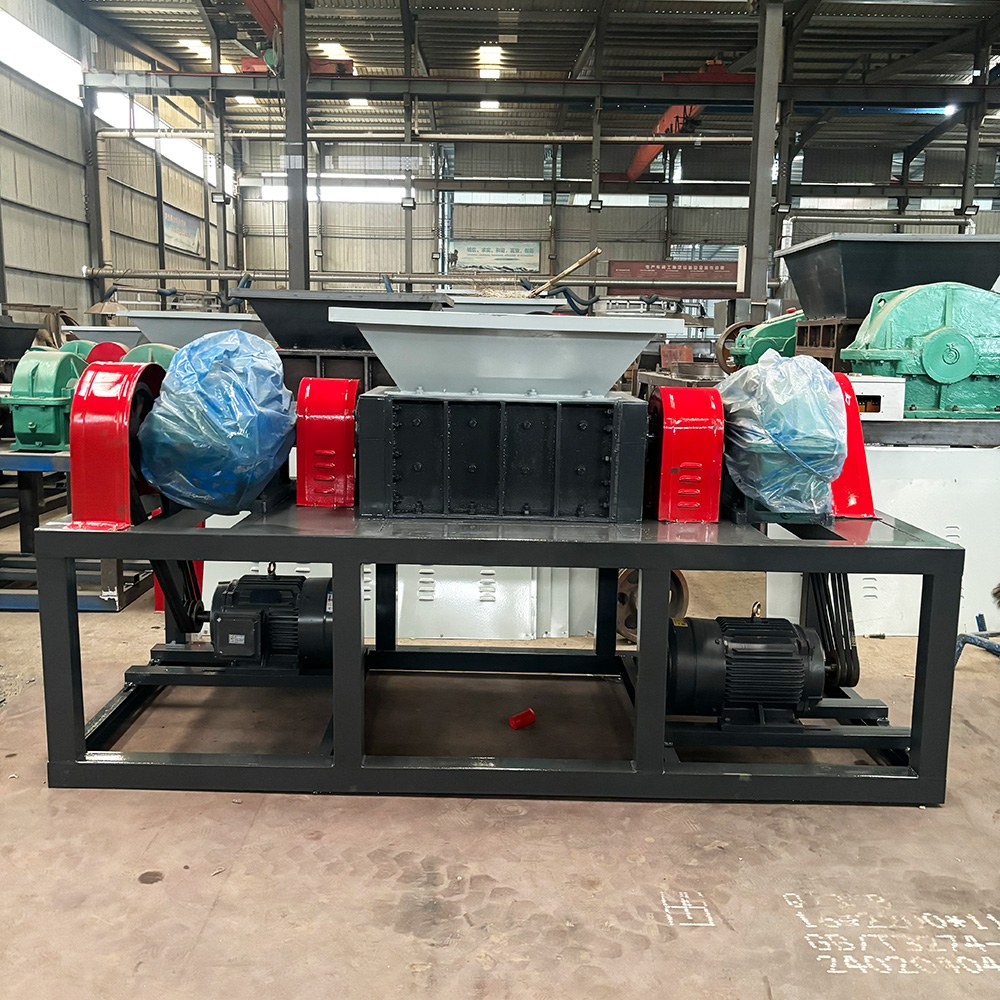
Bare boards are fed to a double-shaft shredder which tears them into strips or fragments, commonly in the 20–50 mm range. The shear action of a low-speed double-shaft machine is well suited here: circuit board laminate is abrasive and glass-filled, and the shock loading of an impact crusher would be punishing on tooling.
For a dedicated PCB line the Model 800 (Ø316 blade) is a typical choice — an 800 × 630 mm chamber on twin 22 kW motors, Ø316 mm blades in 55SiCr at 30 mm thickness, Ø155 mm shaft on 22222 spherical roller bearings. Where boards arrive already depopulated and in volume, the Model 1000 (Ø316) with its 1,000 × 630 mm chamber and twin 30 kW drive increases throughput without changing the downstream process.
Parameter | Model 800 (Ø316) | Model 1000 (Ø316) |
|---|---|---|
Working chamber | 800 × 630 mm | 1,000 × 630 mm |
Main motor power | 22 kW × 2 | 30 kW × 2 |
Blade diameter | Ø316 mm | Ø316 mm |
Blade thickness | 30 mm | 30 mm |
Blade material | 55SiCr | 55SiCr |
Number of blades | 26 pcs | 33 pcs |
Main shaft diameter | Ø155 mm | Ø155 mm |
Bearing model | 22222 | 22222 |
Gearbox | JZQ650 | JZQ650 × 2 |
Rotational speed | 10–12 r/min | 10–12 r/min |
Stage 3 — Fine Grinding and Classification
The coarse fragments are pneumatically conveyed to a hammer mill or pulverizer, where high-speed impact, shearing and friction reduce them to roughly 1 mm, and in high-purity circuits as fine as 0.5–2 mm. The purpose of this stage is liberation: the metal must be physically separated from the resin so that the downstream separators can act on individual particles rather than on composites.
A rotary vibrating screen classifies the ground powder. On-size material proceeds; oversize is automatically returned for regrinding. Closed-circuit grinding of this kind is what makes the final separation consistent.
For fine grinding duties our YH-800 vertical disc powder mill is the dedicated unit, designed for the abrasive, glass-filled powder that circuit boards produce.
Stage 4 — Density Separation
The physical property that makes PCB recycling feasible is the density gap between metal and non-metal. Copper is about 8.9 g/cm³; aluminium around 2.7; the resin and glass-fibre matrix roughly 1.5–2.0 g/cm³. An air-gravity separation bed exploits exactly this: on a vibrating deck with a controlled upward airflow, heavy metal particles migrate to the metal discharge while light non-metallic particles move to the reject side.
A magnetic separator is normally placed before or after this stage to remove ferrous steel (screws, brackets, shields), and an eddy current separator recovers larger non-ferrous pieces such as aluminium heat sinks and connectors.
Stage 5 — Electrostatic Separation for Final Purification
Air-gravity alone leaves fine copper locked with fine resin. A high-voltage electrostatic separator finishes the job: particles are charged — by corona or by triboelectric friction — and then passed through an electric field. Conductive metal particles discharge rapidly and are thrown from the rotor; non-conductive resin and glass particles retain their charge and are pinned to it. The two streams are collected separately.
This step is what takes a line from a workable recovery to a saleable one. Properly configured PCB lines report metal recovery rates above 90%, and well-optimised circuits reach 99%. Metal concentrate purities above 99.5% for copper are achievable on the metal side, while the non-metallic resin powder can be produced with metal contamination low enough to be used as a filler in composite lumber, lightweight concrete or insulation board.
What the Numbers Actually Look Like
It helps to be precise about why boards are worth processing. The following figures are widely cited in the industry:
- Copper content of a typical bare board is roughly 20–30% by mass — the largest single recoverable component.
- Gold content of a tonne of standard circuit board is on the order of 200 g, roughly forty times the grade of an economically workable gold ore. Mobile phone boards can run substantially higher, with figures around 2 kg per tonne quoted for handset-grade material.
- Recovery rates above 90% are standard; 99% is reported for optimised lines.
These numbers are why depopulated boards command a price rather than a tipping fee. They are also why the value is concentrated in the component fraction — the bare board alone carries the copper, but the gold largely leaves with the components in Stage 1.
Dust Control Is Not Optional
Grinding glass-filled laminate generates respirable dust containing glass fibre and brominated flame retardant residues. Every material transfer point on a PCB line must be enclosed and extracted, and the whole line is normally run under negative pressure with pulse-jet baghouse filtration. Properly engineered systems achieve dust capture efficiency above 99%. In most jurisdictions this is a permitting requirement, not a design preference, and it should be budgeted from the outset.
Configuring for Your Board Mix
Feed material | Recommended configuration |
|---|---|
Depopulated bare boards, steady volume | Model 800/1000 shredder → hammer mill → air-gravity → electrostatic |
Whole populated boards, mixed grade | Pre-dismantling line → Model 1000 shredder → magnetic → grinding → separation |
High-grade server / telecom boards | Dismantle for components first; bare boards to standard line |
Low-grade consumer boards, high volume | Process whole; accept lower per-tonne value in exchange for throughput |
Capacity for these lines is commonly specified in the 2 to 10+ tonnes per day band. The binding constraint is rarely the shredder — it is usually the fine grinding and electrostatic stages, which are considerably slower per tonne than primary shredding.
Frequently Asked Questions
Do I need to remove components before shredding?
Not mechanically, but it is usually the right commercial decision for high-grade boards. Components carry most of the gold and silver value and are best routed to a dedicated leaching or refining circuit. Low-grade consumer boards are often processed whole because dismantling labour costs more than the recoverable component value.
Why use a double-shaft shredder instead of a crusher for boards?
Circuit board laminate is abrasive and glass-filled. A low-speed double-shaft machine shears the material with high torque at low RPM, which is far kinder to tooling than the impact loading of a hammer mill. Use the shredder for primary reduction and reserve impact grinding for the fine stage, where it is actually needed for liberation.
Is wet separation better than dry?
Wet (shaking-table) separation can achieve very high recovery, but it requires a water treatment circuit and creates a secondary effluent problem. Dry physical separation is now the dominant route for new installations because the permitting burden is far lighter and there is no sludge to dispose of.
What purity can I expect on the metal output?
With air-gravity plus electrostatic separation and proper closed-circuit grinding, metal concentrates above 99% purity are routinely reported. Reaching the top of that range depends on consistent grind size and well-maintained separator electrodes — it is an operating discipline as much as an equipment question.
Next Step
Tell us your board type (populated or bare, consumer or industrial grade), your daily throughput target and whether you intend to dismantle first. From that we can specify the primary shredder model and blade specification, and provide the interface drawings for the grinding and separation equipment. Contact us to discuss your e-waste project.