
Scrap Cable and Wire Recycling Line: From Coiled Cable to Saleable Copper Rice Without Burning
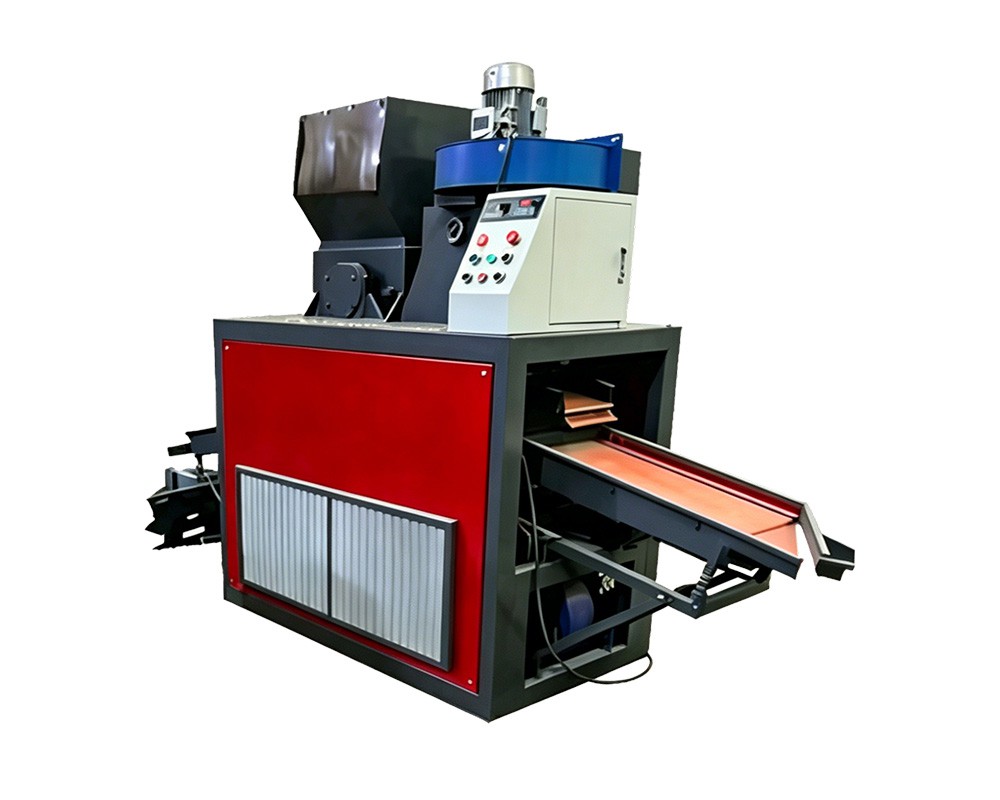
Scrap Cable and Wire Recycling Line: From Coiled Cable to Saleable Copper Rice Without Burning
Published in News & Insights · Recycling Solutions
By Henan Jiacui Intelligent Equipment Co., Ltd.
Scrap cable is one of the few waste streams where the recovered material sells at a price close to primary metal. Copper recovered mechanically as clean granulate — "copper rice" — trades at a substantial premium over burned or hand-stripped wire, and in a growing number of jurisdictions open burning of cable is simply illegal. That combination is what makes a mechanical cable recycling line one of the fastest payback investments in the recycling sector.
The process is entirely dry and physical: granulate, then separate by density, then polish by screening and optionally by electrostatics. No water, no chemicals, no effluent.
Why Dry Separation Replaced Burning
Burning insulation off cable is cheap and effective at liberating copper, and that is why it persisted for decades. It also releases dioxins and furans from PVC, destroys the polymer value entirely, and leaves copper that is surface-oxidised and discounted by smelters. Enforcement has tightened steadily. Mechanical granulation avoids all three problems: the polymer is recovered as a saleable secondary stream, the copper leaves bright and uncontaminated, and there is nothing to permit as an emission source beyond dust collection.
Stage 1 — Pre-Shredding Bulky Cable
A granulator is a precision machine and should not be asked to swallow whole cable drums, armoured cable or bundled harnesses. Where the feed is bulky — power cable, armoured conductor, motor windings, transformer windings — a double-shaft shredder is installed ahead of the granulator to reduce it to a granulator-friendly size.
The Model 600 is frequently used in this pre-shredding role: a 600 × 430 mm chamber, twin 15 kW motors, Ø216 mm blades in 55SiCr at 20 mm thickness, Ø107 mm shaft on 22219 bearings. For armoured or steel-wire cable the Model 800 (Ø400) with its 40 mm blades is the safer specification.
Thin communication cable, household wiring and harness wire generally need no pre-shredding at all and can be fed directly to the granulator.
Stage 2 — Granulation
The granulator is the heart of the line. Cable enters a cutting chamber where a rotor fitted with SKD-11 tool-steel blades shears it against a bed knife, reducing it to particles in the 2–5 mm range. The objective is the same as in PCB recycling: liberation. Copper and polymer must be freed from one another before any separator can act on them.
SKD-11 is specified for this duty because it holds a cutting edge through long runs of abrasive, copper-filled feed — copper is soft, but PVC compounds and fillers are not. Blade count scales with machine size from 6 blades on the smallest unit to 18 on the largest.
Stage 3 — Airflow and Gravity Separation
Granulated material is conveyed into the gravity separator, where a calibrated upward airflow fluidises the bed. Copper at roughly 8.9 g/cm³ and polymer at roughly 1.2–1.4 g/cm³ separate cleanly: heavy copper drops to the metal discharge, light plastic is carried off by the air stream. This single density difference does most of the work in the whole line.
A vibrating screen follows for secondary refinement, removing residual mixed particles and improving final purity. A dust collection fan captures fines throughout — an integral part of the machine, not an add-on.
Stage 4 — Electrostatic Polishing (Optional)
For hair-wire, enameled magnet wire and very fine stranded conductors, gravity separation alone leaves a fraction of copper in the plastic and vice versa. An electrostatic separator adds a final precision pass: conductive copper is attracted to the electrode, non-conductive polymer is rejected by inertia. This is what takes output from the 99.5% range to 99.8%+, and it is worth specifying whenever the feed includes fine or enameled wire.
Sizing the Granulator: Three Real Reference Points
The correct question is not "how big a machine" but "what is my cable mix and how many hours per day will I run". The three models below bracket the range most operators need.
Parameter | RC300 | RC-CWG660 | RC-CWG1000 |
|---|---|---|---|
Output capacity | 100–120 kg/h | 600–650 kg/h | 900–1,000 kg/h |
Total power | 11.65 kW | 40.24 kW | 77.48 kW |
Blade material | SKD-11 | SKD-11 | SKD-11 |
Number of blades | 6 pcs | 14 pcs | 18 pcs |
Copper purity | ≥99.5% | ≥99.5% (99.8%+ with electrostatic) | ≥99.5% (99.8%+ with electrostatic) |
Dimensions (L×W×H) | 2,300 × 950 × 2,000 mm | 4,000 × 5,600 × 2,400 mm | 10,000 × 8,500 × 3,000 mm |
Weight | 680 kg | 3,000 kg | 5,000 kg |
The RC300 suits workshops and small yards — it runs on two-phase supply at 11.65 kW total, needs under 5 m² of floor, and can be moved. The RC-CWG660 is the mid-range industrial unit for dedicated cable yards. The RC-CWG1000 is a full plant-scale machine and should be specified with conveying, feeding and dust extraction designed as part of the installation rather than added afterwards.
Input wire diameter capability is broad — commonly 0.2–30 mm across the range — but the practical constraint is throughput, not diameter. Very fine wire has low bulk density and feeds slowly regardless of machine size.
What Determines Your Actual Yield
Two operators with identical machines can see very different results. The variables that matter in practice:
- Cable composition. Copper content by mass varies enormously between power cable, telecom cable and automotive harness. Yield follows the input, not the machine.
- Feed consistency. A surge that overloads the cutting chamber produces incompletely liberated particles, and liberation failures end up in the plastic stream as lost copper.
- Airflow calibration. The gravity separator must be tuned to the actual particle size and density of the material being run. Fine wire needs different airflow than heavy power cable.
- Blade condition. Dull blades crush rather than cut, producing fines that separate poorly. Blade maintenance is a yield issue, not just a cost issue.
The Polymer Stream Is Also Revenue
It is easy to focus on the copper and treat the plastic as residue. In practice the polymer fraction — clean PVC, PE or XLPE granulate — is a saleable secondary raw material, and on high-volume lines it makes a meaningful contribution to the economics. Keeping it clean is the argument for maintaining separation efficiency even when copper prices are high.
Frequently Asked Questions
Can I feed armoured cable or steel-wire cable directly?
Not recommended without pre-shredding. Steel armour and steel wire will damage granulator blades and contaminate the copper. Install a double-shaft shredder ahead of the granulator and remove ferrous material magnetically before the granulating stage.
What purity of copper will I actually achieve?
Gravity separation alone typically delivers 99.5% or better. Adding an electrostatic separator takes this to 99.8%+ and is worth specifying if your feed includes fine stranded wire, enameled magnet wire or hair-wire, where gravity separation struggles.
Do I need water or chemicals?
No. The process is entirely dry and physical — cutting, airflow, vibration screening and optionally electrostatics. There is no effluent, which is a large part of why dry granulation has replaced both burning and wet separation in new installations.
How do I choose between the RC300, RC660 and RC1000?
Match capacity to your actual daily tonnage and available shift hours, then check your power supply. The RC300 runs on two-phase at 11.65 kW and suits workshops; the RC660 and RC1000 are three-phase industrial machines needing 40 kW and 77 kW respectively. Oversizing ties up capital and floor space; undersizing creates a bottleneck that limits everything upstream.
Next Step
Send us a description of your cable mix — types, approximate copper content, and how many tonnes per day you need to process — plus your available power supply. We will size the granulator, tell you whether pre-shredding is needed, and provide layout and utility requirements. Contact us for a cable recycling line proposal.