
Common Causes of Plastic-Copper Separation Loss and How to Fix Them
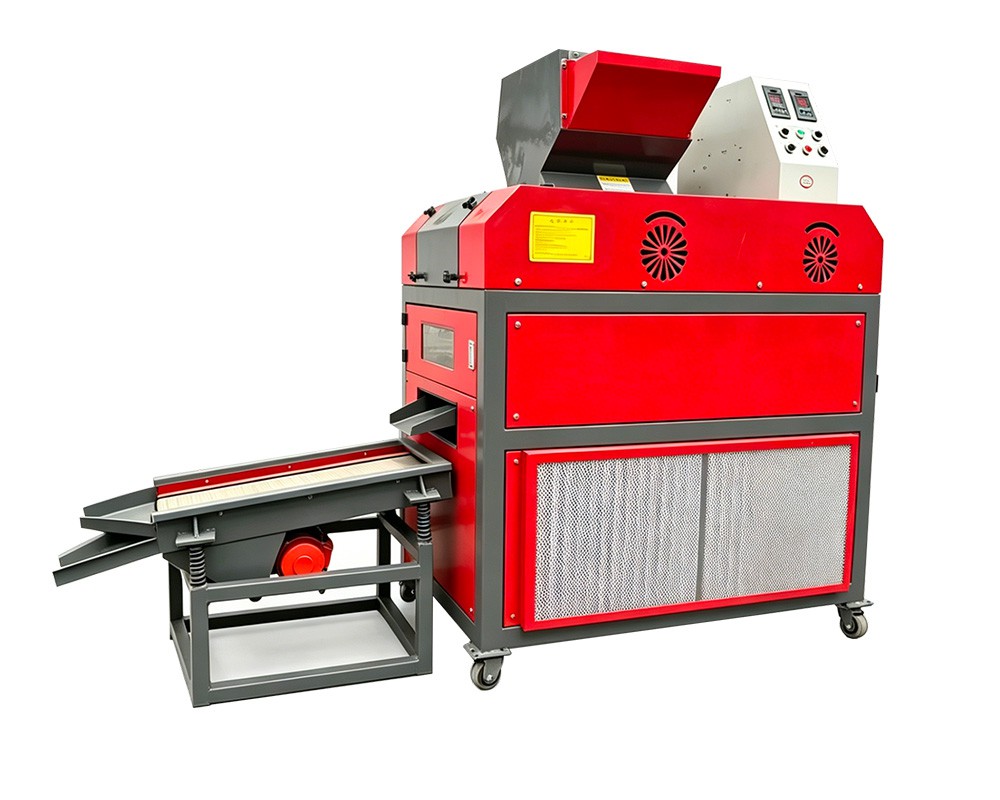
Common Causes of Plastic-Copper Separation Loss and How to Fix Them
Published in News & Insights · Tech & Maintenance
By Henan Jiacui Intelligent Equipment Co., Ltd.
Separation loss is the most expensive fault in a cable recycling plant precisely because nothing breaks. The machine runs, the belts turn, the output looks like copper, and every tonne quietly leaves the yard with a percentage of its value inside the plastic fraction. Nobody reports it, because there is no alarm and no downtime.
This article is a diagnostic guide. It starts with how to measure the loss properly — because most operators are guessing — then works through the seven causes we find in the field, and ends with a sequence you can follow when you do not yet know which one applies.
Measure first: how big is the loss, really?
Before adjusting anything, establish a number. Without one you will tune the machine by appearance, and appearance is a poor instrument: a copper product that looks clean can still be sitting next to a plastic tail carrying several percent copper.
The measurement is simple and takes one shift:
- Weigh the input over a full, steady-state shift. Not a partial hour.
- Weigh the copper product and the plastic product separately as they come out.
- Take a representative sample of the plastic product — several increments across the shift, combined and quartered down — and have it assayed for copper content.
- Compute the copper balance: copper in product plus copper in the plastic tail should equal the copper you fed in. Any shortfall is either dust capture or an unmeasured stream.
A plastic tail assaying above roughly 5% copper is a signal that a polishing stage or a configuration change is worth investigating. Below about 2% on mixed household cable, you are close to the practical limit of a two-stage dry line and further effort usually will not pay back.
Cause 1 — Blunt blades: the loss that starts upstream
Symptom: purity falls gradually over weeks; granulate becomes less uniform; electricity consumption per tonne rises; the copper product contains particles with visible insulation still attached.
Why: a dull blade does not shear, it tears. Torn particles are elongated and often carry attached plastic, which makes them behave partly like plastic in the separator. No separator setting can recover what liberation never achieved.
Diagnosis: take a sample of the granulated mix before separation, spread it on a tray and inspect at 2–3× magnification. If more than a few percent of copper particles still have plastic attached, the problem is upstream of separation.
Fix: rotate or replace the blade set. On our compact machines the rotor carries 6 SKD-11 blades; the RC-CWG660 carries 14 and the RC-CWG800 carries 16. Because they wear as a set, replace or rotate all of them together — a mixed set with uneven edge condition produces inconsistent cut quality that looks like a separation fault.
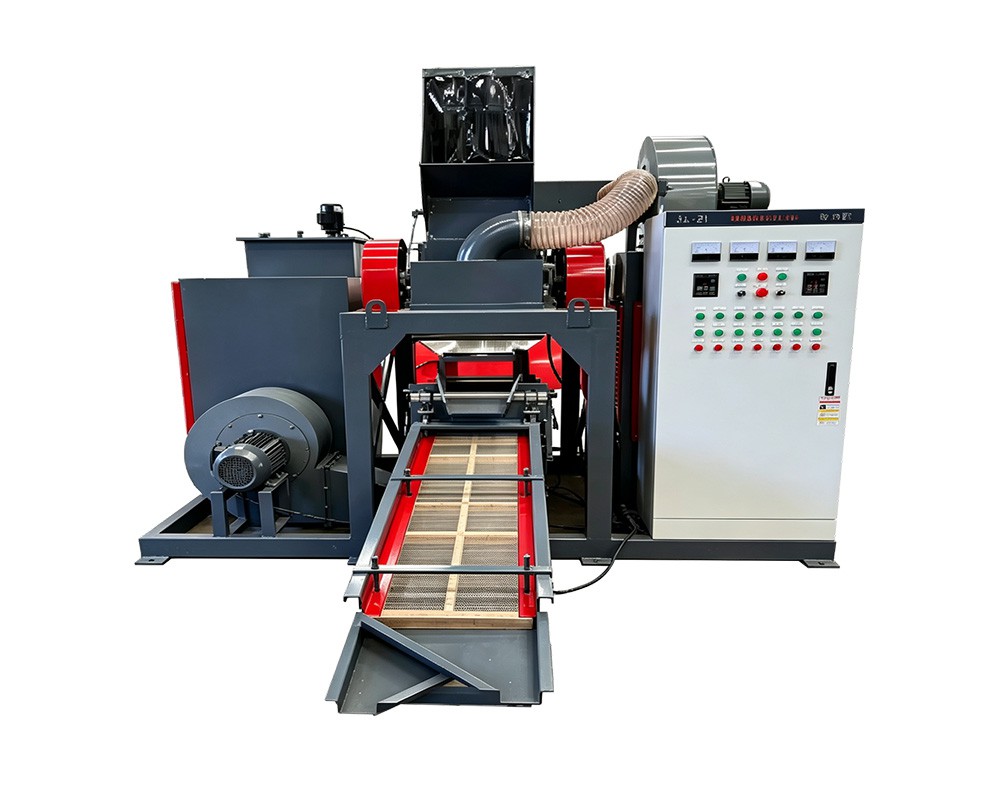
Separation loss usually begins upstream, in the cutting chamber.
Cause 2 — Blade-to-screen gap out of specification
Symptom: granulate size distribution shifts coarser; plastic content in the copper product rises without a change in feed material.
Why: the screen sets the maximum particle size and therefore the residence time in the chamber. If the gap between blade tips and screen is too large, material passes before it is fully cut, producing coarse particles in which copper and plastic are still joined.
Fix: measure the gap at several points around the rotor and correct it to the manufacturer’s figure. Check for a worn screen as well — a screen that has lost aperture definition behaves the same way as a wrong gap. Our granulators are designed to produce a 2–5 mm granulate; if you are routinely seeing larger particles, the gap or the screen is the first thing to check.
Cause 3 — Screen blinding
Symptom: throughput drops; the plastic fraction becomes coarser; separation quality deteriorates through the shift and recovers after a clean.
Why: insulation, particularly from adhesive-taped or rubber-insulated cable, smears and blocks apertures. Once the screen blinds, the downstream separator receives a stream that was never properly classified.
Fix: clean the screen on a defined schedule rather than when throughput drops; check tension; and address the root cause — chamber temperature. If the material is smearing rather than cutting, the feed rate is exceeding the chamber’s clearing capacity. Reducing feed rate often raises hourly output, because it eliminates the blinding cycle.
Cause 4 — Air velocity set too high (copper in the plastic)
Symptom: copper product is very clean, but the plastic tail assays high in copper; yield per tonne of input falls.
Why: this is the most common misdiagnosis in the field. An operator sees a dirty copper product and increases air speed to clean it. That succeeds — and simultaneously blows the fine copper out with the plastic. The error has not been eliminated, it has been moved to the other output, where it is invisible because nobody looks at the plastic.
Fix: tune the air separator against the total mass balance, not against the appearance of one sample. Set air velocity so the copper product meets specification at the lowest velocity that achieves it. Published efficiency ranges for air separation sit at roughly 95–97% on mixed feed; the residual loss concentrates in fines, which is why the next stage matters.
Cause 5 — Air velocity too low (plastic in the copper)
Symptom: copper product contains visible plastic; smelter or trader applies a penalty or downgrades the batch.
Why: insufficient lift, excessive feed depth on the deck, or a deck angle that has drifted. Material crosses the deck before separation has occurred.
Fix: verify deck angle and vibration amplitude against the commissioning record, then raise air velocity in small increments while re-sampling both outputs at each step. Change one variable at a time — adjusting air and angle together makes the result uninterpretable.
Cause 6 — Feed rate exceeding separation capacity
Symptom: separation quality falls during peak feed and recovers when the line is run slower; results vary between shifts and between operators.
Why: every separation stage has a throughput at which its bed depth exceeds what it can stratify. Air tables and electrostatic belts both degrade quietly rather than jamming, so the operator sees worse results without an obvious cause.
Fix: establish a rated feed rate for each material type and hold it, using a weigh feeder or at minimum a consistent hopper loading routine. Uniform feed is worth more than most control upgrades, and it costs nothing.
Cause 7 — Humidity collapsing electrostatic performance
Symptom: the electrostatic stage works well in dry weather and poorly after rain; performance varies day to day with no change in material or settings.
Why: electrostatic separation depends on how long an insulator retains charge. Surface moisture provides a leakage path, so PVC particles discharge faster than they should and the conductivity difference the separator relies on shrinks. Published operating guidance puts the workable band at roughly 30–50% relative humidity, with field strengths typically in the 20–40 kV range.
Fix: control the environment before adjusting the machine. Dry the feed if it is visibly damp, avoid open water in the shed, and consider dehumidification where humid seasons coincide with your best material. Then re-establish the field setpoint on site with the actual material — the commissioning value is a starting point, not a permanent setting.
A diagnostic sequence when you do not know the cause
What you observe | Most likely cause | Check first |
|---|---|---|
Copper product dirty, plastic tail clean | Air velocity too low, or liberation incomplete | Blade condition, then deck angle |
Copper product clean, plastic tail high in copper | Air velocity too high, or no fine-fraction polishing | Reduce air in steps; screen the tail and assay the fine fraction |
Both outputs contaminated | Screen blinding or feed overload | Screen condition and tension; feed rate against rated capacity |
Purity drifts through the shift | Chamber heating, blade smearing, screen blinding | Feed rate; inspect blades at end of shift |
Day-to-day variance with same material | Humidity | Log relative humidity against assay results for two weeks |
Sudden step change in purity | Chipped blade or damaged screen | Inspect rotor and screen immediately |
What a fix looks like in numbers
An illustrative example, to show why this work is worth doing. A line processing 40 tonnes a month of mixed cable at 45% copper content carries 18 tonnes of copper. If the plastic tail runs at 8% copper and the plastic is 55% of output (about 22 tonnes), that tail contains roughly 1.76 tonnes of copper a month. Reducing that to 3% recovers about 1.1 tonnes — which, at any realistic granule price, dwarfs the cost of a blade set, a screen and a day of technician time.
This is why separation loss deserves a monthly measurement rather than an annual audit. It is not a machine fault to be fixed once; it is a process variable that drifts.
Frequently Asked Questions
How much copper loss in the plastic fraction is normal?
On mixed household and communication cable with a well-set two-stage dry line, 2–4% copper in the plastic tail is a normal working range, and below 2% is close to the practical limit. On fine, harness or mixed electronics material, 5–8% is common unless the line has electrostatic polishing. Above 5% on simple household cable is a signal to investigate.
Why did purity drop after I increased air speed?
Because increasing air speed cleans the copper product by pushing fine copper out with the plastic. The contamination has been moved, not removed. Set air velocity at the lowest value that meets your copper specification, and verify by assaying the plastic tail as well as the copper product.
How often should blades be replaced?
There is no calendar answer. Replace or rotate on evidence: granulate uniformity, electricity consumption per tonne, and the share of copper particles with attached insulation in a pre-separation sample. Log blade hours against those three measurements and your own optimum interval will emerge within two or three cycles.
Can I fix separation loss by buying an electrostatic separator?
Only if your loss is in the fine fraction. If the cause is blunt blades, a blinded screen or excessive air velocity, an electrostatic stage will simply polish a stream that should never have been that dirty, at extra cost. Diagnose first: sample the granulated mix before separation. If copper is still bonded to plastic there, the problem is liberation, not separation.
Does humidity really matter that much?
For electrostatic separation, yes — it is the single largest cause of day-to-day variance. For air separation it matters much less. If your results track the weather, humidity control and feed drying will do more than any machine adjustment.
Diagnose Your Separation Loss
If your plastic tail is assaying above 5% copper, send us the assay, the model you are running and a description of the feed. We will work through the diagnostic sequence with you and tell you whether the fix is a blade set, a screen, a setting change or an additional separation stage — in that order of cost.
Send us your material description, daily tonnage and target output, and our engineering team will respond with a model recommendation, a capacity calculation and a quotation. You are also welcome to book a live video walk-through of the Henan Jiacui Intelligent Equipment Co., Ltd. factory in Zhengzhou, Henan, China, or request a reference list of installations running comparable cable or waste streams.
About the Author and the Manufacturer
This article was prepared by the technical sales and engineering team of Henan Jiacui Intelligent Equipment Co., Ltd. (brand name JIACUI). Founded in 2015 in Zhengzhou, Henan Province, China, JIACUI designs and manufactures solid waste recycling equipment and copper wire granulation systems in a 5,000 m² factory with more than 100 employees. Our equipment holds CE, ISO and CSA certification, uses ABB and Siemens control components built to European design standards, and has been delivered to more than 400 customers in over 100 countries. Factory audits have been completed with SGS, BV and TÜV. We hold 27 patents covering shredding, granulation and separation technology. Where this article quotes performance figures, those figures come from our published model specifications and from commissioning tests on real installations; actual results depend on cable composition, feed preparation and operating practice.