
Copper Wire Granulator Maintenance: Daily Checks, Separation Tuning and Troubleshooting Loss of Purity
Copper Wire Granulator Maintenance: Daily Checks, Separation Tuning and Troubleshooting Loss of Purity
Published in News & Insights · Tech & Maintenance
By Henan Jiacui Intelligent Equipment Co., Ltd.
A copper wire granulator is a separation machine as much as a cutting machine, and that is what makes its maintenance different from a shredder's. A shredder that is slightly out of adjustment still produces roughly the right output. A granulator that is slightly out of adjustment quietly loses copper into the plastic stream, and you find out from the settlement sheet rather than from the machine.
This article covers the checks that keep output on specification, how to tune the separation circuit, and how to diagnose the two symptoms that matter: copper in the plastic and plastic in the copper.
How the Machine Actually Works
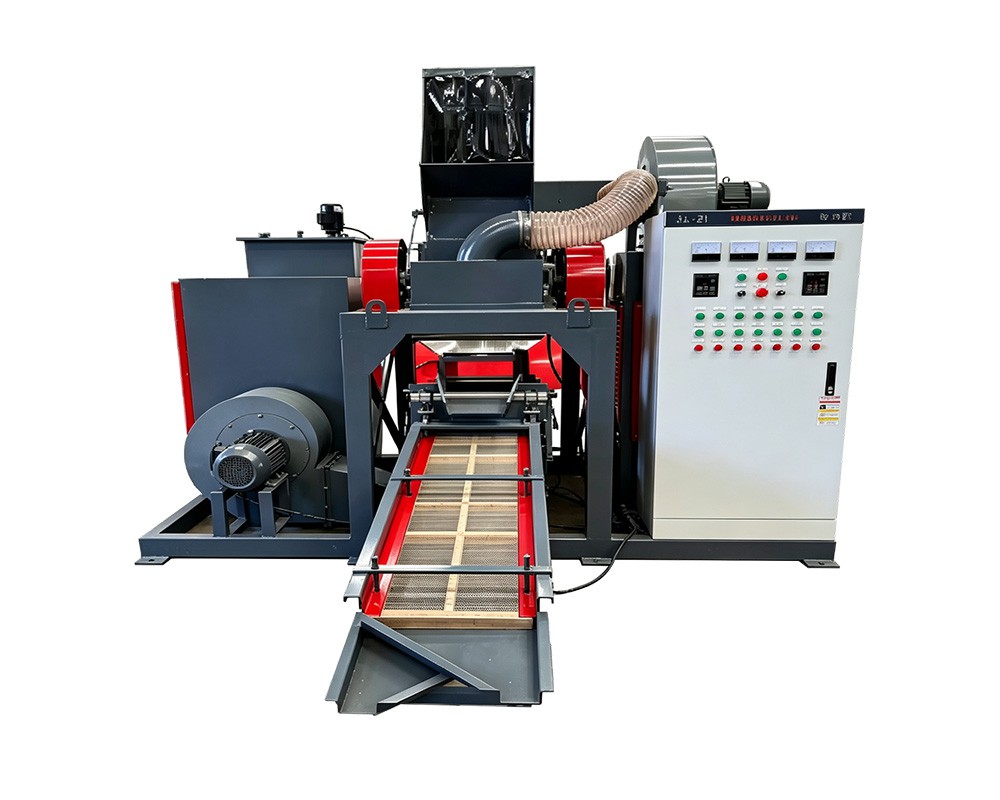
Understanding the mechanism makes the troubleshooting obvious. Three stages, in order:
- Granulation. A rotor fitted with SKD-11 blades shears cable against a bed knife, reducing it to roughly 2–5 mm particles. The goal is liberation — copper and polymer physically separated from each other.
- Gravity separation. A calibrated upward airflow fluidises the particle bed. Copper at roughly 8.9 g/cm³ falls; polymer at roughly 1.2–1.4 g/cm³ is carried off by the air stream.
- Screening. A vibrating screen refines both streams, removing mixed particles. An optional electrostatic separator adds a final pass for fine and enameled wire.
Every purity problem traces back to one of those three stages. That is the framework for the troubleshooting section below.
Model | Capacity | Total power | Blades | Copper purity |
|---|---|---|---|---|
RC300 | 100–120 kg/h | 11.65 kW | 6 pcs SKD-11 | ≥99.5% |
RC-CWG660 | 600–650 kg/h | 40.24 kW | 14 pcs SKD-11 | ≥99.5% (99.8%+ with electrostatic) |
RC-CWG1000 | 900–1,000 kg/h | 77.48 kW | 18 pcs SKD-11 | ≥99.5% (99.8%+ with electrostatic) |
Daily Checks
- Blade condition — visual. Look for chipping and edge rounding before the first run of the day.
- Screen condition. Check the vibrating screen for damage, blinding or loose fixing. A torn screen passes oversize straight through.
- Dust collection. Empty collection points and confirm the dust fan is running. The dust fan is part of the separation circuit, not a housekeeping accessory.
- Airflow path. Confirm the separation air path is clear and the variable-frequency fan responds correctly to adjustment.
- Output inspection. Look at both streams. Copper should be bright and clean; plastic should be visibly free of metallic particles. This takes ten seconds and catches most problems on the day they start.
Periodic Checks
Item | Interval | Action |
|---|---|---|
Blade sharpening / replacement | As indicated by wear | Maintain original edge geometry; replace in sets |
Blade gap and bed knife clearance | At each blade change | Set to specification |
Screen inspection | Weekly | Check for wear, tears, blinding |
Separator airflow calibration | When material type changes | Re-tune to the actual particle size and density |
Belt and drive inspection | Monthly | Tension, alignment, wear |
Electrical connections | Monthly | Terminal tightness, motor temperature, current draw |
Full cleaning of separation circuit | Monthly or per material change | Remove packed fines and dust |
SKD-11 Blade Care
SKD-11 is a high-carbon, high-chromium tool steel chosen because it holds a cutting edge through long runs of abrasive feed. Copper itself is soft, but PVC compounds, fillers and the mineral contamination that comes with recovered cable are not. Points that matter:
- Replace or sharpen as a set. Mixing worn and new blades unbalances the rotor and produces inconsistent particle size, which then degrades separation.
- Keep the bed knife clearance correct. Excessive clearance tears rather than shears, producing fines and unliberated particles.
- Watch for heat. As with any cutting chamber, overheating softens material and smears rather than cuts — visible as rising current and coarser, less liberated output.
- Remove metal first. Steel armour, steel wire and connectors will damage blades quickly. Pre-shred and magnetically separate before the granulator, not after.
Tuning the Gravity Separator
This is the adjustment that most directly controls purity, and it is material-specific. Airflow must be matched to the particle size and density actually being processed — fine stranded wire behaves quite differently from heavy power cable.
- Too little airflow: light polymer is not lifted and reports to the copper stream. Symptom: plastic contamination in the copper.
- Too much airflow: fine copper is carried over with the plastic. Symptom: copper in the plastic stream, and visible metallic content in what should be waste polymer.
- Inconsistent feed: surges overload the chamber, producing incompletely liberated particles that no airflow setting can separate. The fix is at the feeder, not the separator.
When you change cable type, re-tune. It is the most common cause of an unexplained purity drop — the machine was correctly set for the previous material.
Troubleshooting
Symptom | Likely cause | Corrective action |
|---|---|---|
Copper particles visible in the plastic stream | Airflow too high; or blades dull producing fines | Reduce airflow; check and sharpen or replace blades |
Plastic in the copper stream | Airflow too low; or poor liberation from dull blades | Increase airflow; check blade condition and bed knife clearance |
Purity dropping gradually over weeks | Progressive blade wear | Inspect blades; sharpen or replace the set |
Output size getting coarser / less liberated | Blade clearance too large, or bed knife worn | Reset clearance; inspect bed knife |
Motor current rising at constant feed | Dull blades crushing rather than cutting | Sharpen or replace blades |
Fines and dust increasing | Over-grinding from overfeeding or worn screen | Reduce feed rate; inspect screen |
Sudden purity drop after material change | Separator not re-tuned for new material | Re-calibrate airflow to the new particle size and density |
The Case for Electrostatic Polishing
If your feed includes fine stranded wire, hair-wire or enameled magnet wire, gravity separation alone will always leave a residual mixed fraction — the particles are too small and too close in effective density for airflow to resolve them reliably. An electrostatic separator resolves it on a different physical principle (conductivity rather than density), which is why adding one takes output from ≥99.5% to 99.8%+.
The economics are straightforward: if you are running fine wire at volume, the recovered copper typically pays for the separator. If your feed is heavy power cable, gravity separation alone is usually sufficient and the additional stage is not justified.
Frequently Asked Questions
How often should I sharpen the granulator blades?
Let condition decide rather than the calendar. Inspect visually each day and sharpen or replace when you see edge rounding, chipping, or when output quality — particle liberation or purity — begins to drift. Abrasive or contaminated cable shortens the interval considerably.
Why has my copper purity dropped?
Work through the stages in order: blades first (dull blades fail to liberate), then separator airflow (too high carries copper to the plastic, too low leaves plastic in the copper), then screen condition, then feed consistency. If the drop coincided with a change of cable type, re-tune the airflow before anything else.
Do I need an electrostatic separator?
It depends on your feed. For heavy power cable, gravity separation alone typically reaches 99.5% or better and the extra stage is hard to justify. For fine stranded wire, hair-wire or enameled magnet wire, it is usually worth the investment — it is the only reliable way to reach 99.8%+ on those materials.
Can I process armoured cable?
Not without pre-treatment. Steel armour and steel wire damage SKD-11 blades and contaminate the copper output. Fit a double-shaft shredder ahead of the granulator and remove ferrous material magnetically before the granulating stage.
Need Spare Blades or Support?
Jiacui supplies genuine SKD-11 blade sets, screens, belts and separator components for the RC300, RC-CWG660 and RC-CWG1000. If your output has drifted off specification, contact us with your model, cable type and a photograph of both output streams — in most cases we can identify the cause quickly.